
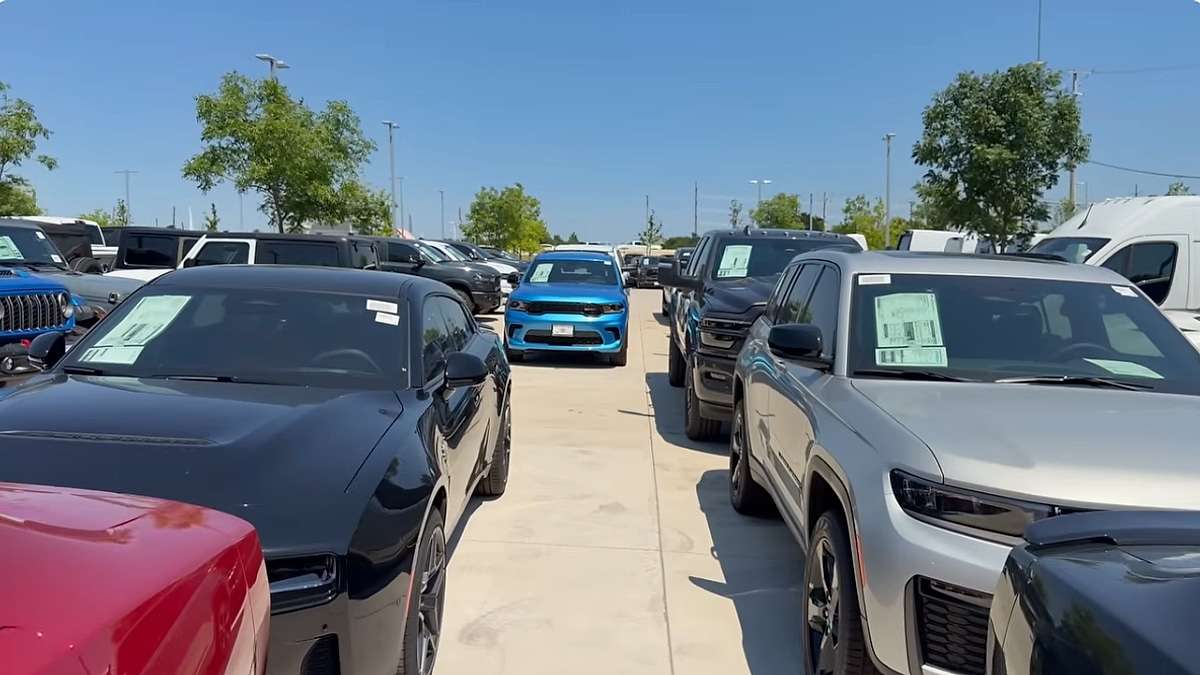

Walk into a packed Dodge, Jeep, and Ram dealer in the Dallas-Fort Worth area right now and you will see something that stops you cold. Row after row of unsold 2026 Grand Cherokees, Durangos, Ram pickups, and Grand Wagoneers packed so tightly together that you literally cannot pull one vehicle out without first moving four or five others. That is not a used car lot with bargain-bin leftovers. That is a brand-new franchise dealership that has essentially run out of room, and the sticker prices explain everything.
The 2026 Jeep Grand Cherokee debuted a new Hurricane 4 Turbo engine this year and Jeep's CEO publicly declared the brand was lowering prices, but when you walk onto a real lot near Frisco or McKinney, Texas, and see a two-wheel-drive Grand Cherokee stickered at $52,000 and a Grand Wagoneer touching $76,000 after dealer add-ons, the words and the reality do not match. This is the bloated, overpriced inventory crisis hiding in plain sight, and Jeep's own leadership knows the brand is fighting to reinvigorate sales before these carrying costs become catastrophic.
Thomas Sieber, an automotive content creator who has been doing dealer lot tours across Texas, recently walked this specific dealership and captured the situation on video. What he found was one of the fullest lots he had ever seen in his life.
Trucks and SUVs parked so close together that salespeople would need 30 to 45 minutes just to dig out one vehicle for a test drive. A Ram pickup stickered at $104,000 with add-ons stacked four deep: $4.99, $3.99, $5.99, $1.99, all tacked onto a base price that was already pushing the limits of what any working Texan would consider paying for a truck. A Jeep Compass with a base of $33,000 that climbed to $35,000 before you handed over your keys. And a $67,000 Grand Cherokee sitting nose to bumper with a $77,000 Ram, neither of which had anywhere to go.
The moral here is simple and uncomfortable: when you price things out of reach, they sit. And when they sit in a lot this crowded, everybody loses.
The Add-On Problem Is Real and Documented
This is not a new story, but seeing it in person at this scale makes it land differently. Dealer markups and add-ons have been a documented issue across the industry for years, but most brands eventually corrected course when inventory started piling up. The CDJR family, meaning Chrysler, Dodge, Jeep, and Ram, appears to be slower to make that correction. The window stickers Sieber photographed showed dealership add-ons ranging from roughly $1,500 on a base Ram to thousands of dollars stacked on top of already-premium Wagoneer pricing. A Grand Cherokee L that carries a base MSRP of $43,000 was sitting at nearly $50,000 on this lot before a single negotiation had taken place. The question is not whether buyers notice. They do. The question is whether they walk.
The Data Backs Up What the Lot Is Showing You
You do not have to take Sieber's word for it or even trust your own eyes walking this dealership. The numbers are brutal and public. Kelley Blue Book reported that as automakers entered 2026, Jeep sat at 130 days of inventory supply and Ram was at 115 days, compared to an industry target of roughly 75 days. Luxury brands like Lexus were operating at just 28 days. Toyota at 33. That means Jeep had nearly five months of vehicles sitting on lots nationwide with no buyers lined up. As we have reported before at TorqueNews, Cox Automotive identified Stellantis as carrying one of the highest unsold inventories on the planet heading into this period, and the financial damage from that position, in terms of floor plan interest and depreciation, is not abstract. It is real money hemorrhaging out of every franchise every single day those vehicles do not sell.
Floor Plan Costs Are Quietly Draining These Dealers
Here is what a lot of people outside the automotive retail business do not understand. Every vehicle sitting on that lot is not free for the dealer. The dealer borrows money to purchase that inventory from the manufacturer, and they pay interest on that loan, called floor plan financing, every day the vehicle remains unsold. We have covered this pressure before when unsold EVs were piling up, but the same financial math applies to gas-powered Jeeps and Ram trucks stacking up in Texas. When you have a $76,000 Grand Wagoneer sitting for 60, 90, or 120 days, the carrying cost on that single unit is significant. Multiply that across a lot that Sieber described as having lines and lines of inventory for weeks, potentially for years, and you have a dealership bleeding money quietly while its salespeople are doing gymnastics just to show a customer a single vehicle.
The 2026 Ram Situation Is Its Own Story
The Ram pickup truck crisis deserves a sentence or two on its own here because the problems run deeper than just lot congestion. The 2025 and 2026 Ram 1500 generated enormous expectations with the Hurricane inline-six and a refresh that promised luxury-truck capability, but the community reception has been complicated.Owners have been coming forward with electrical issues ranging from dead gauge clusters to parasitic battery drain that Stellantis has struggled to resolve with clear timelines for parts. One Ram Laramie owner even turned down a $3,000 NDA offer from the dealer after his truck repeatedly died, which tells you something about how seriously some franchises are taking the reliability conversation. When a $77,000 truck has question marks around long-term dependability and the lot is full of them, buyers hesitate. That hesitation shows up in days-of-supply numbers.
What About the Durango and the Police Department Story?
Sieber made a point during his walk-through that caught my attention: he noted that some police departments had stopped ordering Durangos because of reliability issues causing vehicles to spend too much time in the shop. That is a detail worth underscoring, because fleet buyers are some of the most analytically ruthless customers in the market. They track total cost of ownership. They track uptime. They do not buy on emotion. When we covered the story of a Grand Cherokee owner who experienced their fourth major breakdown in less than a year with 60 days already spent in the shop, that was one owner's nightmare. When an entire police department makes a procurement decision to walk away from a vehicle line, it signals a pattern that has crossed a threshold that individual brand loyalty cannot paper over.
Jeep Says It's Lowering Prices. The Stickers Say Otherwise.
Jeep's design leadership has been making the press rounds to talk up the 2026 Cherokee and what it means for the brand's future direction, and the genuine product story is not bad. The vehicles have real capability improvements. Jeep's interior design chief highlighted cargo space and functionality upgrades that should matter to families shopping in a practical midsize segment. But capability does not sell itself when the sticker on a two-wheel-drive Grand Cherokee reads $52,000 in a market where competitors are fighting for buyers with aggressive incentives and leaner add-ons. Consumer Reports has previously directed buyers away from the Grand Cherokee toward more reliable alternatives, and that brand perception problem is not erased by a design briefing or a CEO quote about lowering prices.
What Buyers Should Take Away From This
If you are shopping for a Ram truck, a Grand Cherokee, a Durango, or a Grand Wagoneer right now, the situation on this Texas lot is actually good news for you as a buyer, even if it is painful news for the dealer. Inventory levels this high historically signal that negotiating room opens up, sometimes dramatically. Dealers paying floor plan interest on vehicles that have been sitting for four months have far more motivation to deal than a dealer with a 30-day supply. Add-ons that are printed on a sticker are not legally binding. They are a starting point for a conversation. Walk in informed, know what the base MSRP is, understand what the add-ons actually include, and be willing to walk out. That lot is not going anywhere fast, and neither is the vehicle you want.
The lesson from this Dallas-Fort Worth lot is not that Dodge, Jeep, and Ram make terrible products. Some of them are genuinely excellent vehicles. The lesson is that pricing strategy has consequences, and when a manufacturer and its dealers push sticker prices to the edge of what a market will bear, then stack add-ons on top of that, the inventory does not move. It just sits, row after row, waiting for someone to shuffle six trucks out of the way before they can even look at the van in the back.
How long do you think it will take this dealer to work through an inventory situation like this? And have you walked away from a Stellantis product recently because of the price? Tell us your experience in the comments section below.
About The Author
Armen Hareyan is the founder and Editor-in-Chief of Torque News and an automotive journalist with over 15 years of experience writing car reviews and industry news. Now based in the Charlotte region (Indian Land, SC, he founded Torque News in 2010, which since then has been publishing expert news and analysis about the automotive industry. He can be reached at Torque News on X, Linkedin, Facebook, and Youtube. Armen holds three Masters Degrees, including an MBA, and has become one of the known voices in the industry, specializing in the landscape of electric vehicles and real-world stories of actual car owners. Armen focuses on providing readers with transparent, data-backed analysis bridging the gap of complex engineering and car buyer practicality. Armen frequently participates in automotive events throughout the United States, national and local car reveals and personally test-drives new vehicles every week. Armen has also been published as an automotive expert in publications like the Transit Tomorrow, discussing how will autonomous vehicles reshape the supply chain, and emerging technologies in vehicle maintenance.
Set Torque News as Preferred Source on Google
Follow us today...



Comments
But you don’t know how big…
Permalink
But you don’t know how big their actual lot is and how they park. Just because it looks like they have a lot they might not!