
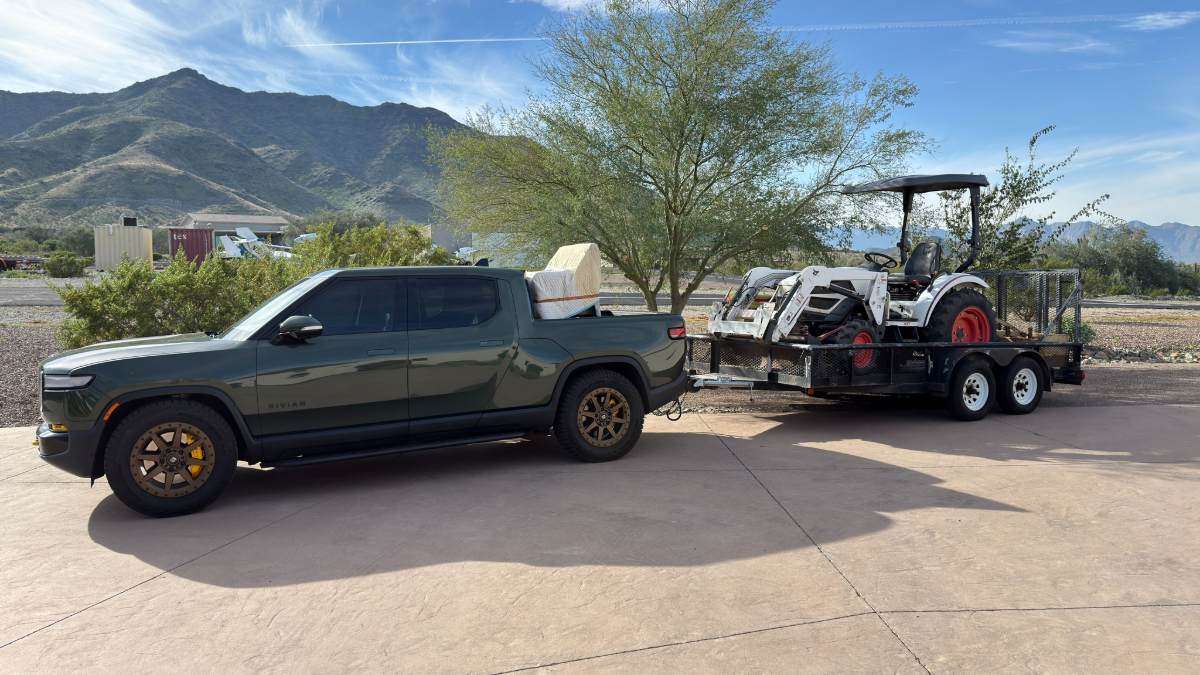

On paper, this sounds like the kind of trip no electric truck owner should attempt. Seven thousand pounds on the hitch. A 5,000-foot climb through the Arizona mountains. Triple-digit miles between chargers.
And yet, according to one Rivian R1T owner, it happened exactly as described, ended with just 9 percent battery remaining, and somehow still reinforced why he thinks the truck is “amazing.”
The owner, driving a 2022 Rivian R1T Quad with the Large Pack, admits up front that he is a first-time EV owner who never expected to be in this position. That context matters. This was not a seasoned hypermiler chasing a spreadsheet result. This was a new EV driver towing a medium-sized tractor on a trailer from the Phoenix area toward Show Low, Arizona, learning the limits of electric towing in real time.
“2022 R1T Quad Large Pack
First-time EV owner, never thought I would, but have been super excited about this truck. Last week, I pulled a trailer with a medium-sized tractor from the Phoenix area to almost Show Low, AZ. This truck is amazing for towing, but I was biting my fingernails on the first leg.
Phoenix to Payson is about a 5,000 ft rise in elevation
Drove 106 miles
SOC departure was 96%
Advertising
SOC arrival was 9%
Load estimated by the R1T: 7,000 lbs
I milked it on some of the hill climbs and would be as low as 35 mph, trying to save some battery. The nav system kept telling me I would have 13 miles and 9% on arrival at the Electrify America charger. At times, going up some of the longer hills, the nav would go into the red, but when I was going down the hills, I saw the reserve come back on the nav. I don't know if I would have made it without modulating the accelerator on the hills, but it doesn't matter because I made it. The next leg to my destination from Payson was about 55 miles, and I charged to 85%, 54 min, so I just set the cruise at 67 mph and climbed another 2500 ft in elevation, and this truck never even noticed. Wow, I had about 40% on arrival. Pretty cool”

The first leg was the stress test. From Phoenix to Payson, the route climbs roughly 5,000 feet over 106 miles. The Rivian estimated the trailer weight at 7,000 pounds. Departure state of charge was 96 percent. Arrival state of charge was 9 percent. Those numbers alone tell you everything about how brutally elevation and mass punish energy consumption, regardless of propulsion type. Gas trucks hide this reality behind fuel gauges that drop quietly. EVs put it front and center.
Rivian R1T: Storage Focus & Cabin Materials
- The R1T balances pickup utility with SUV-like driving manners, using its unibody-style structure and low center of gravity to reduce body motion on paved roads.
- Quad-motor availability enables precise torque control at each wheel, improving traction off-road while contributing to higher energy consumption during everyday driving.
- Storage-focused design elements such as the Gear Tunnel and powered frunk expand usability beyond the bed, but add weight and system complexity.
- Cabin materials and layout emphasize durability and simplicity, aligning the truck more with outdoor-focused use than traditional luxury pickups.
On steeper grades, he slowed as much as possible, sometimes down to 35 mph, consciously feathering the accelerator to preserve range. The Rivian’s navigation system constantly recalculated, predicting arrival with about 13 miles of reserve and 9 percent remaining. At times, the projected range dipped into the red on long climbs, only to recover slightly on downhill sections where regeneration brought some energy back. It was a rolling negotiation between physics and software.
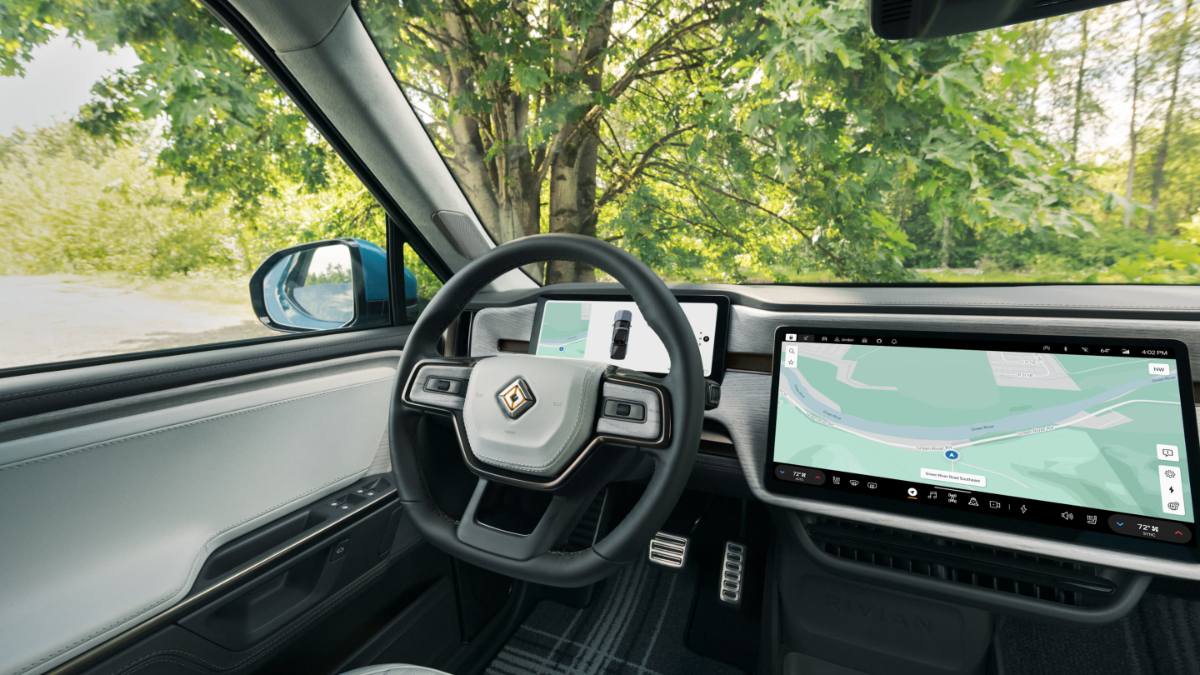
There is an honesty here that seasoned EV discussions often lack. The driver openly admits he does not know if he would have made it without careful throttle modulation. He also admits that he was biting his fingernails for much of the climb. This was not effortless. It was deliberate. And yet, the fact that it worked at all is the point.
After reaching Payson, the tone shifts. The driver charged to 85 percent in 54 minutes and headed out on the second leg, another 55 miles with an additional 2,500 feet of elevation gain. This time, with more confidence and margin, he set the cruise at 67 mph. The Rivian barely seemed to notice the load. He arrived with about 40 percent battery remaining. Same truck. Same trailer. Same mountains. Different energy context, completely different experience.
The comments beneath the post add a useful perspective. One owner notes that towing at 55 mph instead of highway speeds makes a dramatic difference in range, calling it a night-and-day change. Another laments the lack of trailer-friendly charging stations, a recurring pain point for EV trucks, while others point out that trailer manufacturers are already experimenting with battery-assisted campers to extend range. The ecosystem, slowly, is adapting.
Perhaps the most telling comment comes from an owner who sums it up perfectly: the Rivian tows incredibly well, probably better than any truck out there, but it just will not go very far. That is not a criticism so much as a boundary. Within that boundary, the R1T appears to excel. Outside of it, you need planning, patience, and realistic expectations.
What stands out most is the owner’s attitude. Despite arriving with a single-digit battery and visibly adjusting his driving style to survive the climb, he ends the story with enthusiasm rather than regret. The truck never struggled mechanically. It never overheated. It never lost composure. The limitation was energy, not capability. For an electric truck towing heavy loads uphill, that distinction matters.
This story does not pretend that EV trucks are ready to replace diesel rigs for long-haul towing in mountainous terrain. It does something more useful. It shows exactly what the limits look like, in miles, elevation, speed, and state of charge, from someone experiencing them firsthand. And it reminds us that for occasional towing, even demanding towing, an electric truck like the Rivian R1T can deliver something rare: confidence under load, even when the battery gauge is making your palms sweat.
Arriving with a 9 percent battery after slowing to 35 mph may not sound like a victory. But when you are hauling 7,000 pounds up Arizona mountains and still step out thinking, “Wow, that was pretty cool,” it says a lot about the truck you were driving.
Image Sources: Rivian Media Center
Noah Washington is an automotive journalist based in Atlanta, Georgia. He enjoys covering the latest news in the automotive industry and conducting reviews on the latest cars. He has been in the automotive industry since 15 years old and has been featured in prominent automotive news sites. You can reach him on X and LinkedIn for tips and to follow his automotive coverage.
Set Torque News as Preferred Source on Google
Follow us today...




Comments
That extra 54 minutes versus…
Permalink
That extra 54 minutes versus ten or so at the pump though..
You've successfully joined…
Permalink
You've successfully joined the crowd of article writers who expand the length of their (your) article(s) by unnecessarily repeating the same information multiple times.
Learn how to write! Concisely.
You've successfully joined…
Permalink
You've successfully joined the crowd of article writers who expand the length of their (your) article(s) by unnecessarily repeating the same information multiple times.
Learn how to write! Concisely.
The story could have…
Permalink
The story could have mentioned the results of the gravity assisted return trip back down the mountain. He will get home without charging at all, have more charge than when he started down and not have to worry about wearing out his brake pads.( At least the ones on his truck)
106 miles....what a joke!…
Permalink
106 miles....what a joke! Nothing but a novelty toy. I just towed w my 04 Dodge pulling the same weight or more for 387 miles before fill up. My truck is almost 22 years old. Odd how the US measures progress 😂!!!