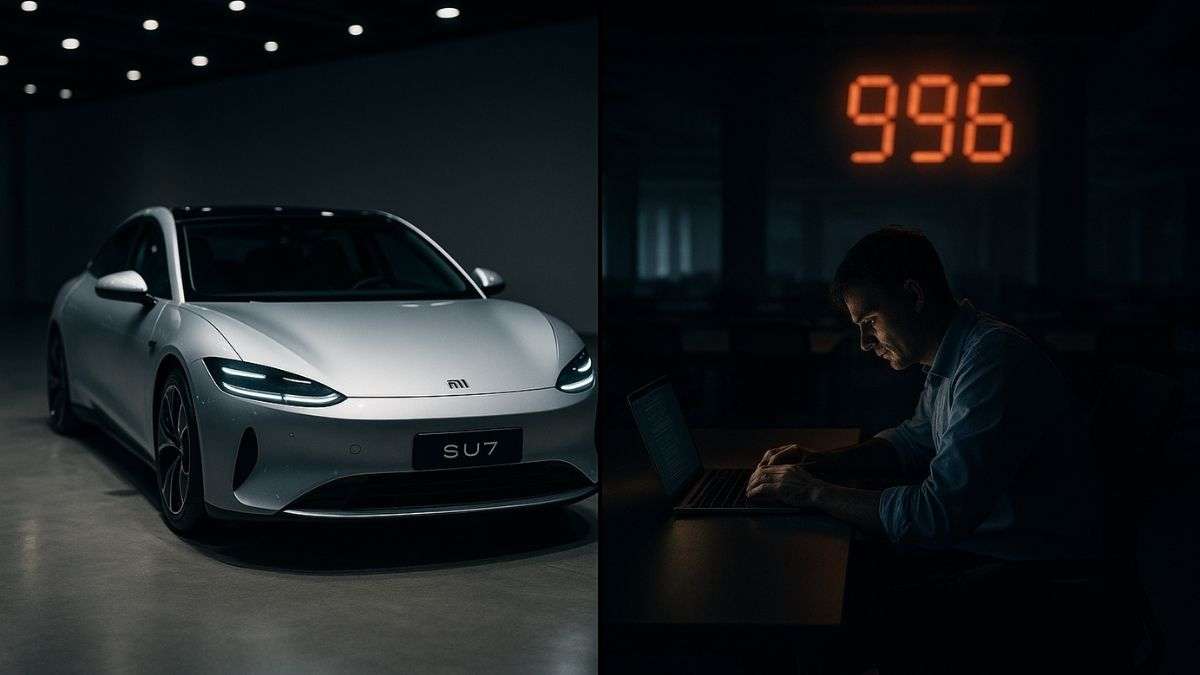

The automotive world is transfixed by Xiaomi, the tech giant often called the "Apple of China." After a decade of dominating the smartphone market, they've made an aggressive, high-stakes leap into the electric vehicle space. Their first car, the SU7, is an undeniable triumph of design and engineering, a high-performance EV that garnered a staggering 10,000 pre-orders almost overnight. It looks, feels, and drives like the shiny, sustainable future we’ve been promised.
But this shiny future has a dark, hidden cost. According to recent reports, Xiaomi’s EV division is operating under an intense "996-plus" work culture. This exposes the grueling human toll required to build the "green" revolution and forces a deeply uncomfortable question: Is an EV truly sustainable if the process of building it is humanly unsustainable?
The "996-Plus" Nightmare: The Human Cost of Speed
For those unfamiliar with the term, "996" is shorthand in China's tech sector for working from 9 a.m. to 9 p.m., 6 days a week. It’s a grueling schedule that has been widely criticized, and even ruled illegal by China's top court, yet it persists as a badge of honor in "wartime" corporate cultures.
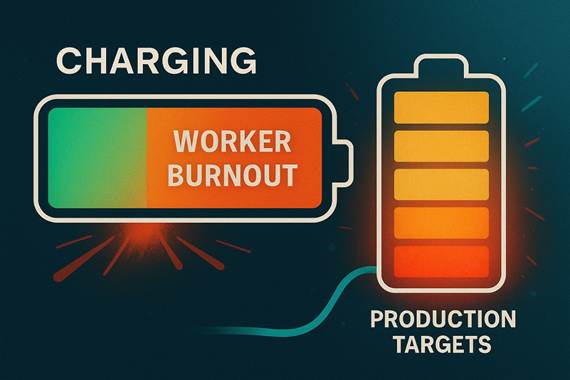
Now, to meet the crushing demand for the SU7 and catch rivals, Xiaomi’s EV division has reportedly adopted a "996-plus" model, implying work hours that are even more extreme. This isn't just "hustle culture"; it's a culture of burnout, where the well-being of the workforce is sacrificed at the altar of production quotas and launch deadlines. While the world sees a sleek EV, the reality behind it is a workforce pushed to its absolute physical and mental limits. This is the hidden toll of mobility's next great leap.
Why the Rush? The Chinese EV "Bloodbath"
To understand why this is happening, one must understand the environment Xiaomi jumped into. CEO Lei Jun has famously called the EV venture his "final entrepreneurial project," staking $10 billion of the company's reputation and capital on its success.
Xiaomi is a late entrant into the most hyper-competitive, oversaturated EV market on the planet. China’s auto market isn't just a race; it's a "bloodbath." Dozens of startups are failing, and established giants like BYD are waging a brutal, ongoing price war, slashing margins to capture market share.
For Xiaomi, the only path to survival is speed. They cannot afford a slow ramp-up. They must innovate, produce, and scale faster than everyone else. When a company is in this "innovate or die" mode, human factors are the first casualty. Sleep, family time, and mental health become secondary concerns to hitting the next production milestone. The pressure to justify the $10B gamble and survive the EV war is immense, and that pressure is being transferred directly to the workforce.
The Green Hypocrisy: When "Sustainable" Isn't
This is where the narrative completely breaks down. Electric vehicles are marketed to the world as the definition of sustainability. They are our clean, green solution to a global climate crisis. We buy them not just for the technology, but to make an ethical, responsible choice.
However, the concept of ESG (Environmental, Social, and Governance) is meant to be holistic. The "S" in ESG—the social component—demands that we evaluate a company's labor practices and its impact on people.
How can a product be considered "sustainable" if it is built on a foundation of human burnout?
This isn't a problem unique to Xiaomi. The EV industry has already faced intense scrutiny over the human cost in its supply chain, particularly the horrific labor conditions in cobalt mines, a mineral essential for batteries. The "996-plus" culture is simply the white-collar, engineering equivalent of that same hypocrisy. It prioritizes the "E" (Environmental) while completely ignoring the "S" (Social). The "green" message feels hollow when the engineering process itself is fundamentally unsustainable for the human beings building it.

Wrapping Up
The Xiaomi SU7 is, by all accounts, an incredible engineering achievement. It proves that a focused, well-funded tech company can successfully disrupt the century-old auto industry. But its success forces an uncomfortable, necessary conversation. As consumers, we must ask whether "sustainability" only applies to what comes out of the tailpipe (or, in this case, what doesn't). Does our desire for a clean future justify a culture of human exhaustion in the present? The "996-plus" model is a stark reminder that the true cost of our shiny new electric future may be far higher than what's listed on the sticker.
Disclosure: Images rendered by ChatGPT 5.0 and Artlist.io
Rob Enderle is a technology analyst at Torque News who covers automotive technology and battery developments. You can learn more about Rob on Wikipedia and follow his articles on Forbes, X, and LinkedIn.
Set Torque News as Preferred Source on Google
Follow us today...