
Every once in a while, a vehicle comes along that completely disrupts the automotive landscape—not just because of what it is, but because of what it represents. When SAIC Motor first teased the MG Cyberster concept back in 2021, my inner car enthusiast immediately went into overdrive. For those of us who grew up admiring the classic, lightweight British roadsters of the mid-20th century - like the MGB, the Triumph Spitfire, and the Austin-Healey - the idea of a modern, emission-free successor seemed like a distant pipe dream. Yet, here was MG, a brand with a storied heritage now backed by the massive manufacturing and financial muscle of Shanghai-based SAIC Motor, promising a dual-motor, open-top electric sports car that looked like a sci-fi spaceship.
I have lusted after the MG Cyberster since the very moment it was announced. In a world where electric vehicles (EVs) have largely devolved into a monotonous sea of heavy, aerodynamic-focused crossovers and blocky family SUVs, the Cyberster represents something increasingly rare: pure, unadulterated automotive emotion. It is a car designed not because a focus group demanded another sensible commuter, but because the industry desperately needed to prove that electric driving can still make your heart race. Watching its transition from a radical concept to a fully realized production roadster has been both exhilarating and deeply frustrating - exhilarating because the car actually exists and lives up to the hype, and frustrating because, as an American enthusiast, it remains tantalizingly out of reach.
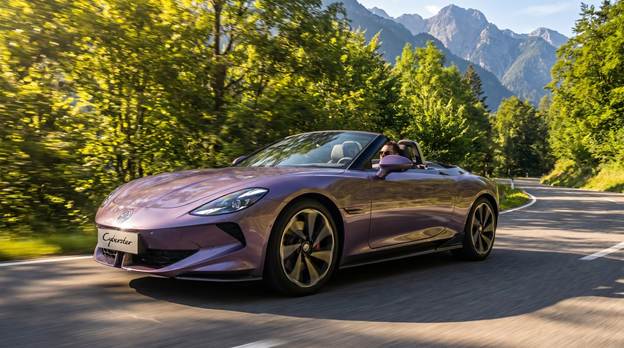
Specs, Performance, and Pricing: The Cyberster Broken Down
To understand why this car has captured the global imagination, you have to look at the hard numbers. The MG Cyberster is not just a pretty face; it is a serious performance machine that punches well about its weight class.
Underneath its sculptural exterior lies a highly advanced electric powertrain. The roadster is offered in two main configurations:
- Single-Motor (Trophy): A rear-wheel-drive (RWD) setup producing 250 kW (approximately 340 horsepower). It sprints from 0 to 62 mph in a very respectable 5.0 seconds and delivers a combined WLTP range of up to 316 miles.
- Dual-Motor (GT): The flagship all-wheel-drive (AWD) monster that generates an astonishing 375 kW (496 horsepower) and 725 Nm of torque. This version rocket-launches from 0 to 62 mph in just 3.2 seconds, matching the acceleration of modern supercars.
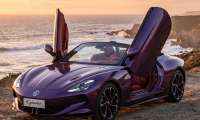
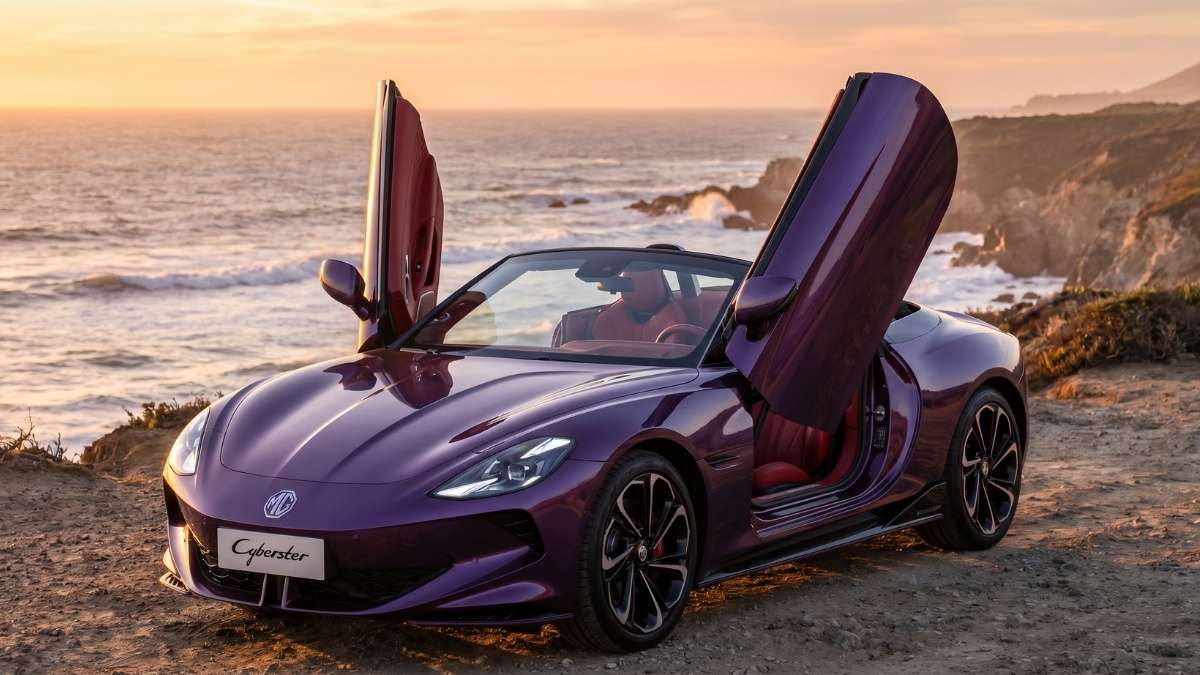
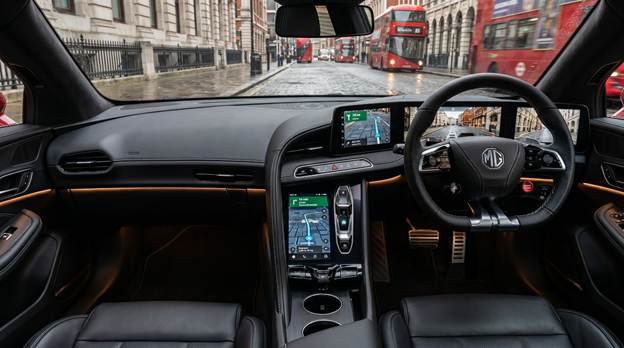
Unique features abound, starting with the spectacular electric scissor doors that open upwards with the touch of a button—a theatrical touch usually reserved for Lamborghinis. It also features a fully electric fabric soft-top that can open or close in just 15 seconds at speeds up to 30 mph, a premium eight-speaker Bose audio system, and a highly futuristic, wraparound triple-screen cockpit that isolates the driver in a digital cocoon.
Of course, all this engineering comes at a price. In its home market of the United Kingdom, the starting price for the single-motor Trophy model sits at approximately £55,245, while the dual-motor GT variant starts closer to £60,245. Its global footprint is also expanding; for instance, the Cyberster was recently introduced in India, where luxury import pricing was revised upward in July 2026 to Rs. 82.5 Lakh, as reported by CarWale. This places it squarely in competition with premium sports cars like the BMW Z4 and Porsche 718 Boxster, but with a fully electric twist that those legacy models are still scrambling to match.


How Well is the Cyberster Selling in Europe?
While critics wondered if European buyers would embrace a heavy, Chinese-built electric roadster carrying a historic British badge, the market response has been incredibly positive. MG Motor has been on a massive upward trajectory across Europe, officially reaching an incredible milestone of 300,000 annual sales across the UK and continental Europe in 2025.
The Cyberster serves as the ultimate "halo" vehicle for this expansion. While mass-market models like the MG4 EV and the MG HS SUV drive the bulk of the volume, the Cyberster has successfully elevated the brand's image from "sensible budget alternative" to "aspirational technology leader." European dealerships report consistent demand and long waiting lists for the roadster, with enthusiasts praising its build quality, everyday usability, and the sheer novelty of being the only real electric convertible on the road today. It has successfully captured the spirit of open-top motoring while silencing critics who believed EVs were destined to remain sterile appliances.
Is There a Legal Path to Put a Cyberster in a US Garage?
This is the million-dollar question for American car enthusiasts. Can you legally import an MG Cyberster to the United States right now?
The short, painful answer is: almost certainly no, at least not for normal road use.
Under the Imported Vehicle Safety Compliance Act of 1988, any vehicle that was not originally manufactured to conform to Federal Motor Vehicle Safety Standards (FMVSS) cannot be legally imported into the US until it is 25 years old. Since the Cyberster began production in late 2023, you would have to wait until 2048 to import one under the standard 25-year exemption.
But what about the loopholes?
- The "Show and Display" Rule: Created under the pressure of wealthy collectors (notably Bill Gates trying to import a Porsche 959), this rule allows the importation of historically or technologically significant vehicles that were produced in limited quantities (usually under 500 units globally). Because the Cyberster is a mass-produced vehicle designed for global consumption, it does not meet the strict historical or rarity requirements enforced by the NHTSA.
- Registered Importers (RI): A Registered Importer can theoretically bring a non-conforming vehicle into compliance by crash-testing multiple units and modifying the vehicle to meet US safety and bumper standards. However, the cost of doing this for a complex, modern EV is astronomically prohibitive, requiring millions of dollars in destructive crash testing and software re-engineering.
- The Mexico and Canada Route: While SAIC has announced plans to build an assembly plant in Mexico to expand its presence in Latin America, they have explicitly stated they have no immediate plans to sell vehicles north of the border. Furthermore, US federal laws prohibit US residents from simply buying a car in Mexico or Canada and registering it domestically if it does not have a US emissions and safety compliance sticker on the door jamb.
For now, the only legal way to drive one on US soil is if a major automotive museum imports one for static exhibition, or if it is brought in under a temporary "Foreign Sovereign" or "Non-Resident Tourist" exception—which limits the car's stay to one year, after which it must be exported or destroyed.
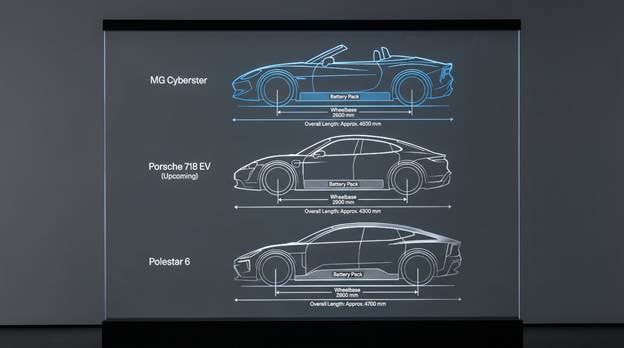
What Other EV Sports Cars Are Heading to the US Market?
While we may not get the Cyberster, the American EV sports car drought won't last forever. Several highly anticipated models are currently preparing to make their US debuts over the next few years:
- Porsche 718 Boxster & Cayman EV (Expected 2026/2027): Porsche is currently finalizing its all-electric replacement for the mid-engine 718 platform. It is highly expected to set the benchmark for electric sports car handling and dynamics, utilizing a custom battery layout designed to mimic the weight distribution of a mid-engine ICE car.
- Polestar 6 (Expected 2026): Based on the stunning O2 Concept, this high-performance electric roadster from Polestar will feature a bonded aluminum chassis, up to 884 horsepower, and a retractable hardtop. It will be a premium, low-volume halo car aimed directly at wealthy enthusiasts. (Polestar was recently banned in the US, but Geely could overcome this ban).
- Caterham Project V (Expected 2027): Known for its ultra-lightweight, back-to-basics track cars, Caterham is aiming to launch an electric coupe packing a 268-hp rear-wheel-drive motor. By keeping the weight under 2,600 lbs, it promises to bring traditional sports car agility to the electric era.
Caterham Cars
- Tesla Roadster 2.0 (Release Date: Indefinite): Originally announced in 2017 by Tesla with a promise of rocket thrusters and a 1.9-second 0-60 mph time, the hyper-performance roadster has slipped into legendary development-hell status, with no firm release date in sight.
Forecasting the Future of the Global EV Sports Car Market
As we look toward the horizon, the global EV sports car market is poised for a massive evolution. Currently, we are in the "pioneer" phase, where manufacturers are experimenting with heavy batteries, trying to figure out how to preserve the agile, lightweight handling characteristics that define a true sports car.
By the early 2030s, the market will reach maturity. This shift will be driven primarily by advancements in solid-state battery technology and ultra-compact electric motors. Solid-state batteries will allow automakers to slash battery weight by up to 50% while maintaining long driving ranges, finally giving electric sports cars the lightweight agility of their internal combustion ancestors.
Who will dominate this space? I predict that legacy performance brands—specifically Porsche and Lotus—will offer the best-engineered driver's cars, leveraging decades of chassis-tuning expertise. However, Chinese automotive giants like SAIC (MG) and BYD (with its high-end Yangwang brand) will hold a massive first-mover advantage, offering cutting-edge technology and supercar performance at a fraction of the cost of their European rivals. When this market matures around 2030, the sports car will no longer be defined by the roar of an engine, but by the instantaneous torque, active torque vectoring, and silent, open-air thrill of the electric drivetrain.
Wrapping Up
The MG Cyberster is a triumphant, beautiful reminder that the transition to electric mobility does not mean we have to sacrifice our passion for driving. It stands alone today as the only true, mass-production electric roadster left standing on the global stage. While its absence in the US market is a tragedy of regulatory red tape and geopolitical trade barriers, its success in Europe proves that the demand for emotional, open-top EVs is incredibly real. Until legacy automakers finally bring their own electric sports cars to American shores, we can only look across the Atlantic with envy, dreaming of the day we can drop the top, step on the accelerator, and experience the silent surge of the Cyberster.
Disclosure: Images rendered by Artlist.io
Rob Enderle is a technology analyst at Torque News who covers automotive technology and battery developments. You can learn more about Rob on Wikipedia and follow his articles on TechNewsWord, TGDaily, and TechSpective.
Set Torque News as Preferred Source on Google
Follow us today...