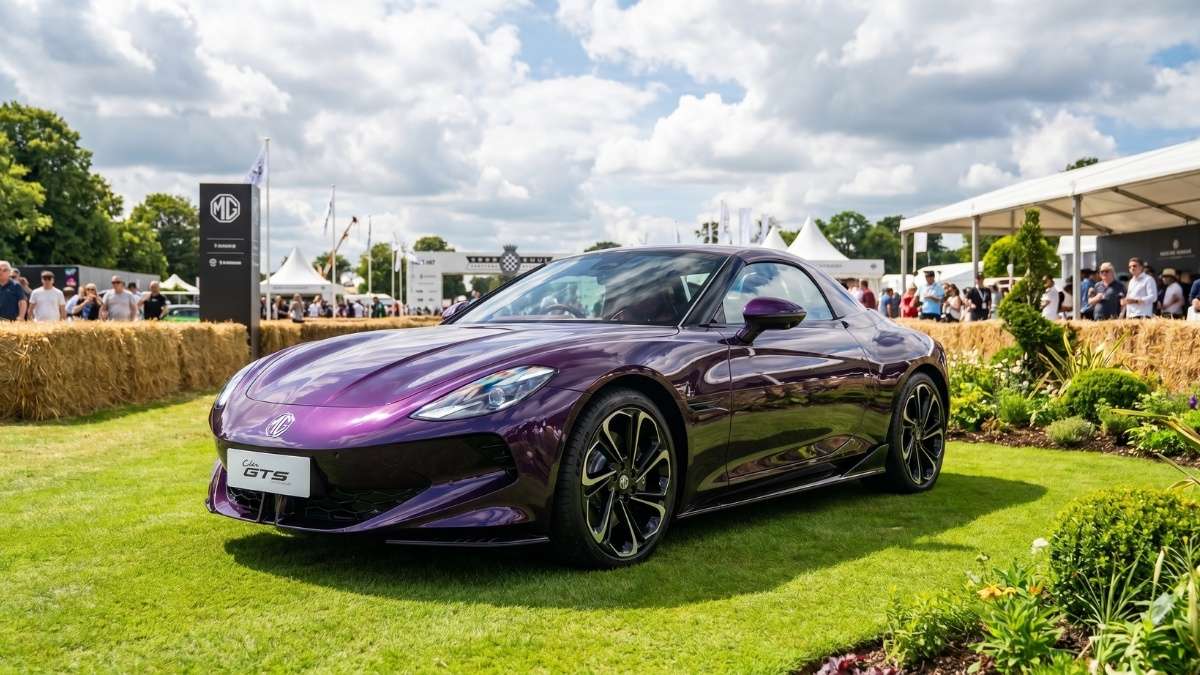

As someone who actively tracks and analytically evaluates emerging automotive developments - specifically 800V architectures, bidirectional charging infrastructures, and advanced battery chemistries - I spend an inordinate amount of time studying vehicle platforms. I prefer doing this on my 16-inch laptop, as the expanded screen real estate allows me to pull up multiple technical schematics and supply chain reports side-by-side. You need that level of workspace when tracking the rapid pace of international electric vehicle development. Recently, while analyzing the latest platform debuts from the Goodwood Festival of Speed, my usual workflow hit a profound pause. MG, a brand historically synonymous with lightweight British roadsters, unveiled a concept vehicle that fundamentally disrupts the luxury performance SUV segment.
It is called the MG Cyber Concept. It is a massive, sporty electric vehicle that looks like an ultra-exotic SUV demanding a three-quarters-of-a-million-dollar price tag, yet it will likely enter the global market at a price point accessible to standard premium buyers. When I study the classic lines of vintage high-performance vehicles - designs I have long admired, much like the timeless aesthetic of a Ferrari 250 GTO (my personal favorite car of all time) - I see an emotional connection to sheet metal that modern, soap-bar-shaped EVs have consistently failed to capture. MG is attempting to recapture that exact visceral emotion with this new flagship. Let us thoroughly examine what this vehicle represents, the industrial heavyweight making it possible, the painful reality for United States buyers, and how this striking new contender compares to the heavy hitters currently dominating the luxury market.
Understanding the MG Cyber Concept
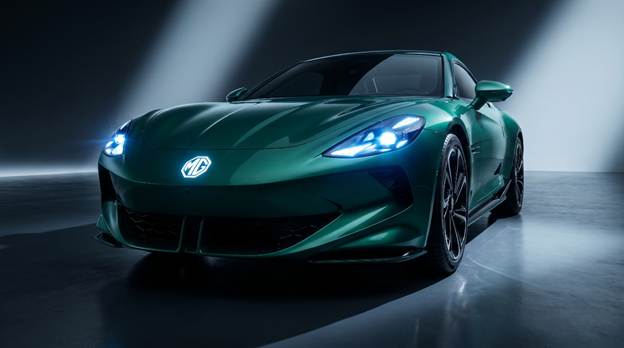
The MG Cyber Concept represents a bold and aggressive pivot for a brand that, under recent ownership, had previously focused on budget-friendly compacts and sensible everyday hatchbacks. Designed to supersede the current MG Cyberster roadster as the company's ultimate halo model, this five-meter-long SUV is unashamedly focused on extreme performance and driving pleasure rather than maximizing cargo space or prioritizing mundane utilitarian function.
Jozef Kabaň, the Vice President of MG's Global Design Center who previously shaped aesthetics at Bugatti and Volkswagen, noted that the future of automotive design must spark curiosity and emotional connection. The Cyber Concept achieves this difficult mandate through a classic cab-rearward design, a sweeping long bonnet, and an extended wheelbase that creates an incredibly athletic stance. It features aggressive upturned claw headlamps connected by an elegant LED light bar, ultra-slim aerodynamic door cameras, and a massive rear diffuser that looks straight out of a Le Mans prototype. These advanced, motorsport-derived aerodynamics give it a striking resemblance to the V12-powered Ferrari Purosangue, but this iteration is entirely battery-powered.
While MG has kept the exact powertrain specifications closely guarded under a veil of corporate secrecy, credible industry leaks suggest it will utilize an uprated version of the IM6 powertrain. This sophisticated dual-motor setup is expected to push out a massive 532kW (roughly 713 horsepower) and 802Nm of torque. Combined with a large, high-density battery pack targeting a range of at least 650 kilometers (roughly 400 miles), this is a vehicle designed to wholly eliminate range anxiety while delivering the kind of visceral acceleration that pins you to your seat. The likelihood of this concept making it to market is exceptionally high. The parent company has a proven, highly efficient track record of bringing ambitious, auto-show concepts directly to its production lines with minimal dilution, though this specific flagship model is not expected to officially land on global roads until 2029 at the earliest.
The Power Behind the Badge and SAIC Motor
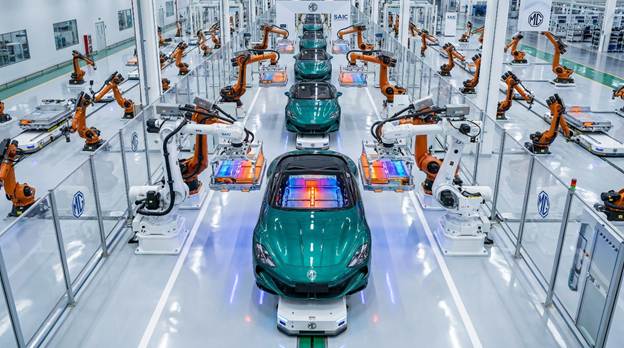
To truly understand how MG has seemingly leaped ahead of everyone else with affordable electric sportscars, you have to look deeply at the corporate entity signing the development checks. MG is no longer the small, financially strapped British workshop of the 20th century; it is wholly owned by SAIC Motor, one of China's absolute largest and most capitalized state-owned automotive giants. SAIC acquired the MG brand assets following the spectacular collapse of the MG Rover Group nearly two decades ago and has since transformed the historic badge into a formidable global technology powerhouse.
SAIC achieved this massive industrial leap forward through ruthless vertical integration and unmatched economies of scale. While legacy Western automakers spent the last decade tentatively dipping their toes into the EV waters and hedging their bets with transitional hybrids, SAIC committed billions to advanced battery chemistry research, software-defined vehicle architectures, and hyper-efficient advanced manufacturing lines. They have perfectly mastered the art of the modular electric platform. By sharing cutting-edge technology across their various brands - most notably their premium IM Motors division- they can successfully amortize the immense research and development costs associated with high-performance electric components.
This brilliant platform-sharing strategy is exactly what allows MG to offer breathtaking vehicles like the Cyberster, and eventually this aggressive Cyber Concept SUV, at retail prices that fundamentally undercut their European rivals by tens of thousands of dollars. SAIC essentially treats advanced electric propulsion as a standard scalable commodity rather than a highly exclusive luxury add-on. Crucially, however, SAIC actively maintained MG's advanced design studio in London to ensure the vehicles still carry a distinctive, premium European aesthetic. By seamlessly blending classic British design heritage with aggressive, scaled Chinese industrial efficiency, MG is currently outmaneuvering traditional performance brands across Europe and the Asia-Pacific region.
The US Market Frustration
For potential EV sportscar buyers living in the United States, watching MG rapidly release these stunning, high-performance vehicles to the rest of the world is an exercise in extreme and mounting frustration. Personally, I drive a Daytona Gray 2022 Audi E-Tron GT. I handle its software modifications myself, and while I absolutely love the engineering precision, the low-slung aesthetics, and the strong secondary market performance of my Audi, the glaring lack of fresh, aggressively priced competition in the American performance EV sector is palpable. We are being artificially starved of highly competitive options. Instead of settling for stopgap hybrid upgrades, I am currently waiting to order a flagship Volvo EX60 P12 pure-electric SUV once the pre-order window becomes available, largely because the domestic market is devoid of the kind of disruptive electric innovation SAIC is currently producing.
The core issue keeping these vehicles off American roads is entirely geopolitical. The United States government has effectively locked Chinese-manufactured vehicles out of the domestic market in a sweeping effort to protect legacy American automakers who are lagging in EV affordability. The administration implemented a staggering 100% tariff on electric vehicles imported from China, alongside steep supplemental tariffs on critical lithium-ion batteries and essential minerals required for production. This means an MG Cyber Concept that might launch at a highly attractive equivalent of $80,000 in Europe would cost an eye-watering $160,000 in the US before local taxes and aggressive dealer markups are even applied, completely destroying its inherent value proposition.
Consequently, American consumers are routinely forced to choose between highly expensive European imports or domestic electric vehicles that, quite frankly, often lack the sleek, emotional design language and aerodynamic grace seen in the Cyber Concept. It creates a stagnant, uncompetitive domestic market where US automakers feel significantly less pressure to innovate on price, battery efficiency, and aesthetics because their most dangerous global competitors are effectively banned at the border. It operates as a strict protective measure for domestic industry, but serves as a massive financial penalty for the American car enthusiast who simply wants a beautiful, high-performance electric SUV without taking out a second mortgage to acquire it.
When Will the US See the MG Cyber Concept
The timeline for successfully bringing the MG Cyber Concept to American shores is incredibly murky, but by analyzing global trade maneuvers, we can make some highly educated projections. Because importing directly from China is completely financially unviable due to the aforementioned 100% tariff wall, SAIC would have to fundamentally alter its entire global supply chain to successfully penetrate the US market.
The most viable and frequently discussed path forward involves localized North American manufacturing. Several competing Chinese automakers are currently exploring or actively building massive assembly plants in Mexico to legally leverage the free-trade provisions of the United States-Mexico-Canada Agreement (USMCA). If SAIC were to establish a heavy manufacturing footprint south of the US border and carefully source enough of their critical battery materials from non-restricted countries, they could theoretically bypass the steepest tariffs. However, lawmakers in Washington are already aggressively moving to close this specific trade loophole, actively threatening severe secondary tariffs on any Chinese-owned brands manufactured in Mexico that attempt to cross the border.
Given the vehicle's projected global launch target of 2029, and heavily factoring in the immense time and capital required to build a fully compliant North American supply chain from the ground up, I would not expect to see an MG badge inside a US dealership until at least 2031 or 2032. Even achieving that distant timeline would require a significant, and currently unlikely, thawing of the frosty US-China trade relations. Until that geopolitical landscape shifts, the MG Cyber Concept will remain highly desirable forbidden fruit for American buyers.
Sizing Up the Competition
While the MG Cyber Concept will undoubtedly act as a highly disruptive force, it will not enter an empty or uncontested arena. By the time it hits global roads in 2029, the high-performance electric SUV market will be densely populated with formidable, highly engineered rivals. Let us comprehensively look at how the MG stands up to its primary competitive targets.
First is the iconic vehicle it heavily mimics in its proportions: the Ferrari Purosangue. The Ferrari is currently an internal combustion masterpiece utilizing a magnificent, naturally aspirated V12 engine. It offers unmatched brand prestige, a roaring, emotional exhaust note, and unparalleled track-honed chassis dynamics. However, it costs roughly $400,000 and requires buying into an incredibly exclusive, gatekept lifestyle just to secure an allocation. The MG Cyber Concept directly aims to offer 80 to 90 percent of the Purosangue's striking visual drama and violent straight-line electric acceleration for a fraction of the cost. While the MG will never match Ferrari's legendary racing heritage or mechanical soul, it provides a highly compelling alternative for affluent buyers who prioritize aesthetic aggression and cutting-edge EV tech over a prancing horse badge.
Next is the BMW X5, specifically its impending 'Neue Klasse' electric iterations like the much-anticipated iX5. BMW represents the long-standing establishment benchmark for premium mid-size luxury SUVs. The German automaker will undoubtedly offer significantly superior infotainment integration, vastly established global dealership support networks, and a highly refined, autobahn-tested ride quality. However, BMW's recent, highly polarizing design language has alienated a notable segment of its traditional base. The MG Cyber Concept, with its classically beautiful, cab-rearward sports car proportions, will likely appeal to buyers heavily alienated by BMW's increasingly brutalist front grille designs. Furthermore, the MG will almost certainly significantly undercut the electric X5 in retail price while offering superior standard horsepower.
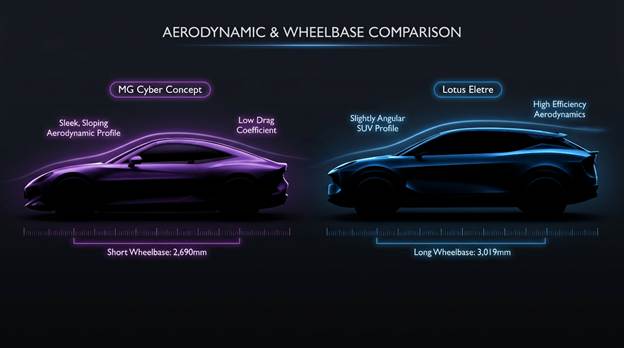
Finally, we must critically consider the Lotus Eletre, another historic British heritage brand now entirely backed by massive Chinese funding (specifically, Geely). The Eletre is already disrupting the market, boasting a cutting-edge 800-volt architecture and up to 905 horsepower in its top-tier R trim. The Eletre is a technological powerhouse equipped with deployable LIDAR arrays and highly aggressive styling. The MG Cyber Concept will have to fight incredibly hard against the Lotus, as both share remarkably similar East-meets-West development philosophies and manufacturing advantages. The MG's distinct advantage will lie directly in its SAIC-backed pricing strategy. If SAIC can deliver the promised IM6 powertrain performance at a retail price significantly below the Lotus Eletre, it will successfully siphon off buyers who demand extreme EV performance but find the Lotus pricing structure simply too expensive to justify.
Wrapping Up
The MG Cyber Concept is not just another design study; it is a clear, highly credible warning shot across the bow of legacy performance automotive manufacturers. By seamlessly combining the immense financial might, scaled manufacturing, and battery expertise of SAIC Motor with a London design studio that fundamentally understands European sports car emotion, MG has created a vehicle that punches far above its anticipated weight class. It successfully captures the exotic flair of the Ferrari Purosangue in a meticulously engineered package that democratizes high-performance electric propulsion for the global market.
Unfortunately, due to strictly enforced protectionist tariffs, the United States market remains highly insulated from this incoming wave of affordable, Chinese-backed automotive innovation. American enthusiasts are continually left standing on the sidelines, forced to pay a hefty premium for domestic or European alternatives while the rest of the developed world gets to experience a true renaissance in accessible electric performance. The MG Cyber Concept solidly proves that the future of automotive design does not have to be a utilitarian appliance; it can be genuinely thrilling, undeniably beautiful, and—for everyone residing outside the US - surprisingly affordable.
Disclosure: Images rendered by Artlist.io
Rob Enderle is a technology analyst at Torque News who covers automotive technology and battery developments. You can learn more about Rob on Wikipedia and follow his articles on TechNewsWord, TGDaily, and TechSpective.
Set Torque News as Preferred Source on Google
Follow us today...