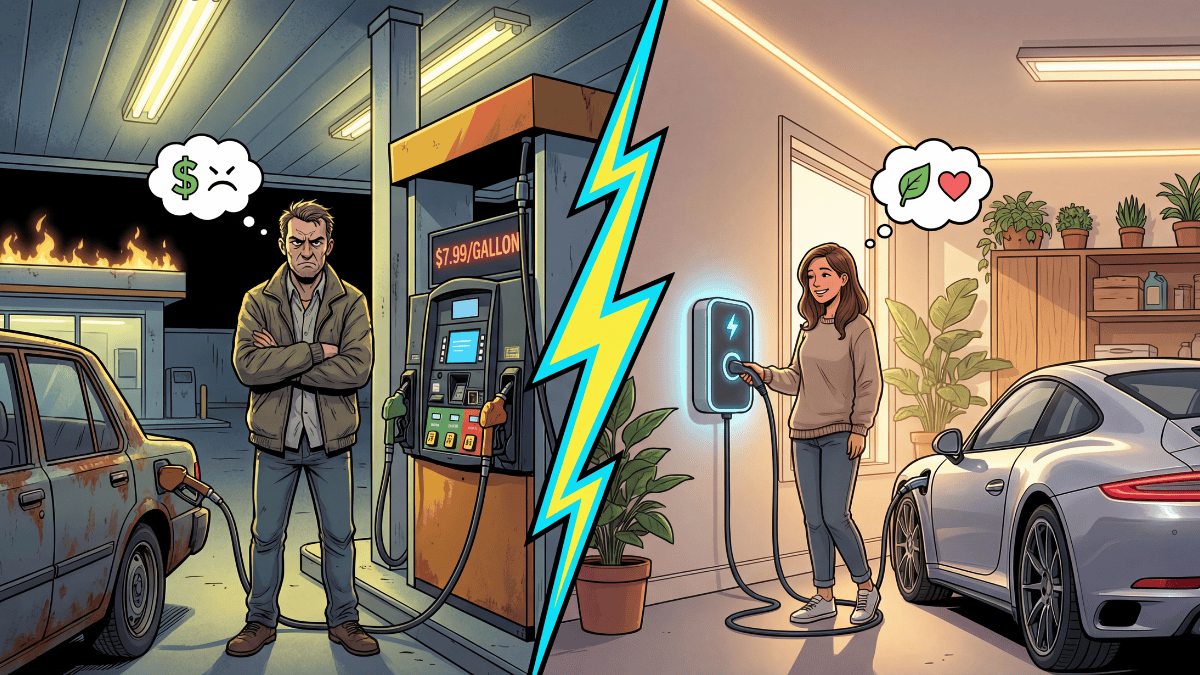

For over a century, the rhythmic combustion of fossil fuels has been the heartbeat of global mobility. But that heartbeat is starting to sound more like a death rattle. As geopolitical instability and dwindling easily-accessible reserves push oil prices toward historic highs, a quiet revolution has been perfecting itself in our garages. New data confirms what early adopters have long suspected: the economic gap between internal combustion engine (ICE) vehicles and electric vehicles (EVs) hasn't just widened—it has become a canyon.
Recent research highlights a staggering shift in "fuel" efficiency. Today, £20 (approximately $25) of overnight electricity can power a modern EV for up to 200 miles. To put that in perspective, the same spend in a standard petrol-powered sedan—at current market rates—will net you barely 100 miles. We are witnessing the birth of the "Double Range Dividend," a phenomenon that is fundamentally altering the math of the showroom floor as EV efficiency continues to outpace internal combustion improvements.
The 15-Year Evolution of the Kilowatt
To understand how we reached this 2:1 advantage, we have to look back at the trajectory of EV charging costs and infrastructure over the last decade and a half. In 2011, the EV landscape was a frontier. The Nissan Leaf had just arrived, and "charging" usually meant plugging into a standard wall outlet and waiting 20 hours for a meager 73 miles of range.
Fifteen years ago, the cost of an EV was front-loaded in the sticker price, while electricity was a neglected utility. However, the true transformation hasn't just been in the price of the electricity itself—which has remained relatively decoupled from the volatility of Brent Crude—but in the efficiency of the powertrains and the sophistication of time-of-use (TOU) metering.
In the mid-2010s, "overnight charging" was a niche concept. Today, smart grids and home integration systems automatically hunt for the lowest rates between 12:00 AM and 5:00 AM. While petrol prices have been subject to the whims of global conflict, the cost of charging has benefited from the massive influx of renewables into the grid. Solar and wind don't have "extraction costs" that spike when a pipeline is threatened; they have high upfront capital costs but near-zero marginal costs for the energy produced. This has allowed EV running costs to remain remarkably flat while gasoline has trended inexorably upward.
Ghosts of Shortages Past: Why the EV is the Ultimate Insurance Policy
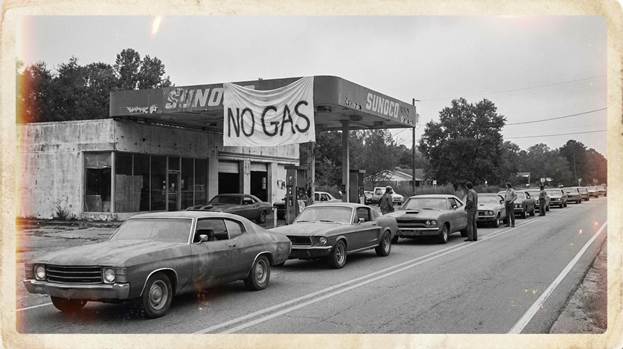
History has a cruel way of repeating itself for those tethered to a single, finite resource. Those who remember the oil shocks of 1973 and 1979 recall more than just high prices; they remember the indignity of "odd-even" rationing days and three-hour lines that ended in empty tanks. During those crises, the lack of viable electric alternatives meant the economy was effectively held hostage. If you couldn't get gas, you couldn't work.
In those eras, the ICE vehicle was an island. Today, the EV is a node in a decentralized energy web. An EV owner with home charging—and perhaps a rooftop solar array—is immune to the "No Gas" signs of the future. The current rising cost of oil is creating a modern-day version of those lines, albeit at the wallet rather than the pump. As petrol prices squeeze the middle class, the EV transitions from a "luxury tech toy" to the only logical insurance policy against a volatile global energy market.
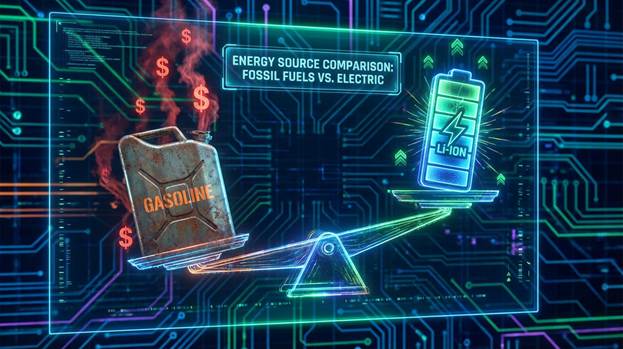
The Economic Tipping Point: When ICE Becomes Non-Viable
At what point does the petrol car become a "stranded asset"? Economists often look for the "tipping point," the specific price at the pump where the psychological and financial burden of internal combustion outweighs any remaining benefits of the technology.
Based on current consumer behavior and the new 200-mile-for-$25 benchmark, that tipping point is closer than most realize. In the US, once gas hits a sustained average of $6.00 to $7.00 per gallon, the total cost of ownership (TCO) for an ICE vehicle becomes a mathematical disaster for the average commuter. In Europe and the UK, where taxes are higher, we are already seeing this exodus accelerate as petrol crosses the equivalent of $8.00 or $9.00 per gallon.
Will we hit this point in 2026? All signs point to "Yes." With supply chains still recovering and global demand for oil reaching its projected peak, any minor geopolitical tremor could send prices past that $6.00 mark. When that happens, the demand for EVs won't just grow; it will explode, likely outstripping the capacity of manufacturers to build them. At that stage, EVs aren't just a choice—they are the only way to maintain a mobile lifestyle without sacrificing one's retirement fund to the fuel tank.

A World Silenced: Life After Internal Combustion
What does a world without ICE cars actually look like? It is a world that is significantly quieter and cleaner. Imagine the streets of a major city without the low-frequency thrum of thousands of idling engines. The "city roar" would be replaced by the quiet whir of tires on pavement and the sound of human conversation.
But the changes go deeper than acoustics.
- Urban Air Quality: The elimination of tailpipe emissions would drastically reduce urban smog and respiratory illnesses, fundamentally changing public health outcomes in high-traffic areas.
- Repurposed Infrastructure: Gas stations, which occupy prime real estate on nearly every major corner, would undergo a massive "Great Repurposing." We would see these spaces transformed into ultra-fast charging hubs that double as high-end cafes or automated parcel lockers.
- The Home as a Power Plant: As Vehicle-to-Grid (V2G) technology matures, your car becomes a massive battery that powers your home during peak hours or outages, turning the vehicle from a liability into a localized energy asset.
Wrapping Up
The shift from petrol to electric is no longer a matter of "if," but a matter of "how fast." The revelation that £20 (approx $25) of overnight charging now beats petrol range is the ultimate catalyst. While we look back at the 15-year journey of EV development as a period of rapid innovation, we will look forward at 2026 as the year the internal combustion engine finally lost the economic argument.
The rising cost of oil serves as a painful reminder of our past vulnerabilities, but the modern EV offers a path toward energy independence that was unimaginable during the rationing lines of the 1970s. As we cross the threshold of $6.00+ gasoline, the ICE vehicle will fade into the realm of the hobbyist and the historian, leaving the road open for a quieter, cleaner, and significantly more affordable future. The era of the "Double Range Dividend" is here, and for the savvy driver, there is no turning back.
Disclosure: Images rendered by Artlist.io
Rob Enderle is a technology analyst at Torque News who covers automotive technology and battery developments. You can learn more about Rob on Wikipedia and follow his articles on TechNewsWord, TGDaily, and TechSpective.
Set Torque News as Preferred Source on Google
Follow us today...