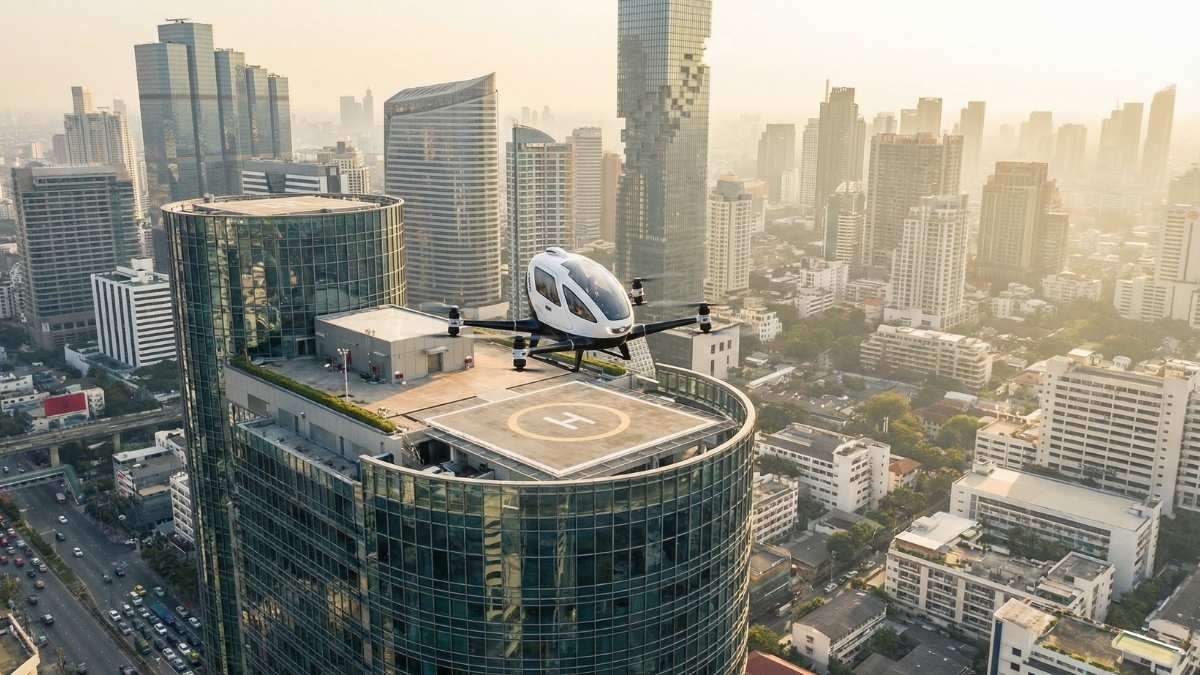

The dream of the "flying car" often feels perpetually stuck in the future—a sci-fi promise that is always five years away. However, on November 24, 2025, that timeline crunched significantly in Southeast Asia. In the heart of Bangkok, amidst the city’s notorious traffic snarls, China’s EHang Holdings completed its first passenger-carrying flight in Thailand with the EH216-S eVTOL (electric vertical takeoff and landing) aircraft.
This wasn't just a tech demo in a remote field; it took place at the headquarters of Siam Commercial Bank in the Chatuchak district, a bustling urban center. With the Director General of the Civil Aviation Authority of Thailand (CAAT), Suttipong Kongpool, bravely strapped into the passenger seat of the autonomous vehicle, the flight signaled more than just technological capability. It marked the firing of the starting pistol for commercial Urban Air Mobility (UAM) in a region desperate for transportation solutions.
The Bangkok Milestone: A Gateway to Southeast Asia
The significance of this flight lies in the regulatory buy-in. When the head of a nation's civil aviation authority steps into a pilotless aircraft, it sends a message that the regulatory framework is shifting from "skeptical" to "cooperative." This flight was part of a regulatory sandbox initiative, a crucial step that allows companies to test operations in real-world environments without the full burden of established commercial aviation laws, which were written for Boeings, not batteries.
For EHang, Thailand is the perfect beachhead. The country combines dense, congested capital cities with a massive high-end tourism industry spread across islands like Phuket and Koh Samui. EHang has explicitly stated that this test sets the stage for commercial operations aimed at island-hopping and tourism. In Southeast Asia, where geography often necessitates slow ferries or circuitous road trips, the value proposition of a 20-minute autonomous flight replacing a 3-hour journey is immense. This event likely heralds a domino effect, with neighboring nations like Indonesia, Malaysia, and the Philippines watching closely as they grapple with similar archipelagic infrastructure challenges.
Why You Won't Own One Yet: The Era of Shared Air Mobility
Despite the excitement, we must temper the "Jetsons" fantasy of a flying car in every driveway. For the foreseeable future, eVTOLs like the EH216-S will remain shared resources rather than personal vehicles. The primary drivers for this are cost, complexity, and infrastructure.
The EH216-S has a suggested retail price outside of China of approximately $410,000. While this is remarkably cheap compared to a helicopter, it is still squarely in the realm of luxury supercars. Furthermore, that sticker price doesn't account for the specialized maintenance, battery management, and insurance required to keep an aircraft airworthy.
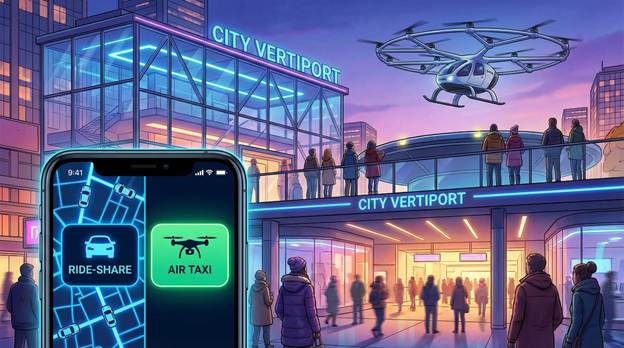
More importantly, the "limitations" of current eVTOLs dictate a fleet model. With flight times currently hovering around 25 minutes per charge, these vehicles need high-utilization rates to be profitable. They need to land, rapid-charge (or swap batteries), and fly again immediately. This logistical dance requires a support network—vertiports, ground crews, and charging infrastructure—that an individual owner simply cannot manage. Consequently, the initial rollout will look less like private car ownership and more like "Uber Air." You will book a seat, not buy the plane.
EHang’s Leadership in a Crowded Sky
In the race to certify and fly, EHang has arguably pulled ahead of Western competitors like Joby Aviation and Archer Aviation, at least in terms of tangible regulatory milestones. EHang is the first company in the world to obtain a Type Certificate, Production Certificate, and Standard Airworthiness Certificate for a passenger-carrying pilotless eVTOL from the Civil Aviation Administration of China (CAAC).
While the FAA in the United States and EASA in Europe are taking a methodical, risk-averse approach to certification—often requiring piloted aircraft first—EHang has gone all-in on autonomy. By accumulating thousands of safe flight hours in China and now expanding these live, passenger-carrying trials to Thailand, UAE, and beyond, EHang is building a repository of data that is hard for competitors to match. They have effectively moved from the "prototype" phase to the "operational validation" phase, leaving many Western startups still stuck in the certification loop.
The Long Runway to ubiquity: Why It Will Take Decades
If EHang is flying passengers now, when will this become common? Realistically, we are looking at a timeline of 10 to 15 years before eVTOLs are a mundane sight in average cities.
The primary bottleneck is no longer just aerodynamics; it is battery density and airspace management. Current battery technology limits these vehicles to short, specific hops. Until energy density doubles, they cannot replace regional transit. Furthermore, integrating thousands of autonomous drones into airspace already crowded with commercial planes, helicopters, and emergency services is a nightmarish air traffic control challenge.
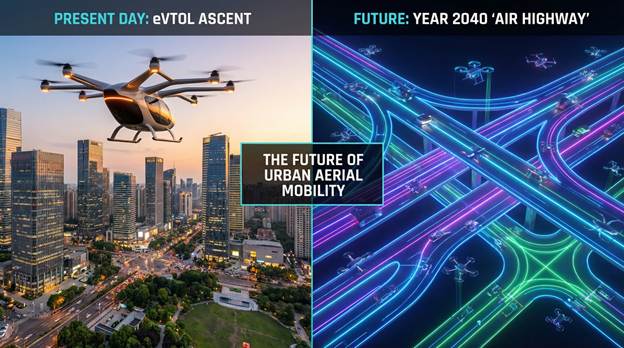
Regulators are notoriously slow because the cost of failure in aviation is total. A single mid-air collision or battery fire over a populated city could ground the entire industry for years. Therefore, the "crawl, walk, run" approach will likely see the "crawl" phase last until at least 2030. Widespread, affordable adoption—where an air taxi ride costs the same as an Uber Black—is likely a post-2035 reality.
Geographic Emergence: Where Will We See Them First?
The adoption of flying cars will not be uniform globally. They will emerge first in countries with centralized regulatory power and a high tolerance for technological innovation—specifically China and the UAE (Dubai), followed closely by pragmatic adopters like Thailand and Brazil.
In terms of location, do not expect to see these in the suburbs immediately. The suburban use case—flying from a driveway to a city center—is a logistical headache due to noise ordinances and the lack of backyard helipads. Instead, early operations will be strictly "Node-to-Node" in two specific environments:
- High-Density Urban Shuttles: Short hops between specific points of failure in a city's transport grid, such as airports to downtown financial districts. Bangkok’s flight from SCB HQ is a prime example.
- Scenic/Tourism Routes: Coastal and island locations where the flight is the experience, or where ground transport is non-existent. Places like Phuket, the Maldives, or the Palm Jumeirah in Dubai will see these vehicles long before a suburb in Ohio does.
Wrapping Up
EHang’s successful flight in Bangkok is a tangible proof-point that the age of the eVTOL is transitioning from power-point presentations to passenger manifests. By securing the first foothold in Southeast Asia, EHang is validating a strategy that prioritizes markets with immediate needs (tourism and traffic) and flexible regulations. While the dream of a personal flying car remains distant, the reality of a summoned flying taxi is landing now—one vertiport at a time.
Disclosure: Images rendered by Artlist.io
Rob Enderle is a technology analyst at Torque News who covers automotive technology and battery developments. You can learn more about Rob on Wikipedia and follow his articles on Forbes, X, and LinkedIn.
Set Torque News as Preferred Source on Google
Follow us today...