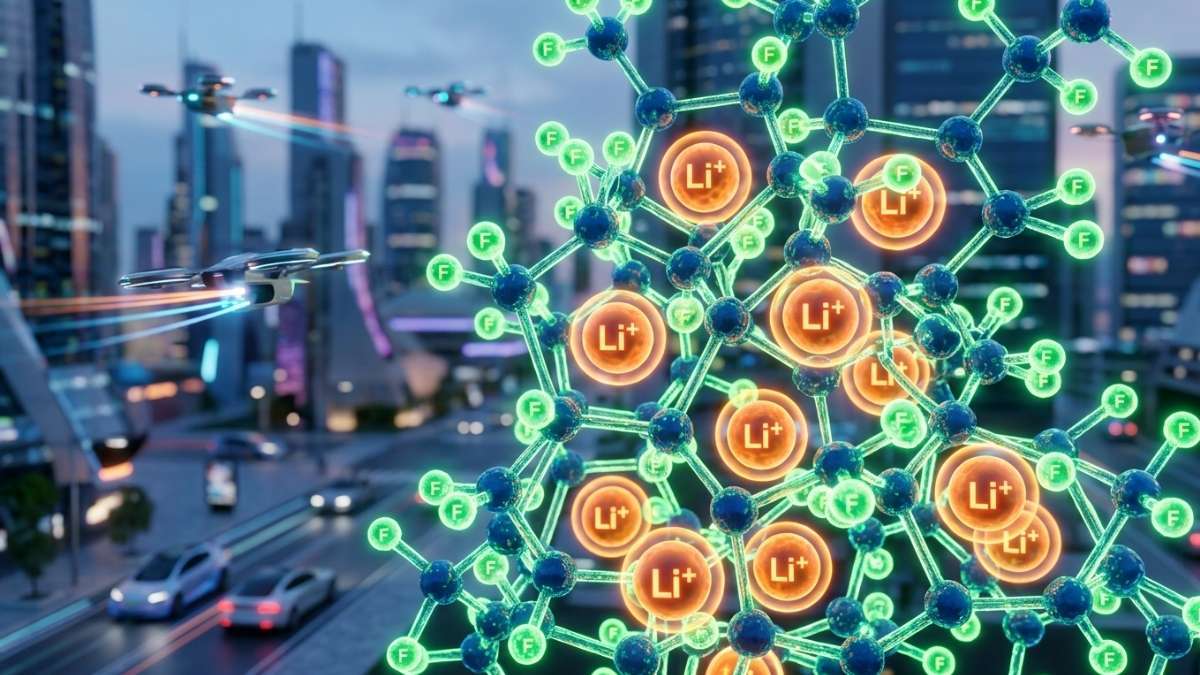

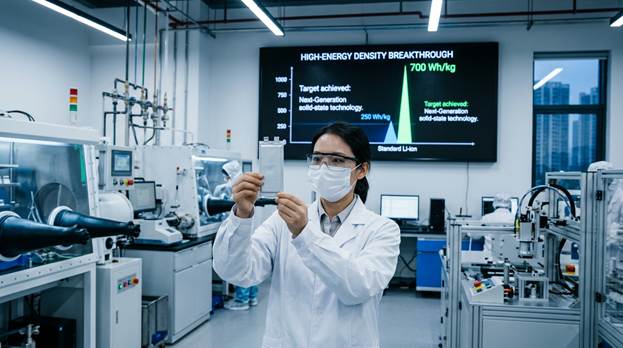
The quest for the "perfect" battery has long felt like a marathon with a finishing line that keeps moving. But this week, a research team out of China—led by Nankai University and the Shanghai Institute of Space Power Sources—didn’t just cross the line; they sprinted past it. By synthesizing a novel fluorinated hydrocarbon electrolyte, the team has enabled lithium batteries to reach a staggering energy density of 700 Wh/kg.
To put that in perspective, the high-nickel NCM batteries found in today’s longest-range Teslas or Lucid Airs typically hover between 250 and 300 Wh/kg. According to technical benchmarks from the Department of Energy’s Battery500 Consortium, the industry has been clawing for years just to reach the 500 Wh/kg mark. We are now looking at nearly triple the energy density of the current "gold standard." This isn't just an incremental step; it is a fundamental shift in the physics of energy storage that threatens to turn the internal combustion engine (ICE) into a historical relic.
The Secret Sauce: Fluorine Over Oxygen
For decades, the limiting factor in lithium batteries hasn't just been the "buckets" (electrodes) holding the power, but the "pipes" (the electrolyte) moving it. Traditional electrolytes rely on carbonate ester solvents. These work, but they are heavy, require large volumes to "wet" the battery internals, and fail miserably in the cold.
The Chinese team, as reported by Car News China, solved this by creating a series of fluorinated hydrocarbon solvent molecules. By replacing traditional oxygen-coordinated systems with fluorine-coordinated ones, they achieved:
- Massive Weight Reduction: The new electrolyte has superior "utilization efficiency," meaning you need far less of it to get the same results.
- Extreme Cold Tolerance: While your current EV might lose 30% of its range in a blizzard, these cells maintain nearly 400 Wh/kg at -50°C.
- Rapid Ion Transfer: The weaker lithium-fluorine bond allows ions to zip through the battery faster, potentially slashing charging times—a critical metric for EV adoption according to JD Power.
A Geopolitical Lightning Bolt: China’s EV Dominance
This breakthrough does more than just power cars; it cements China’s position as the undisputed leader in battery innovation. While Western automakers are still debating the merits of hybrid vs. full electric, Chinese institutions are rewriting the chemical blueprints of the industry.
By achieving 700 Wh/kg, China has effectively leaped over the "solid-state" hurdles that companies like Toyota have been promising to clear for years. This isn't a "lab-only" curiosity; the research was conducted using practical pouch-type cells, a format already used in mass production. As noted by BloombergNEF's battery price survey, China already controls the vast majority of the global supply chain. When a nation controls the most efficient chemistry, it doesn't just win the market—it dictates the terms of the global transition. China is no longer just the world’s factory for batteries; it is the world’s laboratory.
The Robotics Revolution: Beyond the Car
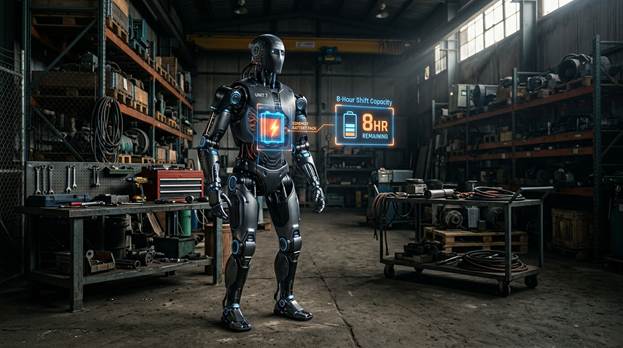
While the automotive world is buzzing, the robotics industry might actually be the biggest beneficiary. Current humanoid robots, like those showcased by Boston Dynamics, are often limited by "active" time because batteries are simply too heavy. A robot carrying a 300 Wh/kg battery is essentially a battery with legs.
At 700 Wh/kg, the power-to-weight ratio changes the game:
- Humanoid Autonomy: Robots could potentially operate for an entire 8-hour shift on a single charge without becoming bulky.
- Low-Altitude Economy: This is a "golden ticket" for eVTOL aircraft (electric vertical take-off and landing), where energy density is the only way to make electric flight commercially viable.
- Space and Defense: The -50°C performance makes this technology ideal for lunar rovers or high-altitude surveillance where thermal management is a constant struggle.
Comparing the Breakthroughs: A New Leader in the Clubhouse
How does this stack up against other "breakthroughs" we’ve heard about recently?
While companies like WeLion have teased high energy densities in their semi-solid state cells for Nio, the Nankai University breakthrough is particularly significant because it focuses on the electrolyte system. This can potentially be integrated into existing manufacturing pipelines more easily than a total move to solid-state ceramics, which experts at MIT suggest are still years away from true mass-market scalability.
The Death Knell for Internal Combustion?
The "ICE vs. EV" debate usually boils down to two things: range anxiety and refueling time.
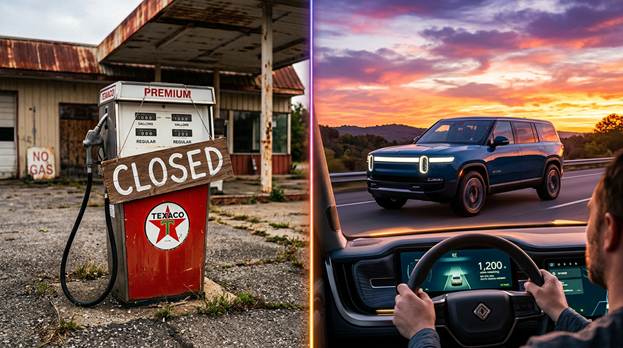
At 700 Wh/kg, a battery pack the size of a standard Tesla Model 3 unit (approx. 450 kg) would hold nearly 300 kWh of energy. That is enough for a range of roughly 1,200 to 1,500 miles on a single charge. At that point, the "gas station advantage" disappears. You could drive from New York to Florida without stopping for fuel—something few gas cars can claim.
Furthermore, because these batteries are lighter, the cars themselves become more efficient. We can stop building "heavy" EVs that chew through tires—an issue widely reported by organizations like J.D. Power—and instead build nimble, lightweight vehicles that outperform their gasoline counterparts in every metric.
Wrapping Up
The synthesis of a fluorinated hydrocarbon electrolyte isn't just a win for the Nankai research team; it’s a pivot point for global transport. By hitting 700 Wh/kg, we have moved from asking "Can an EV replace my gas car?" to "Why would I ever buy a gas car again?" This breakthrough addresses the triple threat of weight, range, and cold-weather performance in one fell swoop. While mass commercialization still requires scaling, the message is clear: the energy ceiling has been shattered, and China is the one holding the hammer.
Disclosure: Images rendered by Artlist.io
Rob Enderle is a technology analyst at Torque News who covers automotive technology and battery developments. You can learn more about Rob on Wikipedia and follow his articles on TechNewsWord, TGDaily, and TechSpective.
Set Torque News as Preferred Source on Google
Follow us today...