
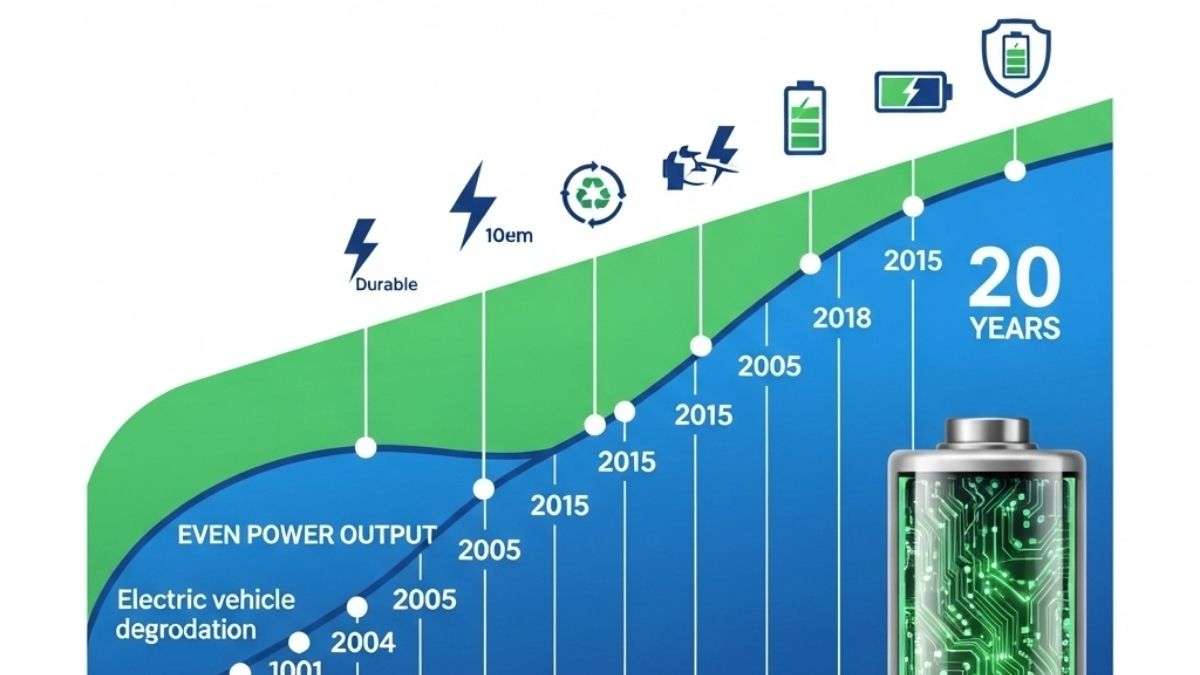

Here in Bend, Oregon, where we value both a good investment and a commitment to sustainability, a new study from telematics leader Geotab has dropped a bombshell that could fundamentally reshape the automotive landscape. For years, skeptics have pointed to the perceived limited lifespan and high replacement cost of electric vehicle batteries as a major deterrent. Well, put those myths to bed: Geotab's comprehensive analysis reveals that modern EV batteries can last up to 20 years with minimal degradation, significantly outpacing the 14-year average lifespan of gasoline-powered cars in the US. This isn't just a minor improvement; it's a game-changer that demands a radical rethinking of vehicle design, ownership models, and regulatory standards.
Debunking the Battery Myth: EVs are Built to Last (Longer Than Your Gas Guzzler)
Geotab's findings, based on data from over 10,000 fleet and private EVs globally, paint a clear and optimistic picture. Researchers found that EV batteries lose only about 1.8 percent of capacity per year, a 22% improvement from their 2019 study. At this rate, a battery retains over 80% capacity after 10 years and approximately 64% after 20 years. To put it simply, your EV's battery is likely to outlive the rest of the car. The study further debunks fears of catastrophic failures, reporting that failure rates remain remarkably low, below 0.5 percent for vehicles produced in the past decade.
The study also offers crucial insights into battery care. While factors like frequent DC fast charging and high temperatures can accelerate wear, modern battery chemistries like Lithium Iron Phosphate (LFP) offer greater resilience and can support lifespans of 15-20 years if properly maintained. This means that with reasonable charging habits (like maintaining a state of charge between 20% and 80%) and advanced thermal management, an EV battery will indeed outlast the average car's functional life, rendering "battery replacement costs" a largely irrelevant concern for first owners.
The Modularity Imperative: Beyond Battery Swaps to Near-Unlimited Lifecycles
This extended battery lifespan introduces a fascinating paradox: if the powertrain is virtually immortal, why is the rest of the car still designed with a finite lifespan? This is where the concept of modular car design becomes not just advantageous, but essential. While companies like Ample are pioneering battery swap technology, enabling quick "refuels" and centralized battery management, the broader implication is for the entire vehicle.
Imagine a car whose chassis, body, and interior components are designed for easy upgrading and swapping. A car could essentially have a nearly unlimited life cycle if its battery pack, computing brains, and even interior modules could be replaced or updated as new technologies emerge. This is a significant departure from the current automotive model, where a major technological upgrade often necessitates buying an entirely new vehicle. Modular platforms are already gaining traction for cost reduction and faster time-to-market , but their potential for extending vehicle longevity is immense.
Autonomous Fleets: Driving the Need for Updateable Vehicles
The future of self-driving car services will further accelerate the need for such modularity. Autonomous vehicles, particularly those deployed in robotaxi fleets like Waymo's, will be in near-constant operation, accruing mileage at a far greater rate than privately owned cars. Their components, from interiors to sensors and even core computing hardware, will wear out more quickly and require more frequent technological upgrades.
The economics of these services will inherently drive a preference for updating over replacing entire vehicles. It makes far more financial sense to swap out a degraded battery, upgrade a sensor suite, or refresh an interior module than to purchase a whole new million-mile-capable autonomous vehicle every few years. This intense operational demand will force automakers to embrace truly modular designs, ensuring that the components with the shortest lifespans or fastest upgrade cycles can be easily replaced, while the fundamental, long-lasting EV platform continues its service.
The Regulatory Imperative: Standardizing for a Sustainable Future
For this vision of near-immortal EVs to truly materialize, however, a critical piece of the puzzle is missing: standardized battery designs and swap capabilities, potentially backed by regulation. While the EU and China are already moving towards stricter battery regulations covering recycling, carbon footprint, and performance standards, specific global standards for swappable batteries remain nascent. For a seamless ecosystem where batteries can be easily exchanged and vehicles updated, universal standards for battery dimensions, connections, and communication protocols will be essential. This would also facilitate second-life applications for EV batteries, further enhancing their sustainability footprint.
Wrapping Up: The Immortal Car on the Horizon
The Geotab study delivers a powerful message: EV batteries are incredibly durable and built to outlast the vehicles they power. This revelation doesn't just debunk anti-EV myths; it opens the door to a radical reimagining of car ownership. If the core powertrain is effectively immortal, the industry must pivot towards modular vehicle designs that allow for easy component updates and battery swaps, extending the life of the entire car. This shift will be particularly driven by the economics of future self-driving car services, which demand maximum operational uptime and cost-effective upgrades. With the right regulatory framework for battery standards, we could soon see a future where our cars, like our trusted appliances, are maintained and updated for decades, truly driving into a more sustainable and economically sensible tomorrow.
Disclosure: Image Rendered with Gemini
Rob Enderle is a technology analyst at Torque News who covers automotive technology and battery developments. You can learn more about Rob on Wikipedia and follow his articles on Forbes, X, and LinkedIn.
Set Torque News as Preferred Source on Google
Follow us today...







Comments
BEV can last 500,000 miles…
Permalink
BEV can last 500,000 miles that is current generation and next generation could be 1 million miles. One car enough for lifetime.
I agree that automotive…
Permalink
I agree that automotive grade lithium ion batteries will last for long enough to debunk the myth that they need to be replaced. However, stating that long battery longevity supports vehicle modularity to the point of infinite lifecycle is more of a wish than reality.
If EV’s could matched ICE in…
Permalink
If EV’s could matched ICE in price, range and time to fill up, they already would have triple the market share. The product must match the need, especially in the commercial EV market.