
What is really flowing when you fill up at the gas station? That is an important question asked recently on Local12 WKRC News, which featured a story about Ohio residents being sold water-tainted gasoline at the pumps that is ruining their car engines.
As it turns out, this is a long ongoing problem in some states that has gotten worse as more car owners are discovering their cars―in some cases―fail to run soon after getting fuel at a gas station.
Related article: Warehouse Discounted Gas You Should and Should Not Buy
Why The Bad Fuel in Ohio and Two Other States?
Water making its way into fuel stations is not an uncommon problem. Sometimes, the underground fuel storage tanks leak, and/or rainwater makes its way past the fueling caps and contaminates the fuel. You may have seen instances occasionally of digging near the pumps during tank repairs and remedying the problem.
Condensation in both storage and vehicle fuel tanks can also lead to water-contaminated fuel―especially in temperate regions where weather conditions fluctuate wildly. As the old saying goes in Ohio, "If you are tired of the weather, wait 10 minutes."
Gasoline containing ethanol like E10, which is 10% ethanol, is another potential source of water in fuel. Ethanol is hydroscopic meaning that it absorbs water from the air.
Of course, there is always this source to consider: The transport of fuel from refineries is not necessarily monitored, which provides a more insidious reason why water in gasoline is being sold to customers in states like Ohio and not in other states.
While state auditors are responsible for ensuring that the gas pumps are pumping the volume of liquid recorded into your tank, depending on the state, sometimes there is no quality assurance that the fuel is not compromised with water.
At the state level, under the authority of the Weights and Measures Division or a similar regulatory agency, the state is responsible for:
Testing and Inspecting Pumps―Ensuring that fuel pumps dispense the amount of gasoline displayed on the pump and checking for proper calibration to prevent overcharging customers.
Sealing Approved Pumps―After an inspection, the pumps that pass are sealed with a sticker indicating they are accurate and certified.
Quality Assurance and Responsive to Complaints―The auditors are typically responsible for monitoring the fuel to ensure it meets state standards for excessive contaminants, like water, and investigating consumer complaints.
Ohio Laws Prevent Fuel Testing
According to the news story, car owners in Ohio are reporting a trend of bad gas at some fuel stations, which is resulting in rough-running vehicles. Repairs and services for removing the water-tainted gasoline and running the vehicles correctly again cost $1,000 and up.
When government authorities in charge of the fuel at the gas pumps were notified that consumers were finding water in their gas tanks, the news team discovered the authorities could not do anything about it because, by law, they were not allowed to test fuel quality at gas station pumps.
"I'm allowed to test for volume so we can verify that you're getting five gallons of gas, but we can't verify what you're getting," stated Tom Woods from the Hamilton, Ohio County Auditor Office.
In fact, three states—Ohio, Nebraska, and Alaska — have laws prohibiting fuel testing at the pumps.
The problem lies with the gas and oil industry lobbyists, who fight to prevent fuel testing permission at gas pumps. Multiple Bills were proposed to combat the problem at the state level but failed due to political pressure from interested parties to leave things the way they are in Ohio.
To get around the Bill problem, government officials in Ohio are working on a bipartisan Bill to authorize―but not force―counties to check the fuel for quality as a compromise to get some protection for car owners.
"We've got some proposed legislation that would make it permissive for the County Auditors to regulate this to check gas for quality, and it makes sense for them to do it," says Republican State representative George Lang of West Chester, Ohio.
For more details about the story, here is the News video:
Their Gas Was Basically Just Water and It Killed Their Cars
What Car Owners Can Do
The News story points out that sometimes a station owner will help a car owner by reimbursing the expense of repairs caused by bad gasoline. However, do not expect this to be a common courtesy of all gas stations; there is no way to prove that the gas in your tank came from a particular station.
Purchasing a "Bacon Bomb" like the one the professionals use to test fuel for water contamination is prohibitively expensive, costing several hundred dollars. A much cheaper alternative is trying out a product like "Gasoila Water Finding Paste" sold on Amazon for only $9.99 that presumably is similar to what the News video shows some gas station owners and fuel testers are shown smearing onto the end of a dipstick to look for a color indication of water in the fuel.
Here is an informative video demonstrating how to use a water-finding paste to test your fuel:
Water Finding Paste - Product Demonstration
But What If It Is Too Late And Your Car Is Already Running Rough From Bad Gas?
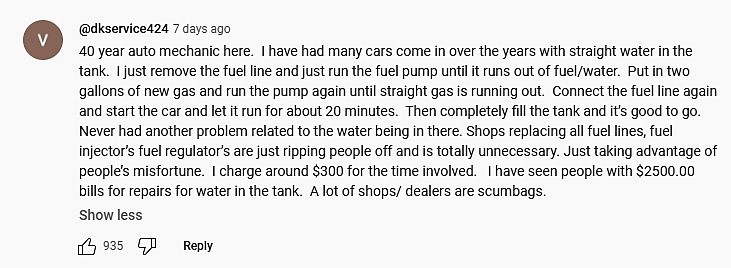
All may not be lost. According to one post from a mechanic, it is not that big of a problem, and in fact, is sometimes used to scam some car owners by overcharging for a relatively easy repair:
However, be aware that long-time exposure to water in your fuel system can and does damage beyond the repair of draining and flushing out your fuel system.
For additional fuel-related articles, here are three for your consideration:
- Gas Thieves are Damaging Cars
- EVs Will Create New Job Opportunities with Gas-Only Trucks
- High Octane Fuel Truths for Car Owners
Timothy Boyer is an automotive reporter based in Cincinnati who currently researches and works on restoring older vehicles with engine modifications for improved performance. He also reports on modern cars (including EVs) with a focus on DIY mechanics, buying and using tools, and other related topical automotive repair news. Follow Tim on Twitter at @TimBoyerWrites as well as on Facebook and his automotive blog "Zen and the Art of DIY Car Repair" for useful daily news and topics related to new and used cars and trucks.
Image Source: Deposit Photos
Set Torque News as Preferred Source on Google
Follow us today...