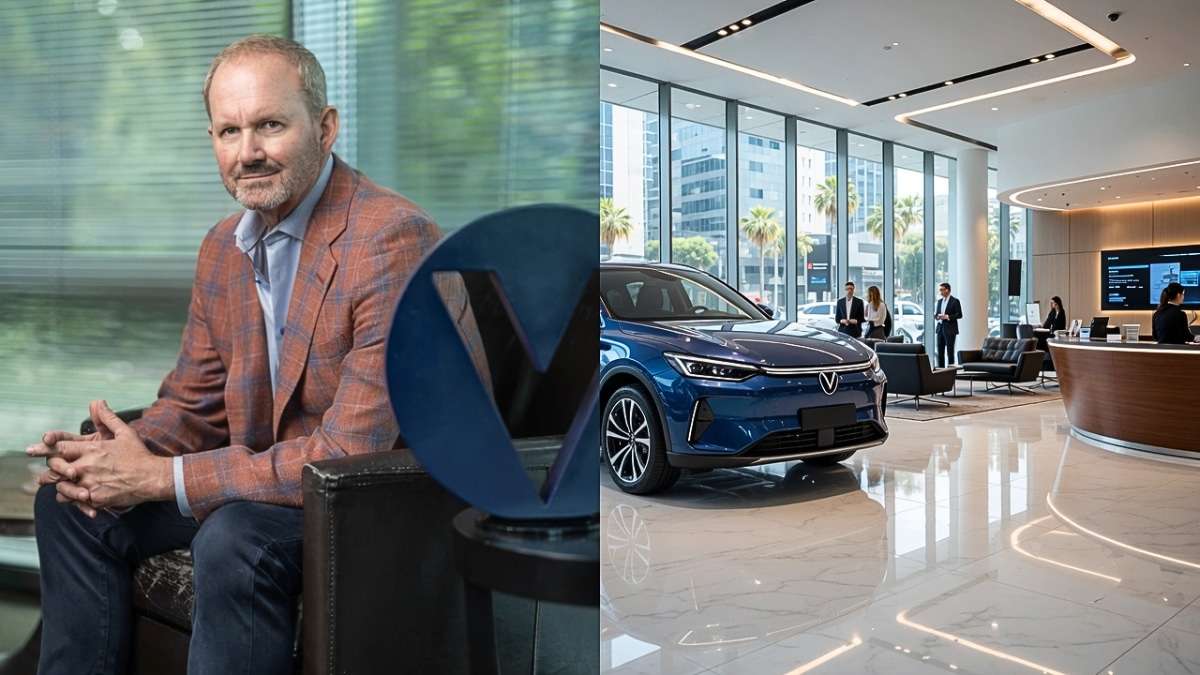

I have covered car buying for 15 years, and I keep noticing the same shift. The lot used to be the story. Now the story is what a dealership knows about you before you even park your car. I saw this firsthand while researching how Tesla's Sentry Mode has quietly turned owners into data collectors for the company, and it made me wonder how far behind traditional dealers really are. So I sat down with David Boice, CEO and co-founder of Team Velocity, to talk about where buying a car is actually headed.
David has been building automotive technology since he was 22, when he co-founded AutoMark with his father and sold it in 2000 as part of one of the largest tech deals the industry had seen. He co-founded Team Velocity in 2008, right in the middle of a brutal economy, and now runs Apollo, the company's connected marketing platform for dealers. I wanted his honest read on where the car buying experience is going. What he told me changed how I think about the whole process.
Are Dealerships Competing On Inventory Or On Data Now?
I asked David straight up whether dealers still think they win by having the right trucks on the lot. He did not hesitate.
"Without question, dealers are competing on data now, inventory and pricing are just table stakes," he said. He explained that when a dealership's data sits scattered across five different systems, the staff only sees a fraction of who the customer actually is. This tracks with what I found while covering the 2027 GMC Sierra's shift toward a more premium market position, where brands are leaning harder on knowing exactly who their buyer is rather than just building more trucks.
"The dealerships pulling ahead are the ones who have a complete, unified view of every customer and can act on the insights that come with that full picture," David told me. He said the real advantage today comes from delivering communications that reflect exactly where a customer sits in their buying journey.
How Vulnerable Is A Dealership That Loses Control Of Its Customer Data?
This question hit harder than I expected. David did not soften his answer.
"Extremely vulnerable," he said. "Once a dealership gives control of its customer data to third parties, they are no longer the one telling the story of that relationship." He explained that this means losing the ability to personalize, to anticipate a customer's next move, and ultimately to retain them.
He walked me through what happens over five years. Competitors who own their data keep getting better at converting and retaining customers. Meanwhile dealerships that outsourced that relationship become replaceable. "Just another name on a lead list instead of a trusted partner in the transaction," David said. That phrase stuck with me. It reminded me of how I felt covering Hyundai's ICCU warranty extension story, where the brand that stayed close to its owners through the crisis came out looking far more trustworthy than the ones that went quiet.
Who Actually Owns The Customer Relationship When Shopping Starts On Google Or A Third Party Site?
Most car buyers today start their search somewhere other than a dealership website. I asked David who owns that relationship once a shopper has already touched Google, social media, or a marketplace before ever calling a store.
"I don't think ownership works the way people assume it does," he said. "It's not about one single touchpoint, Google, social, a marketplace, claiming the customer relationship. It's about whether the entire ecosystem is connected." He explained that a customer might start on a third party site, but if a dealership's systems are talking to each other and capturing that engagement accurately, the dealership can still own the relationship end to end.
"The dealerships that win are the ones whose tools work together seamlessly, not the ones fighting over who touched the customer first," David said.
What Is The Biggest Mistake Dealerships Make Evaluating Their Marketing?
I have sat through enough dealership marketing meetings over the years to guess the answer here, and David confirmed my suspicion.
"Dealerships can sometimes get stuck in the process of evaluating the performance of each tool in isolation instead of looking at the customer experience as a whole," he told me. He gave a simple example. A dealership might see a strong email open rate or a productive ad campaign and call it a win, without asking whether the customer's overall experience actually led to a sale.
"Performance in a silo doesn't tell you if you're retaining customers or building loyalty," David said. "You have to zoom out and look at the entire journey, not just individual line items." This is the same lesson I took away from covering the Cadillac Vistiq's competitive positioning inside the brand's growing EV lineup, where one strong model alone was never the whole picture. It only mattered next to everything else the brand offered around it.
Why Do Dealerships Seem To Know What Car I'm Looking At?
Readers ask me this constantly, and now I finally have a clean answer. Every click on a dealership's website, every search, every filter you apply gets logged. If that dealership runs a connected platform like Apollo, the system ties your browsing behavior to your identity the moment you submit any form, even something as small as a service appointment. That is why the truck you looked at last night shows up in an email by morning. It is not magic. It is unified data doing exactly what David described.
Why Do I Get Trade-In Offers After Browsing One Vehicle Online?
This connects directly to David's answer about John and the Civic. Picture this scenario he gave me. John owns a 2024 Honda Civic worth $24,500 in trade, and yesterday he was browsing 2026 Honda CR-Vs on the dealership's site. "An AI agent with full visibility can immediately present John with a real, personalized offer, trade in the Civic, step into a CR-V, here's your new monthly payment," David explained. That is why trade-in offers now arrive almost instantly. I saw this pattern play out when I covered a Toyota Tacoma owner who was shocked by his dealer's fast, data-driven trade-in number, which came together far quicker than the old appraisal process ever allowed.
Will AI Negotiate With Me When I Buy My Next Car?
David was clear that AI is not a shortcut around fixing a broken process. "AI is a powerful efficiency tool, but it's not a fix for a broken foundation," he told me. "A fragmented dealership that adopts AI is still a fragmented dealership, it just moves faster toward the same disconnected outcomes."
But once a dealership solves its fragmentation problem, David said AI becomes genuinely transformative. "The order matters, fix the foundation first, then AI multiplies the results." So the honest answer is that AI will likely handle more of the early back and forth on pricing and payments soon, similar to what I have already seen develop with Tesla's early Robotaxi pricing data out of Dallas, where automated systems are already setting real world prices without a human in the loop.
Who Really Owns My Information When I Shop For A Vehicle?
This is the question that should worry every car shopper a little bit. According to David, most dealerships are not prepared for a future where AI agents guide the buying process, because that AI is only as good as the data it can see. If your information sits locked inside a single system a dealer does not fully control, you lose leverage without realizing it. This mirrors concerns I raised while reporting on Tesla's in-car camera privacy questions, where owners had no clear sense of who ultimately held their data or how it moved.
David put it bluntly. "AI agent guiding a customer through a purchase is useless if it doesn't have that customer's full profile and history," he said. "But when it does have the full picture, it becomes incredibly powerful."
Are Dealerships Becoming Software Companies?
I think the honest answer is yes, and David's description of Apollo backs that up. He told me it was built from the ground up as a fully connected platform, rather than a collection of tools stitched together after the fact, which he called common in the industry.
"When we roll out new integrations and partnerships, they're built natively into Apollo, not bolted on," David said. "Any dealership can add a third party tool. Almost none can rebuild their entire technology stack from scratch to be natively integrated the way Apollo is." That single sentence explains why some dealer groups are starting to look more like software vendors than car lots, a shift Automotive News recently noted is <cite index="28-1">fueled by vast customer data reservoirs</cite> across the industry.
What Will Determine Whether A Dealership Wins Or Loses A Decade From Now?
I asked David to look ten years out. Inventory, pricing, location, or ownership of customer data, which one wins?
"It won't be any one of those in isolation, it'll be whether they're all connected," he said. He described winning dealerships as running their entire brand off one core system, with:
- No walls blocking data and insights from moving between tools, no manual upkeep across six disconnected pricing platforms, and no third party widgets competing for the same customer's attention.
"When everything is unified, stronger digital relationships happen almost automatically," David said. "That connectivity is what will separate the dealerships that win from the ones that don't."
The Moral Of This Story
Buying a car has quietly stopped being about who has the biggest lot. It is becoming about who knows you best and who can act on that knowledge honestly. I have watched this industry evolve for 15 years, covering everything from Nissan's analog approach with the 2026 Frontier PRO-4X to the rise of connected EV platforms, and the pattern is always the same. The businesses that respect the customer relationship, rather than just mining it, are the ones that last. Trust, once broken by careless data handling, is much harder to win back than a single sale.
I keep thinking about how Tesla owners learned the hard way that their car's cameras and Sentry Mode data could be requested by police without much warning. Data moves in directions people do not always expect. Dealerships now sit on a similar responsibility, and how they handle it will shape whether shoppers trust them or quietly shop somewhere else.
Have you noticed a dealership seem to know more about your shopping habits than you expected them to? And would you trust an AI agent to negotiate your next trade-in on your behalf? Let me know in the comments below.
Return tomorrow, or check our Torque News Home Page for more interesting automotive news articles.
Images by Armen Hareyan.
About The Author
Armen Hareyan is the founder and Editor-in-Chief of Torque News and an automotive journalist with over 15 years of experience writing car reviews and industry news. Now based in the Charlotte region (Indian Land, SC, he founded Torque News in 2010, which since then has been publishing expert news and analysis about the automotive industry. He can be reached at Torque News on X, Linkedin, Facebook, and Youtube. Armen holds three Masters Degrees, including an MBA, and has become one of the known voices in the industry, specializing in the landscape of electric vehicles and real-world stories of actual car owners. Armen focuses on providing readers with transparent, data-backed analysis bridging the gap of complex engineering and car buyer practicality. Armen frequently participates in automotive events throughout the United States, national and local car reveals and personally test-drives new vehicles every week. Armen has also been published as an automotive expert in publications like the Transit Tomorrow, discussing how will autonomous vehicles reshape the supply chain, and emerging technologies in vehicle maintenance.
Set Torque News as Preferred Source on Google
Follow us today...