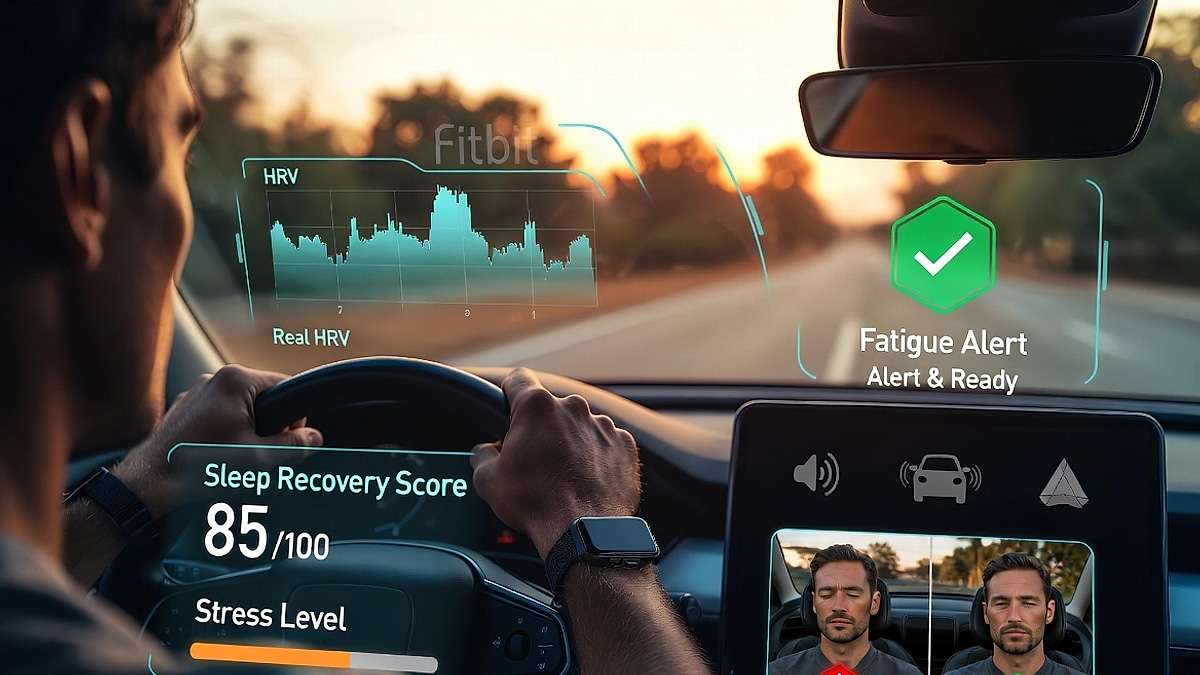

Your car is getting smarter every year. Your body is not keeping up.
Automakers are pouring billions into cameras, sensors, and algorithms to monitor everything happening outside your vehicle. But the most dangerous thing on the road is often the person gripping the steering wheel. That person could be you on a bad night's sleep. It could be you after a stressful week. It could be you at mile 400 of a long road trip, telling yourself you are fine.
The new Fitbit Air, priced at $99, arrives with one clear promise. It watches what your car cannot.
What the Fitbit Air Actually Does
The Fitbit Air is a screenless wearable tracker designed around one core idea: your body needs monitoring just as much as your vehicle does. It tracks heart rate variability, skin temperature, stress response, and sleep recovery scores continuously. There is no display to tap or swipe. It collects data quietly and sends insights to your phone before you get behind the wheel.
That last part matters more than almost any spec sheet detail. Knowing your body's readiness score before you start a drive changes your decision making. You stop asking "am I tired?" and start reading actual biometric data that answers the question for you.
This is the kind of information that can save your life.
The Problem Nobody Wants to Admit
Drowsy driving kills thousands of Americans every year. NHTSA data shows that driver fatigue is a factor in roughly 100,000 police-reported crashes annually. Those are only the ones where fatigue was confirmed. The real number is almost certainly higher.
Here is the uncomfortable truth. Most drivers cannot accurately self-assess their own impairment. You feel alert. Your reaction time is not. Your stress hormones have been elevated for three days. Your heart rate variability has crashed from poor sleep. None of those facts are visible in your rearview mirror.
We have covered how distracted driving affects reaction time and decision making in ways drivers themselves often underestimate. The physiology of fatigue works the same way. You are impaired before you know it.
Why Screenless Is the Right Idea
The design choice that separates the Fitbit Air from most wearables is the absence of a screen. That sounds counterintuitive. But for drivers, it is exactly right.
The problem with glance-heavy devices is that they compete for your eyes. Even the best smartwatches demand a moment of attention. That moment behind the wheel is the same moment you may need to brake. We have reported extensively on how government regulators have tried to limit driver distraction caused by in-vehicle technology, and those rules reflect what research has shown for decades: visual competition kills.
The Fitbit Air sidesteps that trap entirely. You check your data before you drive. You drive. That is the workflow.
Where Tesla Fits Into This Picture
Tesla's Full Self-Driving system has now logged over 5 billion miles of real-world data. The numbers look promising. We have covered how Tesla's FSD may be dramatically safer than average human drivers statistically. But here is what that data also confirms: FSD is still supervised. The human must remain alert and ready to intervene.
That means every Tesla driver running FSD or Autopilot still needs to be physically and cognitively ready to act. A fatigued Tesla driver is a dangerous one, regardless of what the software is doing. A real-world case out of Georgia showed a 2026 Tesla Model Y navigating a driver to a hospital after he suffered a heart attack while FSD held the wheel. That story is remarkable precisely because it was an exception, not a backup plan you can count on.
The Fitbit Air could become the health layer that FSD cannot replace.
Sleep Scores Are Not Just for Athletes
The Fitbit Air uses heart rate variability and overnight temperature patterns to generate a daily readiness score. Fitness influencers have been tracking these numbers for years. Drivers should be doing it too.
Poor sleep compresses reaction time. Elevated stress raises cortisol and reduces fine motor control. High strain scores from the previous day affect cognitive sharpness. These are not abstract wellness concepts. They are the exact variables that determine whether you brake in time or you do not.
Car manufacturers know this. We have seen how Subaru's DriverFocus facial recognition system was named best safety innovation in its class specifically because it detects drowsiness and distraction through a camera pointed at the driver's face. The Fitbit Air works upstream of that. It catches the fatigue before the car even starts.
What $99 Actually Buys You
At this price point, the Fitbit Air is genuinely accessible. It does not require a subscription to be useful. The basic biometric data, sleep staging, stress tracking, and recovery scoring, flows through the standard Fitbit app.
Compare that to the cost of a single serious accident. Compare it to what one distracted or exhausted driving mistake costs in insurance, medical bills, and worse. The value proposition is not subtle.
Tesla Insurance already tracks behavior like hard braking, late night driving, and speed to compute driver safety scores. We covered how Tesla's safety score algorithm can penalize drivers in ways they do not always control. A body tracker that helps you arrive at the wheel in better physical shape could directly influence both your driving outcomes and your insurance exposure.
How to Build the Habit
The Fitbit Air works best as a pre-drive ritual, not just a background device. Here is how to use it intentionally.
Check your readiness score each morning before you start your car. If the score is below 60, consider whether your trip is necessary or whether you can delay it. Pair it with simple habits. If your stress score is elevated, take five minutes before driving. If your sleep score was low, plan for shorter driving windows with real rest stops.
The NHTSA data on distracted and fatigued driving crashes has not improved dramatically in decades despite better roads, better cars, and better technology. The missing piece has always been the driver.
The Bigger Picture for Automotive Safety
Cars are now rolling computers. Tesla collects millions of miles of behavioral data. Subaru reads your face. Ford tracks your lane position. None of these systems read your heart rate variability at 6 a.m. before you walk out the door.
The Fitbit Air fills a gap the automotive industry has not yet solved. It treats the driver as a biological system that needs its own monitoring layer. And at $99, it costs less than most car accessories and less than a single tank of gas in some vehicles.
The car of the future monitors the road. The driver of the future monitors themselves.
What do you think: should automakers work to integrate wearable body data directly into driver monitoring systems? And if your car could read your Fitbit Air readiness score before allowing Autopilot to engage, would you trust that system more?
Armen Hareyan is the founder and Editor-in-Chief of Torque News and an automotive journalist with over 15 years of experience writing car reviews and industry news. Now based in the Charlotte region (Indian Land, SC, he founded Torque News in 2010, which since then has been publishing expert news and analysis about the automotive industry. He can be reached at Torque News on X, Linkedin, Facebook, and Youtube. Armen holds three Masters Degrees, including an MBA, and has become one of the known voices in the industry, specializing in the landscape of electric vehicles and real-world stories of actual car owners. Armen focuses on providing readers with transparent, data-backed analysis bridging the gap of complex engineering and car buyer practicality. Armen frequently participates in automotive events throughout the United States, national and local car reveals and personally test-drives new vehicles every week. Armen has also been published as an automotive expert in publications like the Transit Tomorrow, discussing how will autonomous vehicles reshape the supply chain, and emerging technologies in vehicle maintenance.
Set Torque News as Preferred Source on Google
Follow us today...