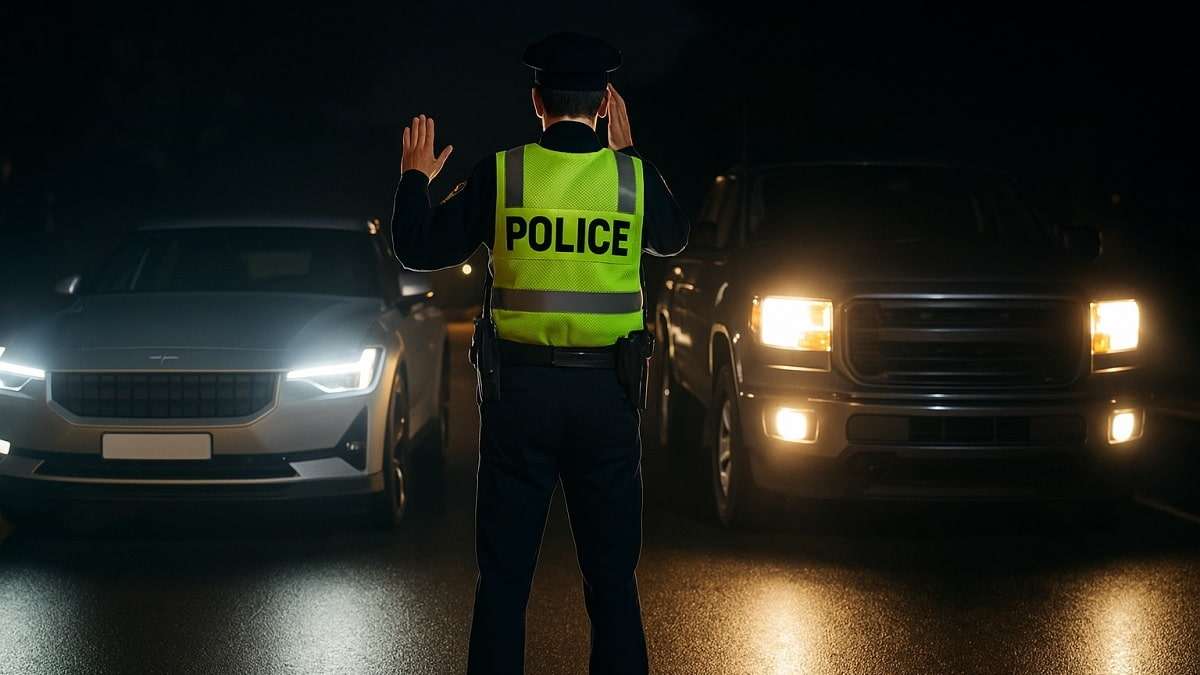

Complaints about headlights being too bright are real. A study by the U.S. Department of Transportation found that 88% of drivers found headlights to have a glare, and 31% found it to be distracting. What’s worse is that 1% of the drivers studied claimed that headlight glare led to either an accident or a near miss.
This has been a popular topic on social media. Here’s a recent post on Reddit with a ton of responses from other drivers commenting about experiences with blinding headlights.
“I’ve had my fair share of headlight/high beam blinds from Tesla Model Y’s (seriously owners need to check their settings or maybe adjust their headlight height), but man the Polestar that drove by me half an hour ago literally burned the back of my eyes. Am I the only one thinking that polestar lights are just too bright?”
ChickenFlavoredCake responded with a comment about pickup truck headlights:
“If you think they're bright, you've never been in a sedan opposite to a new-ish model American pickup truck – LOL.”
Kwkatnip commented about headlamp settings from the automotive manufacturer:
“Always get blinded by those, I don’t understand how car companies can get away with it. It’s definitely a hazard and it stings your eyes.”
Lostinheadguy thinks that the problem is due to aftermarket mods:
“It’s not car companies. Headlights are almost always aimed correctly from the factory - it's folks who replace halogens with LEDs in the aftermarket, or who lift their trucks higher than factory, who cause blinding.
It's also folks who run with their high beams on constantly without realizing it (of which there are many who do this).”
A Brief History of Headlights
Simply put, automobile headlights progressed from acetylene gas, to simple tungsten filament, to halogen, to HID (high-intensity discharge), to today’s LEDs with a few oddball technologies spread along the way.
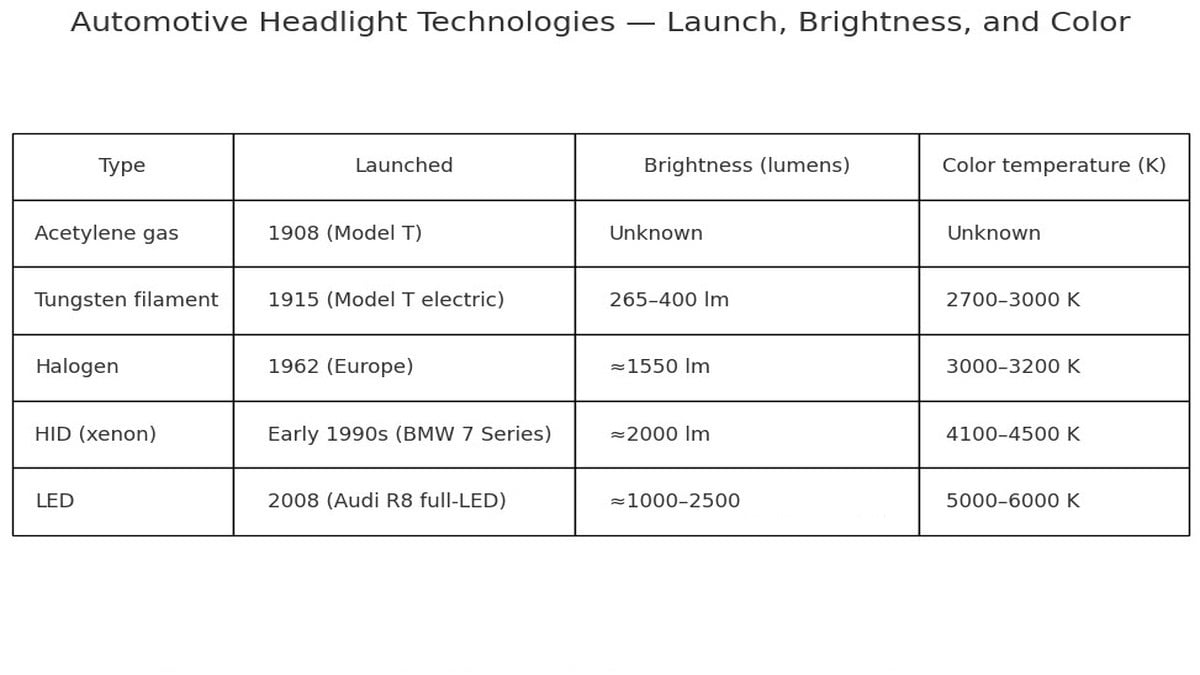
When it launched in 1908, the Ford Model T was equipped with acetylene gas headlamps. Around the year 1915, the Model T switched to electric lights powered by the car's magneto. Depending on the car’s engine speed, the early simple tungsten filament headlamps generated around 265 to 400 lumens of light.
Tungsten headlamps had a long run, and it wasn’t until 1962 that halogen bulbs arrived, first in Europe. The early halogen headlamps generated about 1550 lumens or about five times more light than the first tungsten filament bulbs. Halogen lights were followed by a newer technology called HID headlights, also known as xenon headlights, came out in the early 1990s. They first appeared on the BMW 7 Series, and produced about 2000 lumens.
The latest common headlamp technology is LED (light emitting diode), and the first completely LED-equipped vehicle was the Audi R8, which was released in 2008. Legal low-beam LED modules often deliver on the order of roughly 1000 to 2500 lumens per module.
Headlights Do Seem Brighter
Headlights do indeed seem brighter and it’s from the current trend in LED and HID technology.
Even though LED headlights look dramatically brighter, the light meters show that they only put out slightly more light than modern halogen bulbs. LED lights can seem brighter because of a phenomenon called color temperature. We tend to think of light as “clear,” but headlights put out a range of light that can vary from orange-yellow to blue-white. Headlamps in the blue and white range ten to hit people's eyes harder, especially at night.
Science explains why LED lights seem so much brighter. It's a phenomenon called color temperature. While you may think of light as clear, it actually has a whole spectrum that ranges from orange-yellow to blue-white. These “cooler” colored lights temperatures can be blinding when shining at your, but improve visibility when you are behind the wheel looking out because they help reveal crisper detail on the night road.
To summarize where the different headlight technologies fall on the color spectrum, tungsten incandescent is warm, roughly 2700 to 3000 Kelvin. Halogen shifts slightly whiter near 3000 to 3200 Kelvin. OEM HID xenon centers near 4100 to 4500 Kelvin. Automotive LEDs commonly land near 5000 to 6000 Kelvin, depending on the maker and module. These ranges reflect typical factory specifications rather than aftermarket extremes. The higher Kelvin rating of LED bulbs explains why they seem comparatively brighter that bulbs from previous eras.
The LED Situation
The adoption of LED headlights seems to be the main culprit. Halogen bulbs typically deliver around a thousand lumens per side, which most housings were designed to manage. However, modern LEDs often push several thousand lumens. Putting aftermarket LEDs into halogen housings can scatter light rather than shape it, so enthusiasts who chase maximum output can unintentionally create glare that can overwhelm oncoming drivers. This raises fatigue and invites simple mistakes that no one wants to make.
Regulations do exist, but enforcement rarely keeps pace. LEDs are legal when they are part of a factory engineered headlight assembly. LEDs are usually not permitted as simple replacements in standard replaceable bulb headlamps. Proving a violation requires an officer who knows the original equipment for a given make and model, which is a tall order during routine stops. The gap between what the regulation says and what actually happens forces everyday drivers to live with the fallout.
Recent recall show that even factory systems can miss the mark. Certain 2024 and 2025 Porsche Macan EVs were flagged for headlight brightness that may exceed United States safety standards. Roughly 2,940 vehicles built within a defined window need a software update at a dealer. Another recall due to headlight brightness was done for 2018-2020 Ford F-150 trucks. Owners can schedule a simple visit, yet the episode underscores a broader trend toward higher output that still requires proper engineering.
What Can Be Done
Smarter optics offer a genuine path forward. Adaptive Driving Beam and matrix systems shape light with precision by dimming or blanking pixels around other vehicles while keeping the lane ahead bright. Europe and other global regions have used this approach for years.
Practical coping steps can help as long term solutions are implemented. Try to keep your windshields and mirrors clean, as they cut the micro scatter that turns bright points into hazy halos. Shift your gaze slightly toward the right edge of the lane as oncoming lights approach, and blink to refresh the tear film for clarity. If you wear prescription lenses, ask an eye care professional about anti reflective coatings that improve contrast at night. Adjust seat height and mirror angles to move hotspots out of your direct line of sight.
Vehicle owners can lower the severity of the problem through small choices. Avoid installing LEDs in housings designed for halogen, since those housings were not built to control the newer source. Use high beams thoughtfully in true low visibility conditions. Check headlight aim with a simple driveway procedure or ask a technician during the next inspection.
What Do You Think
What was your worst glare moment this year, and which vehicle caused it?
Have you had a near miss you blame on headlight glare, what happened?
Chris Johnston is the author of SAE’s comprehensive book on electric vehicles, "The Arrival of The Electric Car." His coverage on Torque News focuses on electric vehicles. Chris has decades of product management experience in telematics, mobile computing, and wireless communications. Chris has a B.S. in electrical engineering from Purdue University and an MBA. He lives in Seattle. When not working, Chris enjoys restoring classic wooden boats, open water swimming, cycling and flying (as a private pilot). You can connect with Chris on LinkedIn and follow his work on X at ChrisJohnstonEV.
Set Torque News as Preferred Source on Google
Follow us today...