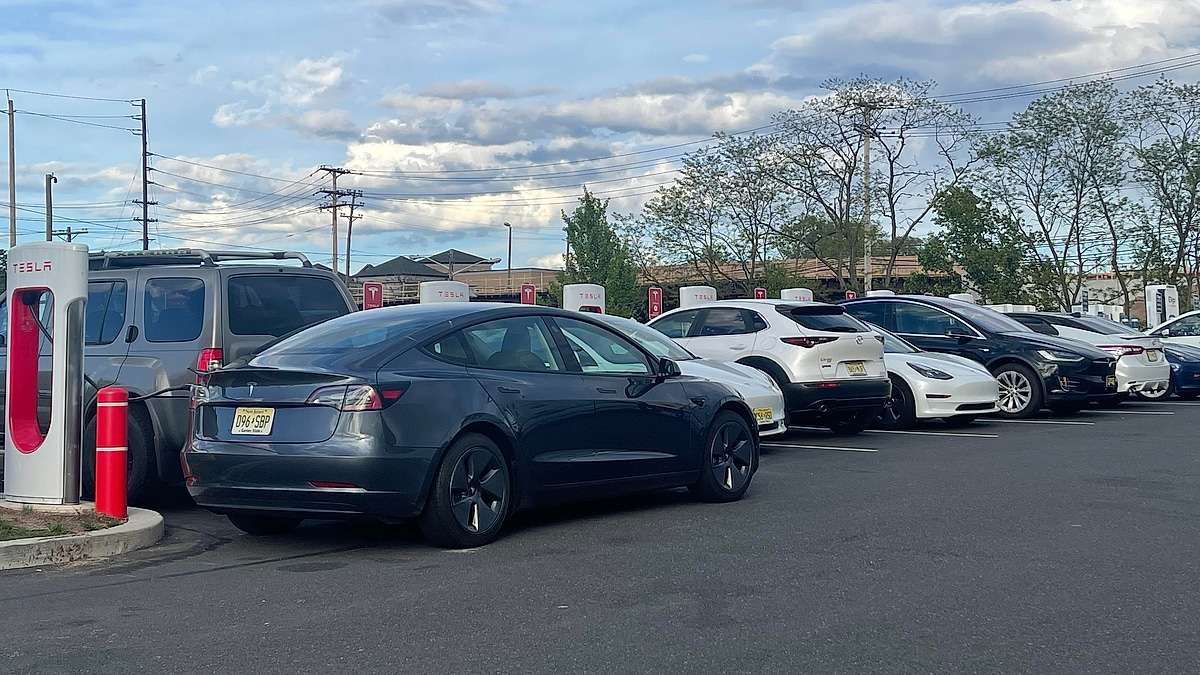

New York City’s public EV charging data shows a problem that a charger map cannot answer. I checked NYC’s municipal EV charging dataset, then compared it with DOT charging rules, charging speeds, garage hours, and parking prices. The finding matters to owners and buyers because a public plug is not automatically useful just because it exists nearby. In New York, where many drivers park on the street and do not have home charging, a charger has to fit the driver’s real routine: when they park, how long they can stay, what the garage costs, and whether the charger is available when they actually need it.
The surface story is charger access. The real story is charger fit.
New York City is building PlugNYC as a public charging network with Level 2 chargers and DC fast chargers. The city’s EV charging dataset covers municipal lots and garages and includes location and usage data. The dataset was last updated on May 5, 2026, according to data.gov.
That sounds like a simple infrastructure story: more chargers, better EV ownership.
But in New York, public charging is not that simple. A charger inside a municipal garage is not just an electrical plug. It is also a parking product. It comes with hours, fees, garage access, dwell-time expectations, connector rules, and neighborhood behavior.

At Bay Ridge Municipal Parking Garage, a four-hour Level 2 session could cost about $19.81 before taxes or fees: $12.25 for parking plus roughly $7.56 for 28 kWh of electricity. That is the part a charger map does not show.
That is the missing layer. Public charging only works when the charging session matches the way the driver already parks.
What Torque News Checked
- Torque News checked New York City’s official EV charging dataset for municipal lots and garages. Data.gov says the dataset includes location and usage data for EV charging stations installed at NYC municipal lots and garages for public use.
- Torque News then checked the DOT’s own EV charging guidance. DOT says Level 2 charging can add up to 20 miles of range per hour, while Level 3 DC fast charging can add more than 30 miles of range in 10 minutes. DOT also says Level 2 chargers are meant for charging while parked at home, work, or on the street, while DC fast charging is closer to a gas-station-style stop.
- Finally, Torque News checked DOT municipal parking rates and garage rules. That matters because the cost of a charging stop is not only the price of electricity. It can also include the price of the parking space.
A Level 2 charger is really a parking habit
Level 2 charging is useful when the car can sit. That makes sense at home, at work, or at a curbside space where the owner already planned to leave the vehicle.
Inside a paid garage, it becomes more complicated.
A driver might see a Level 2 charger on a map and assume it solves the charging problem. But if that driver has to pay for several hours of garage time, the charger may no longer work as a weekly home-charging substitute.
At Bay Ridge Municipal Parking Garage, DOT lists 5 EV charging spaces, hours from 8 a.m. to 10 p.m., a $4 first hour, a $19.50 daily max, and Level 2 charging at $0.27 per kWh.
At Delancey and Essex Municipal Parking Garage, DOT lists 9 Level 2 spaces, 4 DC fast charging spaces, 24-hour operation, a $16 first hour, and a $50 rate up to 24 hours. The same page lists Level 2 charging at $0.27 per kWh and DC fast charging with the first 21 kWh free, then $0.39 per kWh.
Those are not the same ownership proposition.
The electricity rate may match. The parking routine does not.
The charger map hides the real cost
This is where EV coverage often misses the owner’s actual problem.
A charger map tells you where the plug is. It does not tell you whether the plug fits your life.
For a driver who already parks in a municipal garage, the charger can be valuable. For a driver making a quick trip into Manhattan, a DC fast charger with parking offset may make sense. For an apartment dweller trying to replace home charging with several hours of Level 2 charging, the garage price and access window may matter more than the plug itself.
That is why charger count can be misleading. A city can add public plugs and still leave some drivers without a dependable charging routine.
This is not a criticism of EVs. It is a warning about lazy ownership math.
NYC’s own DOT page explains why this matters
DOT says charging an EV can be a challenge in New York City because many people park on the street and do not have access to a home charger. To address that gap, the city has worked with partners to expand public EV charging across the five boroughs.
That sentence is the key to the whole story.
New York does not need public chargers only for convenience. It needs them because many drivers cannot simply plug in at home. That makes public charging part of the ownership foundation, not just a backup.
For homeowners, EV ownership can be simple: plug in overnight and wake up full.
For New York street parkers, the question is different: Where can I leave the car long enough to charge, without turning charging into a weekly parking headache?
Public charging is a market, not just infrastructure
This is the part buyers should understand before they choose an EV.
Public chargers behave like a market. Supply is not just the number of plugs. Supply is the number of plugs available at the time, and price drivers can actually use them.

A charger that sits open at 11 a.m. may not help a driver who needs it at 7 p.m. A Level 2 charger in a garage may be technically available, but too expensive or inconvenient for routine use. A DC fast charger may be better for a quick stop, but it may not replace a weekly overnight charging habit.
This is why the same EV can be easy to own in one neighborhood and frustrating in another. The car did not change. The charging market changed.
The buyer's lesson: do not shop from the spec sheet alone
EV buyers are trained to compare range, charging speed, battery size, incentives, lease payments, and brand reputation.
In New York, they also need to compare charging routines.
A Hyundai Ioniq 5, Tesla Model Y, Chevrolet Equinox EV, Ford Mustang Mach-E, Kia EV6, Nissan Leaf, or used Mercedes EQS can look great on paper. But if the buyer depends on public charging, the real test is not just how fast the car can charge. The real test is whether the charger that fits the car also fits the owner’s schedule.
That is especially true for renters, rideshare drivers, delivery drivers, commuters, and households with no driveway or garage.
The practical consequence
Before buying an EV in New York without dependable home charging, do not only check PlugShare, Google Maps, or the automaker’s charging app.
Go to the charger you expect to use during the exact window you expect to use it. If you would charge after work, go after work. If you would charge on Sunday night, go on Sunday night. Check whether the facility is open, whether the charger is occupied, whether the connector works for your car, whether the app or card reader works, how much parking adds to the session, and whether you have a realistic backup nearby.
A public charger that fails that test is still useful infrastructure. It is just not your home-charging replacement.
If you rely on public charging in New York, we want to hear from you. Is your nearest charger actually useful, or does parking cost, timing, or reliability make it harder than the map suggests? Let us know in the comments below.
Image Sources: Reddit u/hammad22
About The Author
Noah Washington is an automotive journalist based in Atlanta, Georgia, covering sports cars, luxury vehicles, and performance culture. His reporting focuses on explaining the engineering, design philosophy, and real-world ownership experience behind modern vehicles.
Noah has been immersed in the automotive world since his early teens, attending industry events and following the enthusiast communities that shape how cars are built and driven today. His work blends industry insight with enthusiastic storytelling, helping readers understand not just what a car is, but why it matters.
Noah is also a member of the Southeast Automotive Media Association (SAMA), a professional organization for automotive journalists and industry media in the Southeast.
His coverage regularly explores sports cars, luxury vehicles, and performance-driven segments of the automotive industry, including the evolving culture surrounding Formula Drift and enthusiast builds.
Read more of Noah's work on his author profile page.
You can also follow Noah here:
Set Torque News as Preferred Source on Google
Follow us today...