

It takes a while for our collective memory to refresh. Many drivers think that they can’t replace their gas-powered car with an EV because they have unusably short ranges and there aren’t enough fast chargers to easily take a road trip. That was true about fifteen years ago, but it’s not at all true today. If we take a look at range, the Nissan LEAF was arguably the first mass market EV. When it launched in 2011, it had an EPA range 73 miles. Today we have over two dozen EV models on the market with an average range of over 300 miles, and some reaching over 500 miles on a charge.
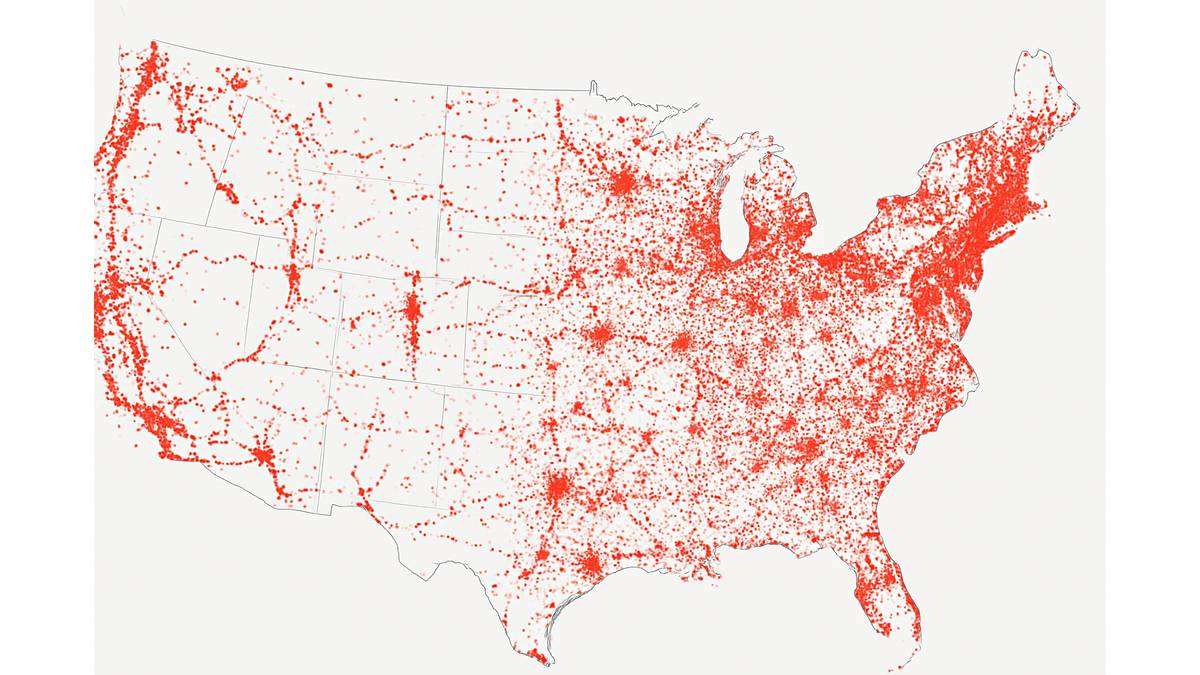
Likewise, the number of charging stations has greatly increased over the last few years. Level 3 “fast charging” sites are best suited for road trips. The number of fast charging sites expanded from roughly 1,000 a decade ago to about 12,000 today. According to a recent New York Times article, roughly 2,000 fast charging stations were added this year alone. A decade ago, most popular routes had gaps of over 100 miles. By 2025 the vast majority have a fast charger at least every 100 miles, well within the range of a modern EV.
This all adds up to much more practical and enjoyable EV road trips. The practicality of EVs for daily driving and road trips is a popular subject on social media. We captured some Reddit comments below to show the current mood.
wvhall1 commented about the ease of very long road trips in an EV.
“I’ve done three road trips (2,200 miles each roundtrip) in my Lucid Air and encountered no charging issues whatsoever!”
flyfreeflylow responded:
“So true. The change since I got my Nissan Ariya in January of '23 is substantial.”
mntgoat made a comment about how dealership attitudes towards EVs has changed:
“I just got a GMC Sierra EV today. I was surprised by how enthusiastic about EVs the dealership was. Three different sales people came in to mention how nice driving those EV trucks is. One of them owns a 2025 EV, and then the owner of the dealership talked about driving one for a month and loving it.
I was used to dealerships trying to convince me not to get an EV.”
PAJW posted one of many real-world examples we saw across social media about how much things have changed in just the last two years:
“There is much less reliance on individual chargers today than a couple years ago.
As an example, I frequently travel the stretch of I-24 between Clarksville, TN and Chattanooga, a distance of about 200 miles.
In 2023, the chargers along I-24 were:
- EA (4 stalls) at Clarksville Walmart
- EA (4 stalls) near Nashville airport at a Kroger
- EA (4 stalls) at a Dollar General in Manchester, Tenn.
- EVgo (1 stall, 50kW) at a hotel in Chattanooga.
For a total of 13 stalls. If any of those were down or busy, you were out of luck. There were others off the interstate, especially in Nashville and Chattanooga, but usually queueing would be faster.
Today, there are about 60 CCS stalls in 7 cities along I-24 in Tennessee. If you have access to the Supercharger network, they provide 100 additional stalls.”
The Explosive Growth of EV Chargers
Just in the past few years, EV road trips that once felt risky are becoming routine. Routes that required meticulous planning now have abundant fast chargers. Especially on the coasts, the national footprint of high-speed charging has grown enough that the open road feels reachable for more EV owners.
By “high-speed charging,” we are referring to Level 3 chargers. As a quick reminder, EV chargers are categorized into three levels based on speed and power (Level 1, Level 2, and Level 3). Level 1 chargers plug into standard 120-volt AC household outlets and have about 1 to 2 kW of power. They add roughly 3 to 5 miles of range per hour and can work well for low daily mileage, or emergencies.
Level 2 chargers require 240-volt AC and typically use a dedicated household feed or are located at public stations, and have 6 to 19 kW of power. The add about 20 to 40 miles of range per hour. They are best for everyday charging at home, work, or destinations.
Level 3, or “DC fast charging” sends power directly to the battery and requires a 480-volt electrical feed. They have 50 to 350 kW of power, and add about 150 to 200 miles in 15 to 30 minutes under good conditions. They are ideal for road trips and quick turnarounds, charging speeds taper as the battery fills and when the pack is cold or hot.
When it comes to road trips and general EV usability, fast chargers matter because they can restore meaningful range in around thirty minutes. Home level charging takes hours. Most owners rarely need public fast charging since most trips are under fifty miles and charging happens at home. Fast chargers are essential for long trips, rideshare drivers, and households without home charging.
EV adoption was faster on the U.S. coasts and that is where the fast charger infrastructure started its build out. Coverage has now spread beyond the coasts. Since 2020, new fast chargers have been installed throughout the South, Midwest and rural areas. More chargers combined with longer vehicle ranges make most major destinations feel reachable, making EV drivers who live in urban areas feel less trapped.
As expected, coastal corridors have seen the fastest improvement and have advanced from passable to easy. One example is the route from Boston to Washington, D.C. It keeps drivers within ten miles of a charger, often within three miles. Similar dense corridors are spreading beyond the coasts, and are giving travelers more flexibility across the country.
Although huge progress has been made, challenges remail. EV fast charging still takes more time that filling a gas tank. Plug types can still be confusing, but the standardization on NACS (Tesla style) charge plugs should alleviate this problem.
Fast charging access will continue to grow mainly because there is money to be made. For example, in 2023, the Tesla Supercharger network generated an estimated $1.74 billion in revenue. Tesla built roughly a fifth of stations and more than half of individual fast charging ports in the U.S. Tesla’s charging success has spurred investment from other providers. In addition to Tesla, five other networks supply about two thirds of the stations. These are ChargePoint, Electrify America, EVgo, Blink Charging, and EV Connect. In addition to networks, some automakers are building out their own networks. A group of automakers (BMW, General Motors, Honda, Hyundai, Kia, Mercedes-Benz, Stellantis, and Toyota) launched Ionna with a plan for 30,000 ports. Ford and Rivian each passed one hundred stations.
Bottom Line
The EV charging map is filling in quickly. Although there is still work to be done, many road trips now feel practical for EV owners, even across the interior. In the coming years focus will be on increasing reliability, speed, and rural coverage. The combination of faster hardware, shared standards, and investment from diverse sources makes us confident that seady progress will continue. Each new fast charging site makes the next journey simpler for drivers planning their next open road run.
What Do You Think?
What is the longest EV road trip you have completed, include route, model, total miles, and charge stops?
What minimum reliable range would make an EV your only car, share your number and why?
Chris Johnston is the author of SAE’s comprehensive book on electric vehicles, "The Arrival of The Electric Car." His coverage on Torque News focuses on electric vehicles. Chris has decades of product management experience in telematics, mobile computing, and wireless communications. Chris has a B.S. in electrical engineering from Purdue University and an MBA. He lives in Seattle. When not working, Chris enjoys restoring classic wooden boats, open water swimming, cycling and flying (as a private pilot). You can connect with Chris on LinkedIn and follow his work on X at ChrisJohnstonEV.
Set Torque News as Preferred Source on Google
Follow us today...




Comments
How EV Road Trips Have Gone…
Permalink
How EV Road Trips Have Gone from Miserable to Enjoyable in The Last Couple of Years. Are you able to back your post with actual customers reviews and video interviews?
I’m not waiting for hours to…
Permalink
I’m not waiting for hours to fill up my car and forget driving in really cold weather either. I’ll keep my gasoline powered car any day!
Still not good. If people…
Permalink
Still not good. If people liked driving EVs, they would take them to track days.