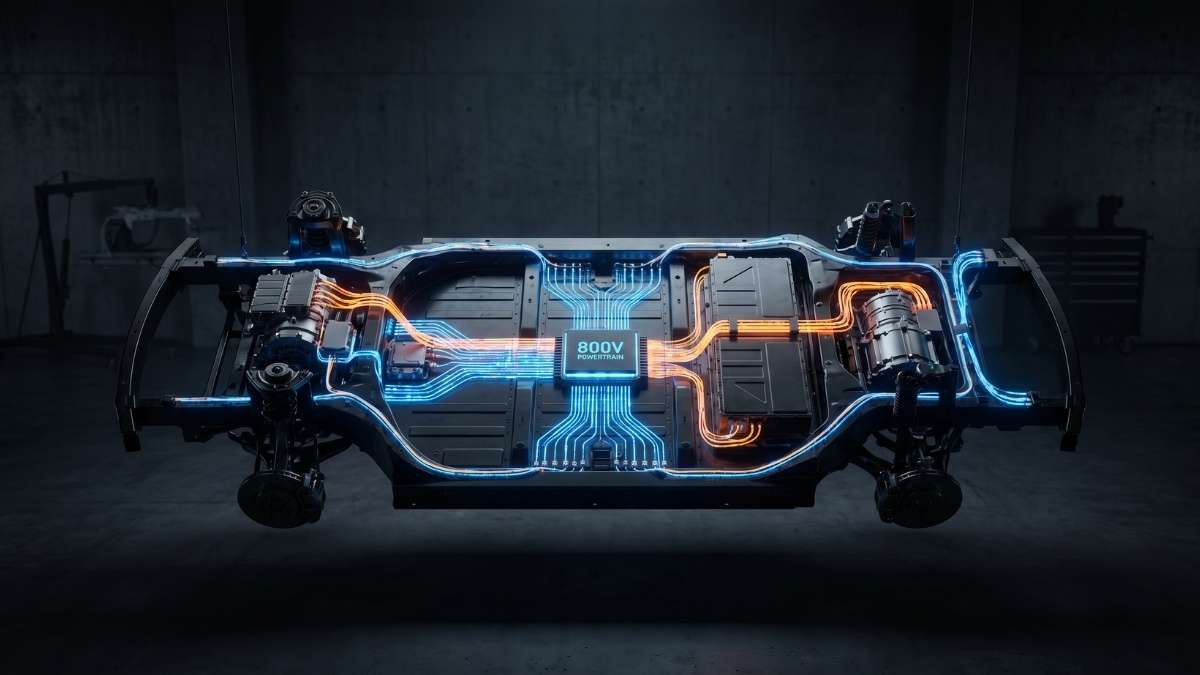

For decades, evaluating a vehicle meant staring at engine displacements, transmission speeds, and torque curves. If you wanted to know how well a car would perform and how well it would hold its value over the next ten years, you looked at the mechanical engineering under the hood. In the modern era of electric vehicles, however, the mechanical metrics have been fundamentally usurped. The single most critical metric of an electric car’s longevity, real-world performance, and resistance to market depreciation is its underlying electrical architecture.
A quiet but brutal platform war is currently playing out across the global automotive landscape. On one side sits the legacy 400-volt (400V) standard—pioneered early on and still utilized by the vast majority of mainstream electric vehicles sold today. On the other side is the high-voltage 800-volt (800V) standard, championed aggressively by forward-thinking manufacturers like Porsche, Audi, and Hyundai.
If you are currently in the market for a new EV, the choice between these two platforms isn't just a minor technical specification detail tucked away in a brochure; it is a dividing line between buying a vehicle that will remain highly functional for a decade or purchasing an expensive piece of hardware that is already effectively obsolete. Buying a 400V EV today is a massive financial mistake, and understanding exactly why requires looking at both the brutal physics under the sheet metal and the harsh reality of the modern charging stall.
The Technical Reality Behind The Voltages
At its absolute core, the difference between a 400V and an 800V EV comes down to a fundamental law of physics: Joule’s Law. This law dictates that the heat loss in an electrical system is proportional to the square of the current ($P = I^2R$). To deliver power ($P = V \times I$) to the battery, an automotive engineer can either increase the voltage ($V$) or increase the current ($I$).
Legacy 400V systems must rely on immensely high current to deliver substantial power. Pumping massive amounts of current through a vehicle's wiring requires incredibly thick, heavy, and expensive copper cables. Worse, it generates immense thermal energy. This heat builds up rapidly in the charging cables, the onboard power electronics, and the battery pack itself.
By contrast, stepping up the system architecture to 800V allows the vehicle to cut the required current in half to deliver the exact same amount of power. By doubling the nominal battery voltage to halve the charging currents, these modern architectures drastically slash energy conduction losses.
This elegant piece of physics allows 800V vehicles to utilize lighter, thinner wiring harnesses, freeing up packaging space and slicing structural weight out of the chassis. Furthermore, these cutting-edge platforms rely on advanced Silicon Carbide (SiC) semiconductors that easily handle dramatically higher thermal limits and switch at much faster frequencies than traditional Silicon, boosting overall powertrain efficiency by up to 10%. You get a lighter car, less wasted heat, and vastly superior efficiency.
The Experiential Gulf At The Charging Station
From a consumer standpoint, these dry electrical formulas translate into two completely different ownership experiences. Imagine pulling up to a public ultra-fast charging station on a cold, rainy road trip.
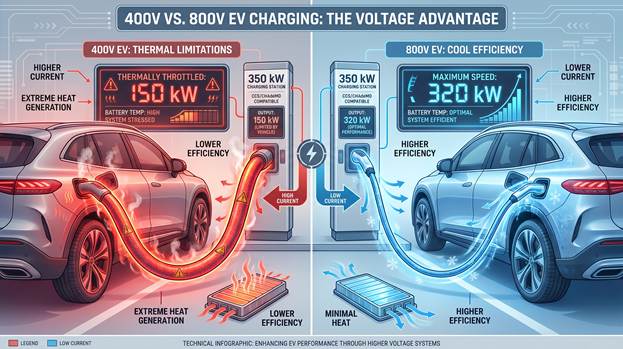
If you are driving a traditional 400V vehicle, your charging experience is strictly capped by thermal limits. Because the high current creates a massive thermal bottleneck, the vehicle’s battery management system will quickly throttle or "gate" the charging speed to prevent catastrophic overheating in the cables and battery cells. Even if you manage to plug into a premium 350 kW DC fast charger, a 400V car simply cannot physically accept that voltage level, typically plateauing around 150 kW to 175 kW. You will find yourself trapped at the station for 35 to 50 agonizing minutes waiting for a standard 10% to 80% state-of-charge replenishment.
Now look at the 800V experience, pioneered heavily by the Porsche Taycan and the Hyundai IONIQ 5. Because these vehicles pull half the current, they completely avoid the extreme thermal bottlenecks of their legacy counterparts. An 800V vehicle can comfortably sustain charging peaks of 250 kW to 320 kW for extended durations.
The experiential difference is staggering: an 800V vehicle can complete a 10% to 80% charge in a blistering 18 minutes. It changes public charging from an inconvenient, chore-driven event into a brief rest-stop interval where the vehicle is done charging before you even finish your coffee.
Why 400V Systems Are Speedrunning Toward Obsolescence
The automotive market is undergoing a profound and rapid shift. During the first wave of modern EV adoption, consumers were primarily obsessed with "range anxiety" - the absolute distance a vehicle could cover on a single charge. But as battery pack sizes have normalized around 75 kWh to 100 kWh, the market focus has firmly shifted toward charging speeds and thermal efficiency.
As a result, 400V architectures have officially hit a developmental dead end. You simply cannot build a premium, fast-charging, hyper-efficient EV on a 400V backbone without making the car prohibitively heavy, complex, and unacceptably expensive to cool. Because of these hard engineering limits, the market is rapidly pivoting to 800V topologies specifically because they offer superior efficiency and dramatically less power loss across both cells and modules.
Every major component supplier and forward-looking automaker is pouring their research and development capital into high-voltage systems. Consequently, 400V systems are being systematically downgraded to budget, low-margin, entry-level platforms. If you purchase a premium or mid-tier 400V vehicle today, you are essentially buying a desktop computer at the tail end of a major processor generation switch; it will function, but it will be thoroughly and embarrassingly outclassed by mainstream options within a single product cycle.
The Infrastructure Race Where 800V Chargers Stand
A common defense mounted by salespeople trying to move 400V inventory is that 800V-capable public infrastructure is still growing, implying you don't need the faster charging capability yet. While it is true that legacy 50 kW to 150 kW chargers currently outnumber ultra-fast stalls, the deployment trajectory tells a completely different story.
Major charging networks across North America and Europe, including Electrify America, IONITY, and EVgo, have entirely halted the installation of legacy 150 kW hardware for their highway corridors. Their current standard deployment centers exclusively on 350 kW hyper-fast dispensers, which operate natively at up to 1,000V.
Even Tesla, long the holdout with its proprietary 400V Supercharger network, has transitioned to its V4 Supercharger posts, which are fundamentally engineered to support high-voltage architectures. This infrastructure pivoting means that 800V capability is expanding exponentially. By 2027, 800V-capable public chargers are projected to become the absolute standard on major highway corridors, outnumbering legacy high-power 400V units and leaving old platforms entirely out in the cold, unable to take advantage of the network's true speeds.
The Coming Cliff For 400V Resale Values
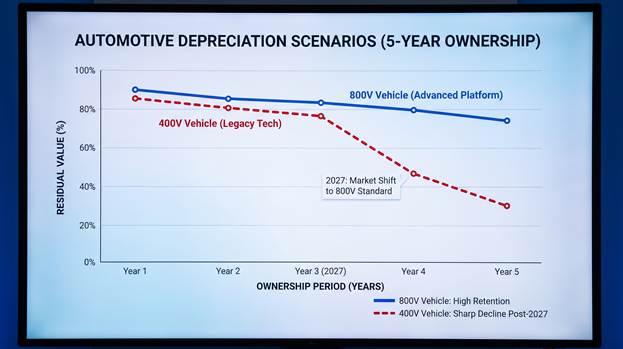
When does a technological trend become an absolute market reality? The financial cliff for 400V vehicles is arriving faster than most consumers realize. By 2028, the used EV market will be absolutely flooded with second-generation 800V cars that offer sub-20-minute charging times as a baseline, entry-level feature.
When a secondhand buyer is looking at two used electric SUVs on a dealership lot, the choice will be devastating for legacy platforms. Why would any rational consumer buy a used 400V vehicle that takes 45 agonizing minutes to charge on a road trip when an 800V alternative sitting right next to it can do it in less than 20 minutes for the exact same price?
This stark divide will trigger severe, accelerated depreciation for 400V platforms. They will become fundamentally undesirable for anyone who intends to drive long distances or rely on public networks, permanently crippling their trade-in value. If you buy a 400V car today, expect to take an absolute bath on the resale value in four years.
What Lies Beyond 800V The Hyper Voltages
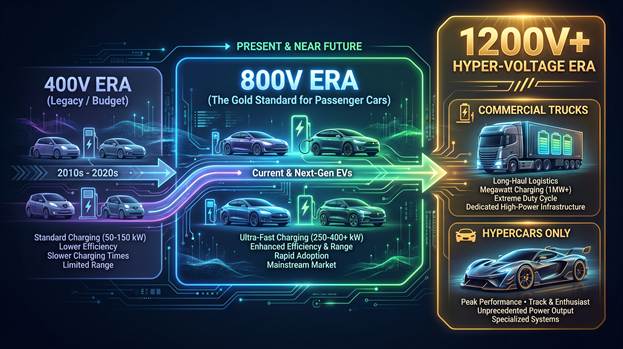
The evolution of automotive electrical engineering will not stop at 800V, which naturally begs the question: will an 800V car become obsolete just as quickly? The answer is no.
Powertrain engineers are already actively designing and simulating 1,200V DC-link hybrid traction inverters to push efficiency to its absolute thermodynamic limits. These hyper-voltage systems are primarily designed to accommodate Megawatt Charging Systems (MCS), which will allow commercial semi-trucks, heavy logistics equipment, and ultra-premium passenger hypercars to charge at speeds exceeding 1,000 kW.
However, unlike the massive leap from 400V to 800V, the consumer benefits of transitioning from 800V to 1,200V will yield sharply diminishing returns for normal passenger cars. Moving beyond 800V introduces intense engineering hurdles, including aggressive insulation challenges, the risk of localized electrical arcing, and elevated electromagnetic interference that requires incredibly costly shielding.
Furthermore, humans hit a natural psychological limit; reducing a charging stop from 45 minutes to 15 minutes (the 400V to 800V jump) completely redefines the usability of a car. Squeezing that down from 15 minutes to 8 minutes (the 800V to 1,200V jump) provides only minor convenience gains at the cost of vastly more expensive vehicle components. Because of these physics-based trade-offs, 800V is highly likely to remain the absolute sweet spot for passenger vehicles for at least the next 15 to 20 years, ensuring that an 800V purchase today remains fully future-proof well into the 2040s.
To deeply understand how these advanced high-voltage architectures interact with battery chemistry to ensure longevity, you should review MotorTrend’s comprehensive guide on EV batteries, types, and charging lifespans, which perfectly outlines how cell design dictates real-world durability.
Wrapping Up
The transition from 400V to 800V is not a superficial feature upgrade or a clever marketing gimmick; it is a foundational, physics-driven paradigm shift in electric vehicle utility. If you buy a 400V vehicle today, you are purchasing technology that has completely run out of developmental runway. You are actively choosing to lock yourself into slower charging speeds, heavier vehicle weight, immense thermal waste, and an inevitable financial beating when it comes time to trade it in.
By contrast, the 800V standard championed so masterfully by early adopters like Porsche and Hyundai delivers the exact mechanical advantages needed to survive the test of time. It represents the pinnacle of current battery physics and is the only logical choice for an informed buyer who expects their vehicle to remain relevant, hyper-efficient, and valuable in a rapidly evolving electric world. Do not be left holding the bag on obsolete technology; demand 800V.
Disclosure: Images rendered by Artlist.io
Rob Enderle is a technology analyst at Torque News who covers automotive technology and battery developments. You can learn more about Rob on Wikipedia and follow his articles on TechNewsWord, TGDaily, and TechSpective.
Set Torque News as Preferred Source on Google
Follow us today...