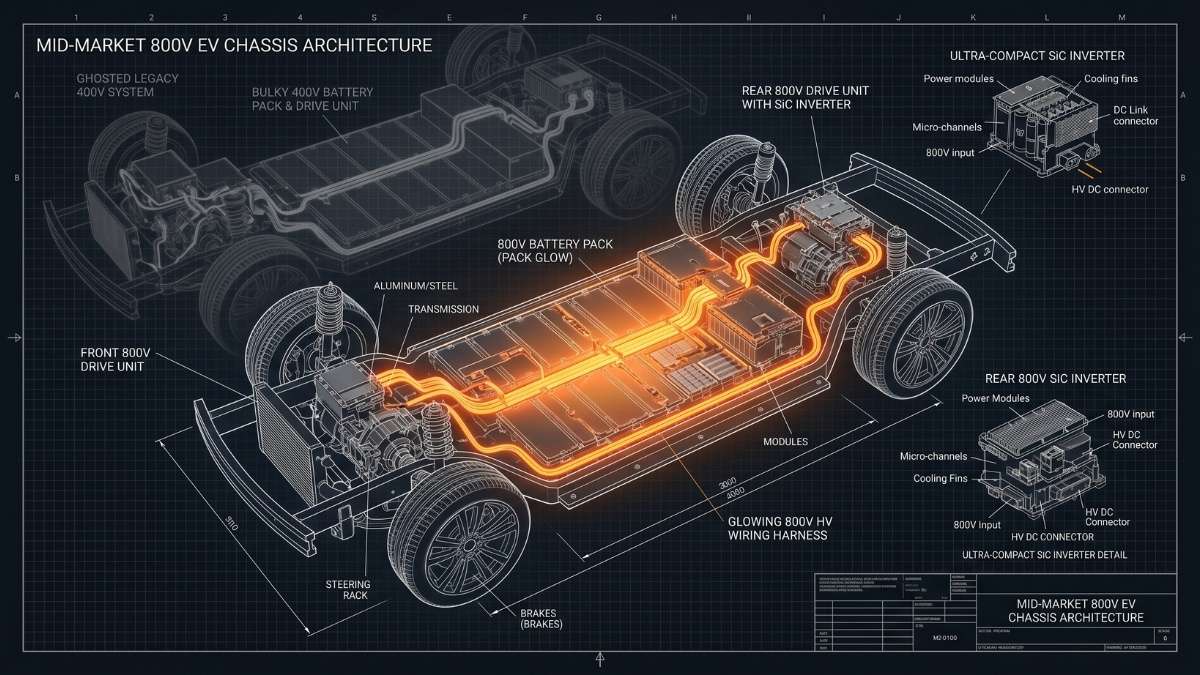

For the past decade, the electric vehicle (EV) conversation has been dominated by a single, exhausting narrative: range anxiety. Automakers responded the only way they knew how, by stuffing increasingly massive, heavy, and expensive battery packs into passenger vehicles. But as an industry analyst who has watched tech cycles play out for nearly forty years, I can tell you that treating a charging problem with a capacity solution is a fundamental architectural error. It is the equivalent of adding a larger fuel tank to an inefficient vehicle instead of refining the engine.
The real problem facing mainstream adoption is not how far a car can go on a single charge, but how long it takes to replenish that energy—and what that demand does to our fragile electrical grid.
Until recently, ultra-fast charging at 800 volts (800V) was a luxury playground reserved for high-end statement cars like the Porsche Taycan or the Lucid Air. The rest of the motoring public has been relegated to 400V systems. When these lower-voltage vehicles plug into high-power DC fast chargers, they generate immense thermal energy. To combat this heat, charging cables must be thick, liquid-cooled, and heavy enough to frustrate the average consumer. Worse yet, the efficiency losses inside the vehicle's onboard conversion hardware place an unsustainable burden on local substations.
That dynamic is breaking open. A quiet revolution is sweeping through the mid-market EV space, driven not by flashier digital dashboards or autonomous software promises, but by hardware-level power electronics.
The catalyst for this shift is the commercial maturity of silicon carbide (SiC) semiconductors. Traditional power inverters and chargers have long relied on silicon-based Insulated-Gate Bipolar Transistors (IGBTs). Silicon, however, hits a physical wall at higher voltages; it leaks energy as heat, forcing engineers to build bulky, heavy thermal management systems around it. Silicon carbide, a synthetic compound of silicon and carbon, can handle drastically higher switching frequencies and thermal loads with a fraction of the footprint, which has led to intense engineering interest from organizations like the IEEE Power Electronics Society regarding its power density benefits.
Recent infrastructure breakthroughs highlight this transformation. Hardware providers have successfully commercialized ultra-fast charging systems utilizing advanced silicon carbide technology that achieves an astonishing 96.5% power efficiency. When you reduce conversion losses to less than 3.5%, the fundamental math governing grid infrastructure changes overnight.
Local utility providers no longer have to dread the installation of multi-stall fast-charging stations, because the grid-side power draw becomes predictable and clean. For the mid-market buyer, this means a vehicle that can capture massive amounts of energy in minutes without melting its internal components or requiring heavy, expensive cooling loops.
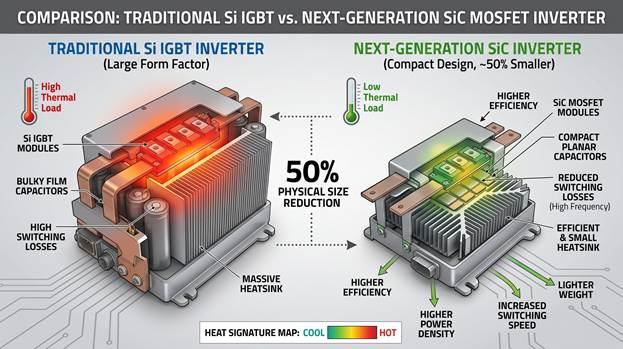
Why Eight Hundred Volts Transforms the Entire Automotive Math
To understand why an 800V architecture is an absolute game-changer for affordable vehicles, we must revisit high school physics: power equals voltage multiplied by current ($P = V \times I$). If an automaker wants to deliver 200 kilowatts of power to an EV battery using a standard 400V system, the system must pull a massive 500 amps of current.
Current is the primary culprit behind electrical resistance and thermal waste. High current demands exceptionally thick copper wiring throughout the car's internal plumbing, adding significant weight and manufacturing complexity to the vehicle.
By doubling the system voltage to 800V, the current required to deliver that exact same 200 kW of power is slashed cleanly in half to 250 amps. Because heat generation scales with the square of the current ($I^2R$), cutting the amperage in half reduces the thermal energy generated within the car's electrical systems by a staggering factor of four.
+-------------------------------------------------------------+
| THE HIGH-VOLTAGE EFFICIENCY FORMULA |
+-------------------------------------------------------------+
| 400V System: 200 kW Power / 400V = 500A Current |
| --> Generates High Heat (Requires heavy copper & cooling) |
+-------------------------------------------------------------+
| 800V System: 200 kW Power / 800V = 250A Current |
| --> Cuts Heat Generation by 75% (Enables lighter, cheaper |
| components and faster charge times) |
+-------------------------------------------------------------+
This math allows automotive engineers to pull off a series of brilliant design optimizations that are critical for driving down mid-market vehicle costs:
- Weight Reduction: Engineers can substitute thick, unyielding high-voltage copper cables for significantly thinner, lighter, and more flexible wiring harnesses. This shaves dozens of pounds off the vehicle's total curb weight, directly translating to increased driving range without adding a single battery cell.
- Compact Packaging: Because the components run significantly cooler, the size of the liquid-cooling pumps, radiators, and hoses can be aggressively downsized. This frees up precious cabin volume and structural space within a compact car or mid-sized crossover chassis.
- Regenerative Braking Efficiency: An 800V electrical system can accept much higher bursts of energy from regenerative braking systems. Instead of friction brakes throwing away kinetic energy as heat during high-speed deceleration, an 800V system captures that power and feeds it back into the battery with minimal restriction.
Ultimately, this hardware-level win resolves the single greatest hurdle to widespread EV adoption: the charging curve. In a 400V vehicle, the peak charging speed is typically a brief spike that rapidly tapers off to protect the battery pack from overheating. An 800V vehicle utilizing silicon carbide electronics can sustain a flat, high-speed charging curve for the majority of the charging session. We are moving away from an era where a driver sits at a rest stop for forty-five minutes, shifting to a world where a ten-to-eighty percent charge is achieved in twelve to fifteen minutes. That is less time than it takes to buy a coffee and use the restroom.
Mid-Market Automakers Deploy High-Voltage Platforms First
While early adopters look to premium brands for technological showcases, the real battle for global vehicle electrification is fought in the $30,000 to $45,000 price bracket. The early leaders in this transition have surprised legacy Detroit automakers. Hyundai and Kia were the first to democratize high-voltage architecture with their E-GMP platform, proving via official Kia Press Documentation on E-GMP Charging Capabilities that cars like the Kia EV6 could deliver premium-tier 10-to-80 percent charging in just 18 minutes at mainstream price points.
However, the next wave of mid-market high-voltage deployment is becoming much more aggressive. Continental European and Asian manufacturers are scaling production platforms designed specifically to eliminate the cost premium of 800V components.
A premier example of this shift arrived when Renault officially unveiled its highly flexible, mass-market 800V EV platform under its forward-looking "futuREady" strategy. As outlined in Renault Group's Platform Architecture Roadmap, the newly developed RGEV Medium 2.0 platform targets an exceptional driving range of up to 750 kilometers (approximately 466 miles), stretching to 1,400 kilometers when paired with a highly optimized range extender. By integrating silicon carbide inverters directly into its modular C- and D-segment architectures by 2028, Renault is signaling to the industry that high-voltage capability is no longer an optional luxury add-on; it is a baseline requirement for market relevance.
Concurrently, other automotive giants are executing their own mass-market transitions. BMW is rolling out its highly anticipated sixth-generation eDrive technology, baked directly into the scalable "Neue Klasse" platform. As highlighted by Edmunds' Coverage of BMW's Neue Klasse Concepts, this architecture introduces a 30% jump in charging speed and relies heavily on integrated silicon carbide power electronics and 800V systems to make high-voltage everyday driving both accessible and affordable.
Not to be outdone, Kia continues to refine its competitive positioning. During its investor updates, the automaker finalized a comprehensive strategy designed to scale next-generation high-voltage platforms rapidly into smaller, highly affordable vehicle segments across North America and Europe to hit an ambitious target of 1.2 million zero-emission vehicle sales by 2030.
Mainstream buyers can expect to see these advanced 800V platforms arriving on dealership lots in significant volumes between late 2026 and mid-2027. The vehicles hitting the market will not be exotic sports cars, but the next generations of family crossovers, compact commuter hatchbacks, and practical utility vehicles.

Projecting the Horizon for Global Critical Mass
When analyzing a technological shift of this magnitude, it is vital to separate optimistic marketing roadmaps from cold, hard market data. The transition from legacy 400V architectures to 800V standard systems is following an exponential adoption curve that mirrors the semiconductor transitions of the early 2000s.
According to a highly comprehensive market study published by Fortune Business Insights on the 800V Electric Vehicle Architecture Market, the global market valuation for 800V architecture sat at an impressive $4.98 billion in 2025. As manufacturing lines scale up and component costs drop, the market is projected to skyrocket from $7.12 billion in 2026 to a staggering $52.80 billion by 2034. This represents an extraordinary Compound Annual Growth Rate (CAGR) of 28.5% over the forecast period.
+-------------------------------------------------------------+
| PROJECTED GLOBAL 800V MARKET INDUSTRY VALUE |
+-------------------------------------------------------------+
| 2025: $4.98 Billion |
| 2026: $7.12 Billion (Current inflection point) |
| 2034: $52.80 Billion |
| --> Driven by an extraordinary 28.5% CAGR as high-voltage |
| tech transitions to mid-market platforms. |
+-------------------------------------------------------------+
Geographically, the momentum is heavily anchored in the Asia-Pacific region, which commanded a dominant 57.63% share of the global 800V architecture market in 2025. This concentration is a direct result of massive supply chain integration in countries like China and South Korea, where battery manufacturing and silicon carbide semiconductor fabrication occur in close proximity. As these component ecosystems mature, the cost advantages are being exported to western markets, forcing North American and European suppliers to adapt or face structural obsolescence.
We can project that 800V technology will achieve clear critical mass—meaning it will account for more than 50% of all new pure battery-electric vehicle sales globally—by the year 2030.
The transition will occur in a classic top-down market cascade. By 2027, the premium EV segment will have abandoned 400V systems entirely. By 2029, the economies of scale unlocked by massive component suppliers will drive the cost of an 800V silicon carbide powertrain down to absolute parity with legacy 400V systems. At that inflection point, building a 400V car will actually become more expensive for an automaker due to the specialized sourcing required for older, bulkier copper and thermal components.
Smart Buyers Vote for High-Voltage Tech Today
If you are currently in the market for an electric vehicle, the rapid emergence of affordable 800V options should radically alter your purchasing strategy. Buying a 400V electric vehicle today is the modern equivalent of purchasing a non-high-definition television right as flat-screen HDTVs began hitting mainstream prices. You are intentionally investing your hard-earned capital in a trailing technology that is facing a steep depreciation curve.
When the secondary used-car market becomes saturated with high-efficiency, fast-charging 800V vehicles in three to five years, legacy 400V cars will likely face severe drops in residual value. Used-car buyers will naturally reject vehicles that require them to spend nearly an hour tied to a fast charger when an equivalent, affordable high-voltage model can complete the task in fifteen minutes.
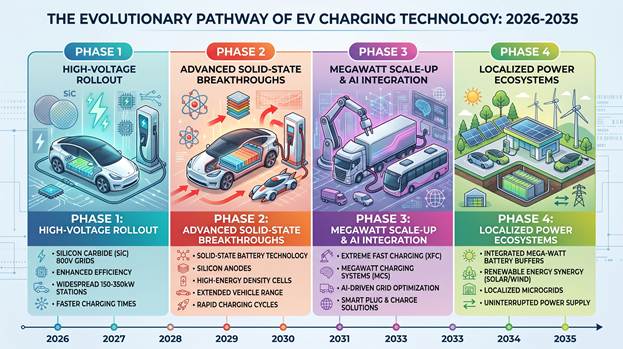
Beyond protecting your financial investment, favoring 800V technology today positions you to take full advantage of the next wave of grid and battery innovations. Silicon carbide power electronics are merely the foundational layer. What is coming next will push charging speeds down into single-digit minutes:
- Next-Generation Active Cooling: Emerging charging cables are integrating advanced phase-change cooling liquids that can absorb massive amounts of heat without increasing the cable's thickness or rigidity.
- Localized Energy Storage Matrixes: To protect regional grids from sudden spikes in energy demand, next-generation ultra-fast charging stations are being paired with localized, stationary battery storage units. These onsite packs act as an electrical buffer, trickling energy from the grid during low-use hours and blasting it into an 800V car during a fast-charge session without disturbing the local town's power grid.
- Solid-State and High-C Chemistry Integration: As solid-state battery cells move out of laboratory environments and onto production lines by the turn of the decade, their unique internal chemistry will allow them to accept raw, high-voltage energy without the structural degradation that plagues current lithium-ion cells. To keep up with these advancements, monitoring technical publications via the Society of Automotive Engineers (SAE International) provides excellent clarity on how fast-charging metrics are evolving.
An 800V silicon carbide architecture is the mandatory gateway system required to unlock these arriving technologies. Without it, your car simply cannot communicate effectively with the future of energy infrastructure.
Wrapping Up
The automotive market is sitting at a historic crossroads. For years, critics have rightly pointed out that the public charging infrastructure is too slow, too unreliable, and far too demanding on our local municipal grids. The introduction of 800-volt architectures powered by silicon carbide semiconductors elegantly dismantles these criticisms from the hardware level up. By achieving a remarkable 96.5% efficiency rate during power conversion, this technology slashes thermal waste, eliminates unnecessary vehicle weight, and delivers the ultra-fast charging experiences that mainstream consumers require.
With major automotive players like Renault, BMW, and Kia aggressively integrating these high-voltage systems into their mid-market platforms, the technology is moving quickly into the mainstream. The data confirms that this is not a short-term trend; with an estimated market expansion crossing twenty-two billion dollars by 2034, high-voltage architecture is the definitive future of transportation.
For the smart consumer, the directive is clear. Skip the legacy platforms, look past the superficial digital gimmicks, and invest in a vehicle built on an efficient, future-proof 800V foundation. Your wallet, your schedule, and the electrical grid will thank you.
Disclosure: Images rendered by Artlist.io
Rob Enderle is a technology analyst at Torque News who covers automotive technology and battery developments. You can learn more about Rob on Wikipedia and follow his articles on TechNewsWord, TGDaily, and TechSpective.
Set Torque News as Preferred Source on Google
Follow us today...