
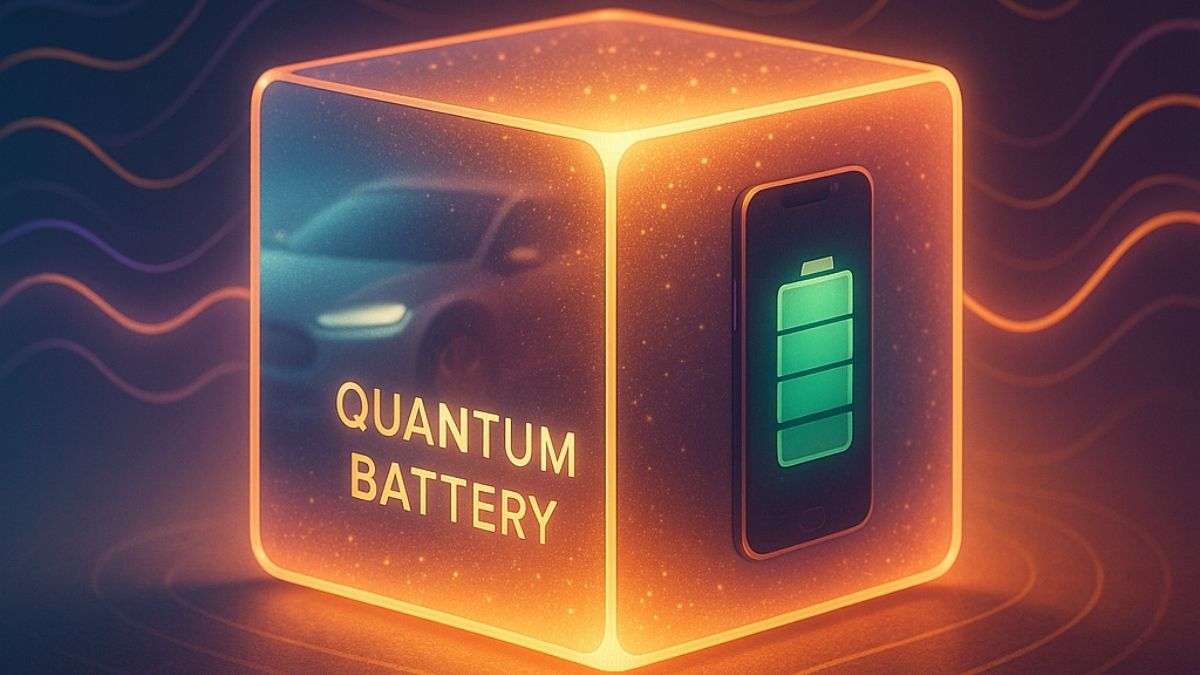

Imagine charging your smartphone just once a week. Or an electric car that can drive for a thousand miles on a single charge. This isn't science fiction anymore. This week, news broke of a revolutionary quantum battery breakthrough that could power a phone for a week on a single charge (New quantum battery breakthrough promises week-long phone charge). While still in its early stages in the lab, this technology, rooted in the bizarre rules of quantum mechanics, holds the potential to completely redefine our relationship with portable power.
This isn't just about longer battery life for gadgets; it's about fundamentally altering the energy landscape. Once scaled, this quantum leap will inevitably pivot to electric vehicles, offering ranges and charging speeds that make current lithium-ion technology look ancient. It promises to ignite a new race for adoption, potentially giving an unprecedented edge to tech-savvy EV manufacturers, especially those with roots in consumer electronics.
The Promise and Pitfalls of Quantum Power
The concept of a quantum battery relies on phenomena like quantum entanglement and superabsorption, where the battery's charge time doesn't increase linearly with its capacity. In theory, a quantum battery could charge much faster and hold significantly more energy than traditional batteries, potentially even without losing charge over time. This breakthrough signals a path to incredibly dense, stable, and long-lasting power sources.
However, like all nascent technologies, challenges abound:
- Viability at Scale: The current breakthrough is a lab phenomenon, operating on a microscopic scale. Scaling this technology from a few atoms to a smartphone-sized, let alone a car-sized, battery is a monumental engineering feat.
- Stability and Environment: Quantum states are notoriously fragile and sensitive to environmental interference (heat, vibration). Maintaining these states in real-world applications is a significant hurdle.
- Cost and Materials: The materials and processes required to create quantum batteries could be prohibitively expensive in the short term.
- Energy Source: While quantum batteries might hold and discharge energy efficiently, they still need an initial energy source to charge them.
Despite these challenges, the underlying science is compelling, and the potential rewards are immense.

The EV Revolution, Redefined: Range and Recharge Beyond Imagination
When quantum battery technology eventually pivots to electric vehicles, it will be an absolute game-changer, addressing the two biggest hurdles to mass EV adoption: range and charging time.
- "Thousand-Mile" EVs: A 40% (or more) increase in energy density could easily push EV ranges far beyond 1,000 miles on a single charge. This would eliminate range anxiety entirely, making cross-continental travel in an EV as seamless as it is with a gasoline car, if not more so.
- Instantaneous Charging: If a quantum battery can charge a phone in minutes, imagine the implications for a car. We could see charging times drop to a matter of seconds or low single-digit minutes for an 80% charge. This would make recharging an EV faster than filling up a gas tank, fundamentally altering the user experience.
- Lighter Vehicles, Better Performance: Higher energy density means less battery weight for the same range, leading to lighter, more agile EVs with improved handling, efficiency, and performance.
- Enhanced Grid Stability: With faster charging, EVs could also become a more dynamic part of grid management, able to quickly absorb or return power.
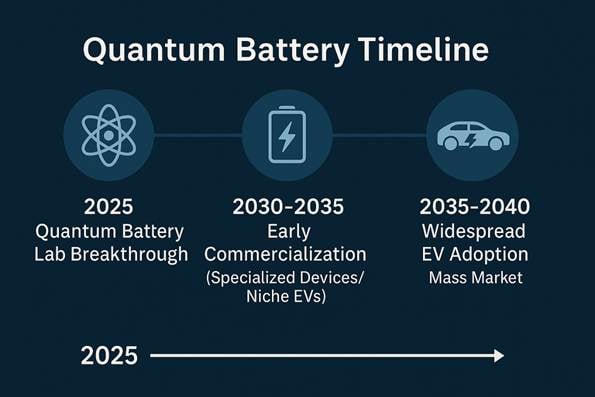
This pivot to vehicles isn't going to happen next year, or likely even in the next five years. Given the scale-up challenges, a realistic timeframe for early commercial EV applications (perhaps in premium or niche vehicles) would likely be 10-15 years out, with widespread adoption taking even longer. However, the foundational research begins the countdown.
The Race for Quantum Power: Who Will Lead the Charge?
When this technology matures, the race to integrate it will be fierce.
- Tesla: With its relentless focus on battery innovation (like the Tera-Cell) and vertical integration, Tesla is a prime candidate. They would likely want to secure exclusive access or develop their own quantum battery research.
- Traditional Automakers: Giants like Mercedes-Benz, BMW, and GM, all investing heavily in next-gen battery tech, would undoubtedly be keen to acquire or license this technology to maintain competitiveness.
- Chinese EV & Tech Giants: This is where it gets interesting. Companies like BYD, which is both a major EV manufacturer and a global battery producer, are perfectly positioned. Even more so, consumer electronics giants like Xiaomi, Huawei, and Oppo, who are now aggressively entering the EV market, have unparalleled expertise in miniaturizing and mass-producing advanced battery technology for phones. Their existing supply chains and R&D synergy between phone and car batteries could give them a unique advantage in pivoting quantum batteries to EVs early and at scale.
Beyond the Road: A Revolution Across Industries
The impact of quantum batteries wouldn't stop at EVs. This technology would revolutionize countless sectors:
- Consumer Electronics: Week-long phone charges are just the beginning. Laptops, wearables, and smart home devices would operate for vastly extended periods.
- Aerospace & Drones: Longer flight times and greater payloads for drones, advanced air mobility (AAM) vehicles, and even electric aircraft.
- Medical Devices: Implantable devices and portable medical equipment could operate for years without charging.
- Grid Storage: More compact, efficient, and stable energy storage solutions for renewable energy grids.
- Space Exploration: Powering satellites and long-duration missions with unprecedented efficiency.
Wrapping Up
The quantum battery breakthrough, promising week-long smartphone power, is far more than a niche scientific curiosity. It's a foundational advancement that will, in time, unleash an unprecedented revolution across the energy and transportation sectors. While significant hurdles remain in scaling this technology from the lab to mass production, its potential to deliver thousand-mile EVs with near-instantaneous charging is undeniable. The race to harness this power will be global, with tech-driven EV manufacturers, particularly those from China with dual expertise in consumer electronics, poised to gain a decisive advantage. The future of power is no longer just incremental; it’s quantum, and it's coming to redefine everything.
Set Torque News as Preferred Source on Google
Follow us today...







Comments
Do not add capacity to the…
Permalink
Do not add capacity to the automobile
That is unnecessary. Instead, integrate a charger into the automobile. A small 20kW power plant would allow for practically unlimited range in normal driving scenarios, a bit of storage lets you really goose it from time to time. Charge at cruise, charge ++ on the downhill. So many benefits to this!
Unlimited range,
No fuel or charging
No charging infrastructure
It’s not a storage device V2G or V2H it’s a full fledged power plant that won’t drain the storage when you need power elsewhere.