
The concept of the road trip is uniquely woven into the fabric of global transportation culture, representing far more than mere point-to-point transit. Historically, it has been defined as a journey of exploration where the transit itself is an integral part of the experiential destination. It is a manifestation of personal autonomy, allowing travelers to diverge from fixed schedules, discover regional nuances, and interact directly with changing landscapes.
At its core, a true road trip requires a vehicle capable of sustained high-speed cruising, predictable range, and a supporting infrastructure that acts as a reliable safety net rather than an obstacle course. Today, this concept is undergoing a profound structural shift as it wraps around the unique characteristics of the electric vehicle (EV). This resurgence is not driven simply by a desire to save money or project environmental responsibility; it is being propelled by the realization that modern electric drivetrains offer a fundamentally superior, less fatiguing way to travel long distances when supported by mature infrastructure.
The Historical Rise, Fall, and Structural Decay of Highway Travel
To understand why the electric vehicle is rescuing the road trip, we must first examine how the practice fell into structural decay over the last several decades. The golden era of American road tripping emerged post-World War II, catalyzed by the construction of the Interstate Highway System. It was a period defined by cheap fossil fuels, iconic roadside architecture, and a cultural obsession with automotive freedom.
However, by the late 1990s and through the early 2020s, the traditional Internal Combustion Engine (ICE) road trip experienced a massive decline. This erosion was caused by a combination of economic, psychological, and logistical stressors:
- Volatile Fossil Fuel Pricing: Surging fuel costs transformed a spontaneous weekend drive into a calculated, highly restrictive line-item expense.
- The Stress of Spatial Confinement: Legacy combustion vehicles generate constant high-frequency cabin vibrations, mechanical noise, and micro-shocks through the floorboards. Over an eight-hour driving window, this creates a phenomenon known as mechanical fatigue, leaving passengers exhausted upon arrival.
- Logistical Degradation: The interstate roadside environment became highly homogenized, characterized by fast-food drive-thrus designed for ultra-rapid turnover rather than healthy, restorative pauses.
As a result, long-distance driving transformed from an aspirational lifestyle choice into an exhausting chore, with consumers increasingly abandoning the highway in favor of commercial short-haul aviation, despite the invasive security lines and systemic delays of modern airports.
Reaching the Infrastructure Tipping Point along Major Interstates
The recent decline in highway travel has been decisively reversed by an infrastructure explosion. For the first few years of the modern EV transition, long-distance travel remained the domain of early adopters willing to endure complex routing spreadsheets and highly unreliable third-party charging networks. That experimental phase is officially over.
According to data compiled by the Joint Office of Energy and Transportation, the national charging footprint has crossed an aggressive tipping point, now boasting over 288,000 public charging ports across 95,000 highly visible locations in the United States. This rapid expansion is heavily reinforced by the National Electric Vehicle Infrastructure (NEVI) formula program, which mandates and funds the installation of ultra-fast DC charging stations every 50 miles along designated Alternative Fuel Corridors, closely hugging major interstates.
[National Charging Footprint - Key Metrics]
├── Total Public Charging Ports: 288,000+
├── Total Public Charging Locations: 95,000+
└── NEVI Infrastructure Mandate: Ultra-fast DC stations every 50 miles
Crucially, the industry-wide consolidation around the North American Charging Standard (NACS) / SAE J3400 has unlocked previously closed networks, providing drivers with unprecedented reliability and redundancy. Range anxiety has been systematically replaced by digital certainty. Modern trip-planning algorithms, such as those integrated into Google Maps and specialized applications like A Better Routeplanner (ABRP), communicate directly with the vehicle’s battery management system (BMS). They monitor real-time state of charge (SoC), ambient temperatures, elevation changes, and actual dispenser uptime to deliver precise, stress-free route guidance.
The Most Exceptional American Highway Routes Unlocked for Modern EVs
With the charging network operating at critical mass, travelers can now comfortably execute iconic long-distance itineraries across North America without fear of infrastructure failure. These routes are fully supported by high-output DC fast chargers capable of replenishing high-voltage architectures in the time it takes to walk into a rest stop.
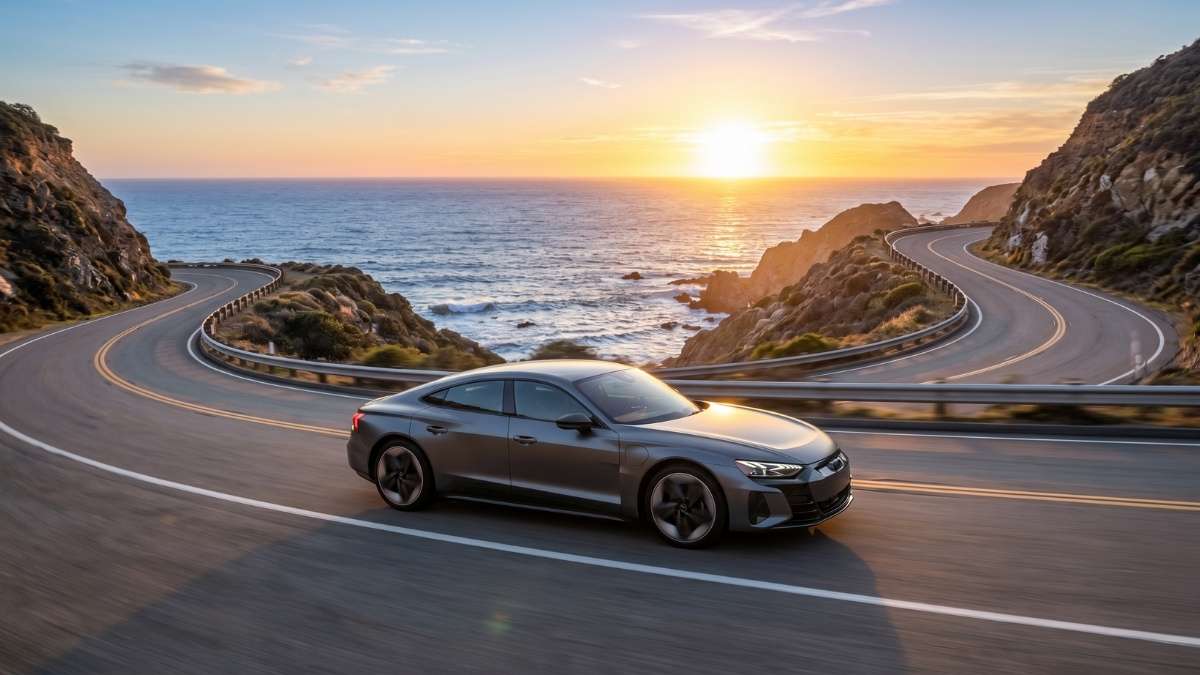
The Pacific Coast Highway (California Route 1): Running from Southern California through the rugged cliffs of Big Sur up to the Pacific Northwest, this route is densely packed with high-capacity fast chargers. The continuous regeneration opportunities provided by down-hill braking along coastal curves continuously feeds energy back into the battery pack, optimizing real-world efficiency.
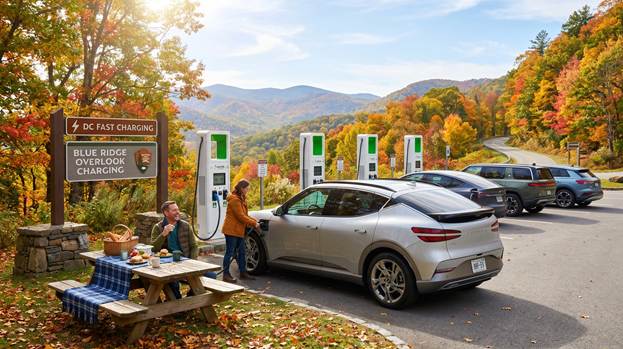
The Blue Ridge Parkway: Wending through the Appalachian Mountains, this historically remote route is now flanked by robust charging hubs in adjacent mountain towns. Drivers can experience dramatic elevation changes while utilizing the massive torque of an electric motor to effortlessly glide up steep grades without the engine strain, downshifting noise, or altitude power loss common to combustion vehicles.
The Great Autumn Crossing (I-90 Corridor): Running through the northern tier of the United States, this massive corridor once presented a significant challenge for early electric vehicles. Today, the systematic deployment of NEVI-funded multi-stall stations guarantees that even the most remote stretches across Montana, Wyoming, and the Dakotas feature well-maintained, high-kilowatt dispensers capable of handling severe weather driving.
Why an Electric Vehicle Delivers a Markedly Superior Touring Experience
The argument for electric vehicle road tripping extends far beyond environmental metrics or operating costs. When analyzed from a product and lifestyle perspective, an EV offers a luxury grand touring experience that no internal combustion car can match.
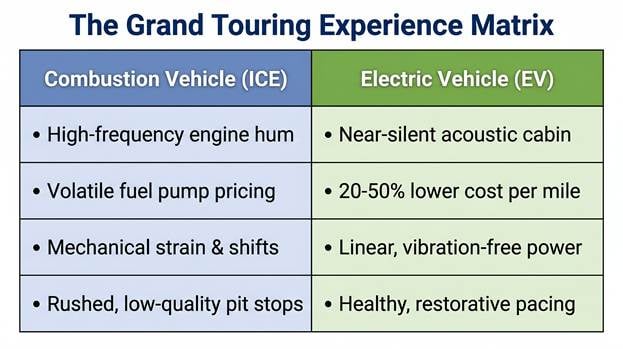
The most profound differentiator is cabin acoustics and vibration-free operation. Internal combustion engines rely on thousands of controlled explosions per minute, translating into constant low-frequency noise and structural vibrations that continuously assail the human nervous system. EVs operate in near-silence, drastically lowering driver stress and cognitive fatigue over multi-hour stints. Recent commercial fleet transport studies have validated this, showing that a vast majority of drivers report noticeably lower fatigue directly attributed to reduced cabin noise. As documented by wellness insights published on the American Lung Association's Each Breath Platform, this absence of acoustic pollution creates a calm, conversational sanctuary inside the vehicle, allowing premium audio systems to perform with absolute clarity.
Furthermore, the economic advantages are stark. Operating an EV on a long-distance journey reduces fuel costs per mile by 20% to 50% compared to volatile gasoline prices. Additionally, because electric architectures completely eliminate complex mechanical systems like multi-speed transmissions, valvetrains, exhaust systems, and engine oil loops, the probability of a catastrophic thermal or mechanical failure mid-trip is dramatically reduced.
Finally, the charging routine itself actively enforces a healthier, more civilized travel cadence. Rather than conducting rushed, toxic fueling stops at traditional gas stations, EV drivers plug in and step away. Because modern high-output dispensers are strategically colocated with premium dining, retail, and recreational areas, the charging window matches the natural human need to stretch, walk, and rest. This structural pause significantly mitigates the physical risks associated with prolonged sitting during long drives, transforming the journey from a grueling endurance marathon into an enjoyable lifestyle experience.
The Global Landscape of Zero-Emission Long Distance Travel
While the resurgence of highway touring is making massive waves across the United States, the phenomenon is unfolding with distinct characteristics on the global stage.
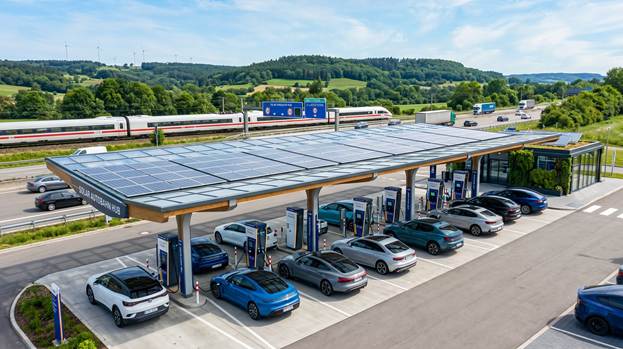
In Western Europe, the deployment of the Alternative Fuels Infrastructure Regulation (AFIR) has created a highly unified cross-border charging grid. European highway touring often involves traversing multiple countries in a single day, supported by mandatory roaming agreements that allow a single smartphone application or RFID card to activate dispensers from the tip of Italy to the north of Norway. The density of the European network allows for shorter, highly frequent charging stops that perfectly complement the compact geography and historic highway rest stops of the continent.
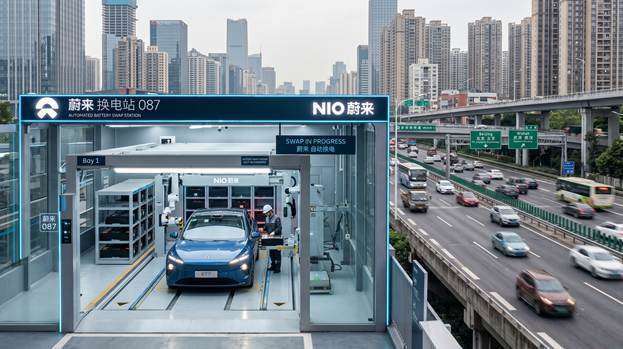
Conversely, in regions like China, the market has expanded through a dual approach: massive deployments of ultra-high-speed DC fast chargers alongside a rapid proliferation of automated battery-swapping stations built by companies like Nio along primary national expressways. This allows long-distance travelers to choose between a standard 15-minute charging rest break or a fully automated three-minute mechanical battery swap, mirroring the legacy refueling timeline while retaining all the operating benefits of an electric drivetrain.
When contrasted with these global regions, the United States trend remains distinctly shaped by vast geographic distances, larger vehicle form factors, and an emphasis on destination-based charging at premium national parks, remote resorts, and historic highway corridors.
Wrapping Up
The ongoing revitalization of the great highway road trip is a classic example of technology shifting consumer behavior by offering a demonstrably better experience. By combining a silent, vibration-free cabin with an interstate charging network that has firmly achieved critical mass, the modern electric vehicle has successfully decoupled long-distance travel from its historical stressors.
As public infrastructure continues to expand under federal initiatives and unified hardware standards, the artificial barriers to zero-emission long-distance travel have collapsed. The contemporary road trip is no longer about managing range limitations or enduring mechanical fatigue; it is about rediscovering the open highway with a level of comfort, intelligence, and performance that represents the absolute pinnacle of modern automotive engineering.
Disclosure: Images rendered by Artlist.io
Rob Enderle is a technology analyst at Torque News who covers automotive technology and battery developments. You can learn more about Rob on Wikipedia and follow his articles on TechNewsWord, TGDaily, and TechSpective.
Set Torque News as Preferred Source on Google
Follow us today...