
The global automotive sector is undergoing a massive, structurally jarring realignment. The legacy players in Detroit, Stuttgart, and Tokyo are rapidly running out of time to adapt to this new reality. For years, Western automakers treated electric vehicles (EVs) as a regulatory compliance exercise or an overpriced luxury novelty. They aggressively protected their legacy internal combustion engine (ICE) margins while simultaneously outsourcing critical battery supply chains and software development to third-party vendors. That strategic miscalculation is now coming due, and the market is punishing them for it.
China’s leading EV manufacturer, BYD, is executing an aggressive global expansion strategy that leaves little room for complacency. They are shifting away from simply competing on rock-bottom pricing toward completely dominating on core technological merit. The arrival of the newly updated BYD ATTO 3 EVO serves notice that the second wave of the EV transition has officially arrived. This era is defined not by superficial styling gimmicks, but by deep structural engineering, software-driven efficiencies utilizing highly optimized execution-layer automation, and advanced high-voltage architectures that drastically reduce vehicle charging friction.
Decoding the Engineering Behind the BYD ATTO 3 EVO
When the original ATTO 3 arrived on the global scene, it was a respectable but relatively conservative entry-level front-wheel-drive crossover built on a standard 400-volt electrical foundation. It was constrained by a modest peak DC charging acceptance rate of roughly 88 kW. However, the new ATTO 3 EVO represents a complete, deep-tissue engineering overhaul that essentially swaps out the entire structural backbone of the vehicle.
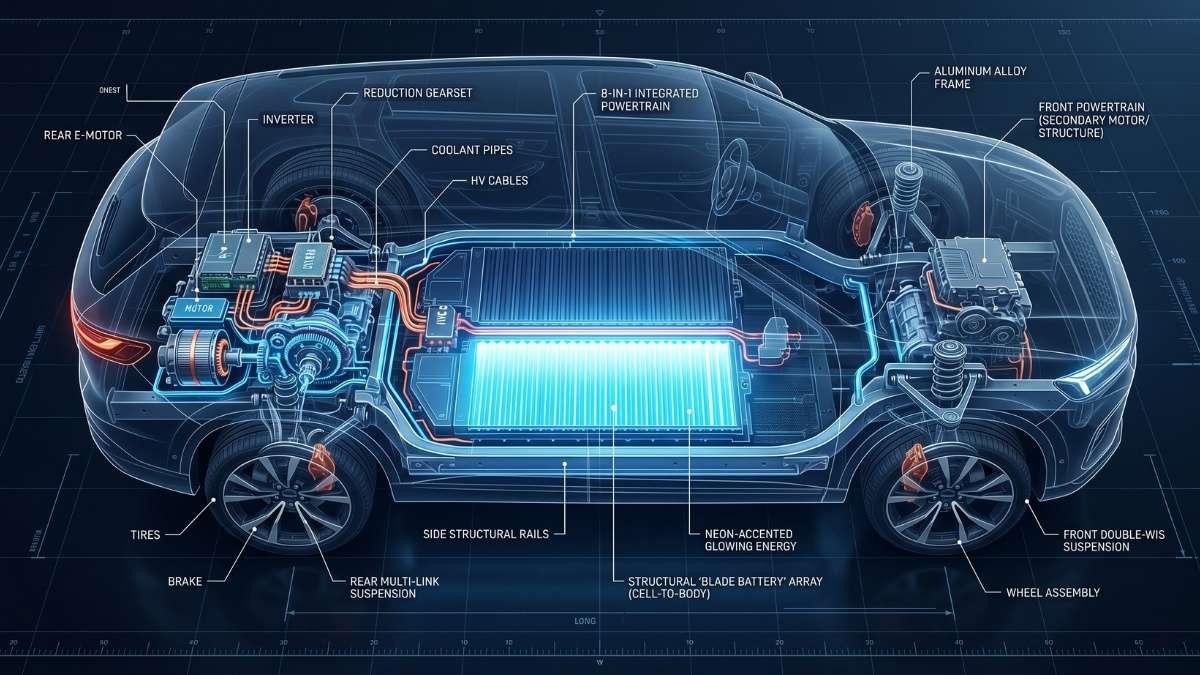
By migrating the crossover to its advanced, high-voltage e-Platform 3.0 Evo, BYD transitioned the powertrain configuration to a much more dynamic, performance-oriented rear-wheel-drive setup, with an available dual-motor all-wheel-drive system. More importantly, they integrated a massive 74.88 kWh proprietary Lithium Iron Phosphate (LFP) Blade Battery directly into the frame using Cell-to-Body (CTB) structural packaging. Rather than encasing battery cells into modules, and modules into a heavy standalone pack, the cells themselves serve as load-bearing structural elements of the vehicle's floor pan. This engineering shift vastly improves torsional rigidity, maximizes cabin packaging efficiency, and increases the rear cargo area to 490 liters alongside a new 101-liter front trunk (frunk).
The base rear-wheel-drive variant now pushes out 230 kW of power and 380 Nm of torque, rocketing from 0 to 100 km/h in a swift 5.5 seconds. The dual-motor Excellence trim dials that up to a staggering 330 kW (443 horsepower), cutting the sprint time to just 3.9 seconds. The vehicle also implements highly sophisticated execution-layer automation to handle power distribution, thermal management, and advanced driver assistance systems (ADAS), avoiding the unnecessary complexity and inherent unpredictability of cognitive agentic AI for core driving functions.
Iconic BYD Electric Vehicles Outpacing Western Rivals
The ATTO 3 EVO does not exist in a vacuum; it is part of a broader, highly synchronized product offensive. BYD is systematically dismantling the competitive advantages of established Western automakers across multiple vehicle segments by offering technically superior products.
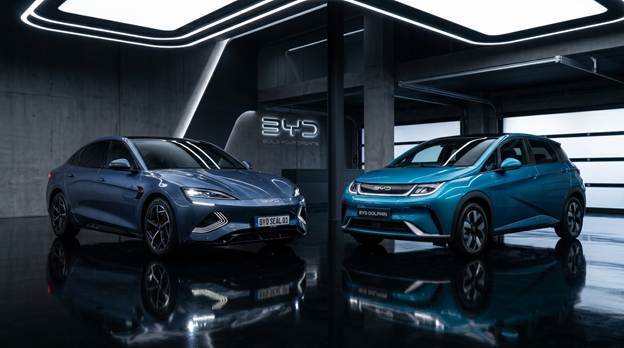
Consider the BYD Seal, a mid-size electric sedan designed to compete directly with the Tesla Model 3 and the BMW i4. The Seal leverages the same Cell-to-Body architecture and an innovative 8-in-1 electric powertrain that integrates the motor, transmission, inverter, and onboard charger into a single, compact unit. This level of component integration results in higher energy efficiency and significantly less weight. While the Tesla Model 3 remains a formidable competitor, BYD's aggressive pricing, combined with a vastly superior interior material quality and standard features, makes the Seal an incredibly compelling alternative in the European and Asian markets.
Similarly, the BYD Dolphin is applying immense pressure to the European compact hatchback segment, directly challenging the Volkswagen ID.3. The Dolphin offers a highly efficient heat pump as standard equipment—a feature that many European automakers still relegate to the options list. By utilizing their proprietary LFP Blade Battery technology, which has safely passed rigorous nail penetration tests without thermal runaway, BYD provides a level of safety and longevity that older NCM (Nickel Cobalt Manganese) battery chemistries struggle to match.
Why Fast Charging Has Become the Ultimate Product Differentiator
In the early phases of the modern EV transition, raw driving range was the primary metric used to evaluate incoming products. Automakers engaged in an expensive, heavy race to pack ever-larger battery packs into vehicles to combat consumer range anxiety. However, adding more physical cells introduces a compounding engineering penalty: it increases vehicle weight, degrades handling dynamics, increases structural crash-protection demands, and severely drives up retail costs.
The industry is rapidly discovering that charging speed, rather than raw battery capacity, is the true key to unlocking widespread consumer adoption. According to a comprehensive market analysis by Fortune Business Insights on the 800V Electric Vehicle Architecture Market, the global migration toward high-voltage systems is accelerating at an exponential rate. Operating a vehicle's electrical system at 800 volts or higher yields profound physical and economic advantages.
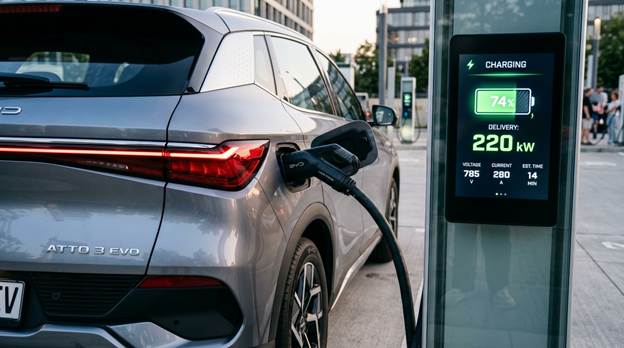
By operating at a high-voltage threshold approaching 800V, the ATTO 3 EVO more than doubles its peak DC fast-charging capacity to 220 kW. This upgrade allows drivers to recharge from 10% to 80% capacity in an impressive 25 minutes. Based on Joule's First Law, electrical heat loss in a conductor is proportional to the square of the current. By doubling an EV’s operating voltage, engineers can cut the electrical current in half while delivering the exact same total power output. Lower current translates to significantly less heat generation, allowing automakers to swap out thick, heavy, liquid-cooled copper wiring harnesses for thinner, lighter, and far less expensive alternatives.
Furthermore, high-voltage platforms dissipate heat far more effectively, maintaining elevated charging speeds across a broad portion of the state-of-charge curve. Traditional 400V vehicles frequently hit their advertised peak charging speeds for only a few fleeting moments before thermal saturation forces the battery management system (BMS) to aggressively throttle power delivery. Slashing DC fast-charging times bridges the operational gap between an EV and an ICE vehicle, making long-distance road trips seamless and practically eliminating charging friction.
Chinese Competitors Pushing the Charging Advantage
BYD is far from the only Chinese automotive heavyweight utilizing high-voltage charging systems to disrupt the global marketplace. A fast-moving cohort of domestic players is aggressively deploying next-generation platforms that make many current Western luxury EVs look technologically obsolete.
XPENG has systematically deployed its SEPA 2.0 architecture across its lineup, showcasing models like the G6 and G9. Operating on a true 800V silicon carbide (SiC) platform, these vehicles can add up to 300 kilometers of range in roughly 10 minutes when connected to high-power infrastructure. Similarly, Zeekr—the premium EV arm of Geely—has pushed charging technology to its absolute physical limits. The Zeekr 001 sedan utilizes an advanced 800V system paired with new lithium iron phosphate battery chemistries that accept peak charging rates exceeding 500 kW.
When contrasted with these rapid charging cycles, legacy Western platforms are struggling to keep pace. Volkswagen's mainstream MEB platform remains rigidly anchored to a 400V architecture, and Ford’s popular Mustang Mach-E is limited to a 150 kW peak ceiling. These engineering choices mean Western drivers spend significantly longer hooked up to highway fast chargers compared to consumers driving next-generation Chinese hardware.
Beyond Batteries: BYD’s Unmatched Competitive Advantages
The ultimate competitive question looming over the automotive sector is whether BYD has permanently eclipsed Tesla as the global EV leader. While Tesla historically held an ironclad grip on global battery-electric vehicle (BEV) volume, the market dynamics have fundamentally shifted. BYD's total volume - when combining pure BEVs and its high-efficiency plug-in hybrids—frequently outpaces Tesla on a quarterly basis.
BYD’s most formidable competitive advantage is its absolute mastery of vertical integration. Unlike traditional automakers that function primarily as vehicle assemblers, BYD is a battery manufacturer, a semiconductor fabricator, and a motor builder. They control nearly their entire supply chain, from raw material processing to final vehicle assembly. This insulates BYD from global supply chain shocks and allows them to iterate on new technologies at a pace that legacy automakers simply cannot match. While Tesla relies heavily on tier-one suppliers like Panasonic and CATL for battery cells, BYD produces its own Blade Batteries, allowing them to dictate the form factor, chemistry, and structural integration of their power storage systems.
Furthermore, BYD has demonstrated a shrewd understanding of automotive software. Rather than pursuing overly ambitious and often problematic fully autonomous systems reliant on experimental AI, BYD has focused heavily on robust, deterministic execution-layer automation. This ensures that critical vehicle systems—from traction control to thermal battery management—operate with flawless reliability, enhancing safety and efficiency without over-promising on self-driving capabilities that the market and regulators are not yet ready to fully embrace.
The Apex of BYD Engineering and What Comes Next
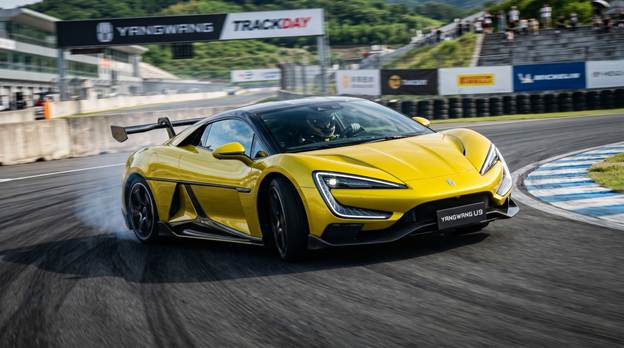
To truly understand where BYD is heading, one must look at their ultra-luxury sub-brand, Yangwang. The Yangwang U8 off-road SUV and the Yangwang U9 supercar represent the absolute apex of BYD's engineering capabilities and serve as a technological showcase for the rest of the industry. The U8 utilizes an astonishing quad-motor setup, delivering over 1,100 horsepower and allowing the massive SUV to perform 360-degree tank turns on its own axis. It even features an emergency flotation mode, allowing the vehicle to navigate deep water in extreme survival scenarios.
The Yangwang U9 supercar pushes the envelope even further, showcasing BYD’s revolutionary DiSus Intelligent Body Control System. This advanced active suspension technology allows the U9 to maintain a completely flat cornering posture, actively lift individual wheels over obstacles, and even drive on three wheels in the event of a catastrophic tire failure.
Looking forward, BYD is aggressively pursuing the next generation of energy density. While their LFP Blade Batteries currently offer an unparalleled mix of safety and cost-effectiveness, the company is deeply invested in the commercialization of solid-state batteries. These future power units promise to double the energy density of current lithium-ion packs while simultaneously reducing the risk of fire and vastly decreasing charging times. As BYD rolls out these advanced technologies, the competitive gap between them and the legacy automakers will only continue to widen.
Wrapping Up
The launch of the BYD ATTO 3 EVO is not merely a mid-cycle refresh; it is a profound declaration of intent. By democratizing 800V charging architectures, leveraging brilliant cell-to-body structural engineering, and utilizing highly efficient execution-layer automation, BYD is setting a new baseline for what consumers should expect from an electric vehicle.
Legacy automakers can no longer rely on brand heritage to command a premium in the marketplace. The Chinese EV vanguard, led decisively by BYD, but closely followed by aggressive innovators like XPeng and Zeekr, has shifted the competitive paradigm. The race is no longer simply about building an electric car; it is about mastering the deep, complex integration of high-voltage electronics, software, and advanced manufacturing. Those who fail to adapt to this new reality will rapidly find themselves rendered obsolete in a market that refuses to slow down.
Disclosure: Images rendered by Artlist.io
Rob Enderle is a technology analyst at Torque News who covers automotive technology and battery developments. You can learn more about Rob on Wikipedia and follow his articles on TechNewsWord, TGDaily, and TechSpective.
Set Torque News as Preferred Source on Google
Follow us today...