
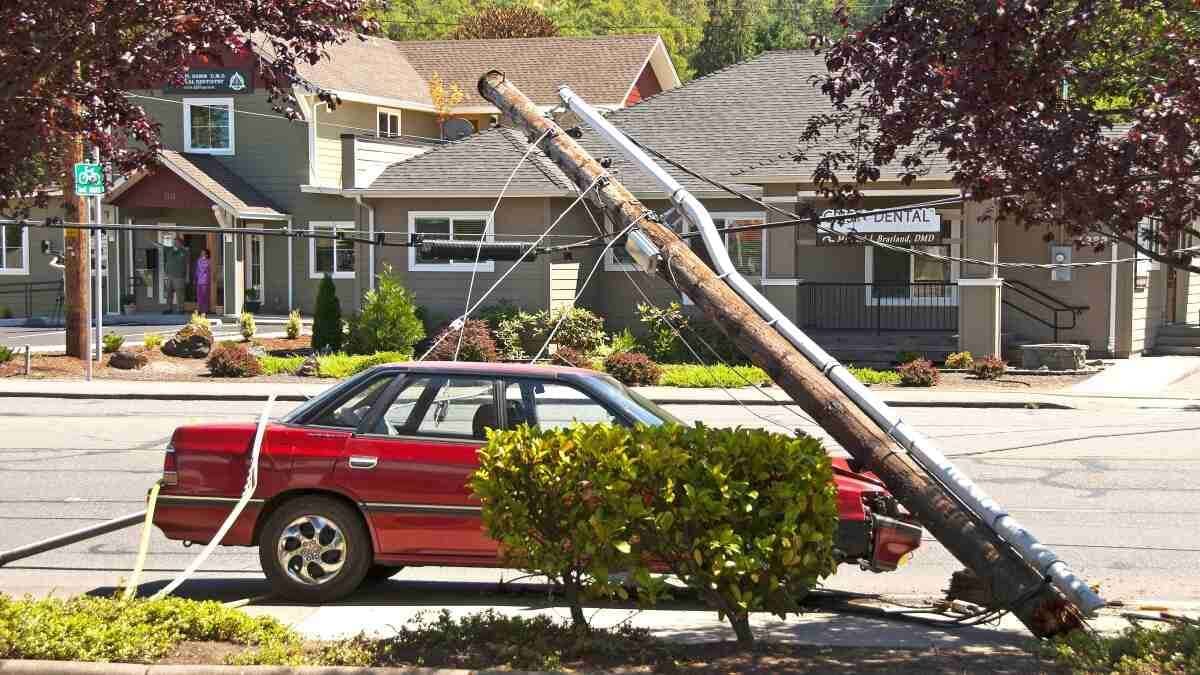

What seems like an insult to an injury is that you could be held accountable for a car accident that damaged an electric pole, a guard rail, or even a road sign. That was what one car owner discovered two years after an accident that totaled his car in a post titled "I hit a pole in 2023, I had collision coverage. Just got a bill from the electric company for 24 thousand."
"Hello, so I had Geico insurance at the time and had full coverage on a financed car. I ended up swerving off the road for a biker that rode across the road, and I ended up hitting a pole knocking it down.
It was a 1230 and there were no cameras or anything. It ended up being my fault. But it was covered by insurance… I had gap coverage and Geico paid out the amount the vehicle was worth and gap covered the rest. The car was a total loss.
Two years later, I get a letter from the electric company for $24,000 saying this is what I owe. I had full coverage and collision insurance, and I have not heard from Geico since they dropped me. But I had full coverage. Is Geico expecting me to pay for the pole even though I had insurance with them? Or is this more of a mixup between the electric company and my old car insurance?
This scares me; I can't afford this."
As it turns out, the OP does have a lot to worry about but should not panic just yet.
Related article: This Is a Story That Breaks My Heart That a Very Good Toyota Rav4 Customer Had To Go Through
Understanding Your Insurance Policy
From the comments in the discussion thread, one important factor stands out: car owners who do not understand their insurance policy as well as they should.
One standout misunderstanding is the definition and separation of what is full coverage, collision insurance, and minimum liability insurance. In short, some insurance policy owners believe that full coverage means it covers everything when, in truth, it does not and/or covers less than they believe.
Here’s an instructive summary about car insurance basics:
1. Liability Insurance: In short, it covers medical expenses, lost wages, and legal fees if you injure someone in an accident. For example, you run a red light and hit another car. The driver is injured and goes to the hospital. Your bodily injury liability pays for their medical bills and any lawsuit they might file.
2. Property Damage Liability: This one covers damage you may have caused to someone else's property (e.g., their car, fence, building). For example, you accidentally hit a parked car. Your property damage liability pays to repair that car.
From 1 and 2, there are three components to car insurance liability coverage with limits:
- Bodily injury coverage per person
- Bodily injury coverage per accident
- Property damage coverage per accident
These limits are usually expressed as a series of numbers, such as 15/30/10.
For example, let's pretend that you collided with a van carrying several passengers. With the hypothetical limits, your liability coverage would pay up to $15,000 per person for bodily injuries caused to people in the van but no more than $30,000 in total bodily injury costs for the incident. You'd also be covered for up to $10,000 in property damage.
The point to remember is that this is the typical "minimum" level of insurance required by most states. However, the numbers per category can and do vary.
3. Collision Insurance: This one is for your car and covers damage to your own vehicle from a collision, regardless of fault. For example, you back into a pole and damage your bumper. Collision coverage pays to repair your bumper minus your deductible.
4. Comprehensive Insurance: This part of a policy covers non-collision-related damage to your vehicle, like theft, vandalism, and hail. For example, a tree branch falls on your car during a storm and cracks your windshield. Your comprehensive insurance pays for the damage.
5. Full Coverage Insurance: This is the one that gets misunderstood the most but is a common term used to describe a policy that includes the four aforementioned policies listed. For example, you hit a deer (comprehensive) and then rear-ended another car the next month (collision). With full coverage, both incidents are typically covered.
6. Uninsured/Underinsured Motorist Coverage: This one is a safety net for you from other drivers with no insurance or not enough. For example, someone with no insurance runs a stop sign and hits your car. Your uninsured motorist coverage pays for your injuries or car repairs.
7. Medical Payments (MedPay) / Personal Injury Protection (PIP): Another safety net, this one covers your medical bills and sometimes lost wages, no matter who is at fault. For example, you break your arm in a car crash and MedPay or PIP helps pay hospital costs and wages lost from missed work.
Aside from the year and model of your car, your age, your credit report, etc. the seven components of a car insurance policy listed above can possess a range of coverage limits and deductibles, and therefore, determines how much you pay in premiums.
For example, if you select a bodily injury liability coverage of $25,000 per person / $50,000 per accident versus a coverage of $100,000 per person / $300,000 per accident, you will pay less for the first option and more for the second option.
The benefit of choosing the higher option is that it could save you from paying thousands out-of-pocket.
Which brings us back to the point of this article: Insured car owners who choose the lowest possible property damage liability by going with the state mandated minimum coverage might actually be hurting themselves financially.
"Most people (who don't understand insurance) are short-sighted and only care about the lowest monthly premium they can pay. The state insurance commissioner also doesn't want to listen those same people complain about rates. They don't understand what it actually means in the context of an accident, claim, or their financial security. Working claims with that level of coverage was easy though." ―Former Ato/Arb/DVC adjuster
In most states, the minimum property damage coverage is $25,000. However, in some states like Massachusetts and New Jersey, it is $5,000―nowhere near the amount needed for a power line pole bill:
This happened to me as well. I was involved in a hit and run which totaled my car and smashed a guardrail. Few months later I get a 5k bill for the repair of the guardrail.―chuck-u-farley
I hit a pole on my PC800, insurance covered the 1st 50k to replace the pole and I owed the remaining 1200 bucks. ―Lower-Ad-6952
The OP appears to be bewildered by the fact that colliding with an electrical pole is something he can be billed for and that the billing can arrive years after an accident.
Post responses tell him that the delay in the billing is not unusual and the reason why the bill was sent to him rather than his insurance provider is that his contact info came from the original police report.
Thread Responses Offer Good Advice
The best responses were those that advised the OP to contact his previous insurance provider with the bill from the electric company and find out how much coverage he had at the time of the accident for property damage.
CALL GEICO―lerriquS_terceS (arbitration adjuster 10-yr experience)
Send it to your insurance, it should be covered under liability. If you have limits greater than the demand you should be good. But, if there is shared ownership of the pole they will be able to figure it out. As long as the policy was in force for the date of loss you should be good. ―Animendo
Make sure every time you speak to Geico to say that you are recording the conversation if you can. Since it's a couple years back, they sometimes have been known to try and ignore claims like that. When they say all calls are recorded, say I'm on a recorded line as well or start by saying hi my name is such and such on a recorded line. Just a recommendation as an insurance agent. This is what I do for my clients. ―Prestigious-Cup6119
Final Thoughts: The odds are good that Geico will honor the OP's policy but for the OP's concerns, it really depends on how much property damage liability he had signed up for that may or may not cover the $25,000 bill.
If there is one take-away from his experience, it is to be aware that the property damage liability component of your car insurance policy is nothing to make light of. Just a little more coverage could save you from an unexpected debt. If you are in an accident that involves property damage, be sure to check your policy and contact your insurance agent for documentation so that you will have a paper trail the courts can follow should a bill arrive in the mail and your ex-insurer is less than cooperative.
Have you ever been in an accident and received an unexpected bill for property damage? If so, tell us about it in the comments section below and how it worked out for you.
For additional car insurance-related articles, here is one that is almost unbelievable: “Fake Bear Video Footage Used to Scam Car Insurance Company”
Timothy Boyer is an automotive reporter based in Cincinnati who currently researches and works on restoring older vehicles with engine modifications for improved performance. He also reports on modern cars (including EVs) with a focus on DIY mechanics, buying and using tools, and other related topical automotive repair news. Follow Tim on Twitter at @TimBoyerWrites as well as on Facebook and his automotive blog "Zen and the Art of DIY Car Repair" for useful daily news and topics related to new and used cars and trucks.
Image Source: Deposit Photos
Set Torque News as Preferred Source on Google
Follow us today...




Comments
That’s like an 1985 Subaru.
Permalink
That’s like an 1985 Subaru.
No way this story is for…
Permalink
In reply to That’s like an 1985 Subaru. by Chris Gilliland (not verified)
No way this story is for real…
Not so unbelievable…
Permalink
In reply to No way this story is for… by Elias T. Pancake (not verified)
Not so unbelievable. According to Edison International in California "You’ve probably seen Transmission & Distribution crews working to repair or replace power poles hit by a car. What you don’t see is what happens after the repairs. Southern California Edison’s Claims Department takes over. Vehicles hit poles approximately 2,500 times per year, and the cost of replacement ranges from $7,500 for a street light to $100,000 for a transmission pole."
And that was 15 years ago!
Good eye. Yeah, the OP did…
Permalink
In reply to That’s like an 1985 Subaru. by Chris Gilliland (not verified)
Good eye. Yeah, the OP did not mention what vehicle he had so a stock photo demonstrating the scenario is appropriate.
You had gap coverage on that…
Permalink
You had gap coverage on that? Interesting fellow
All this person needs to do…
Permalink
All this person needs to do is send the letter back to the power company with Geico's customer service number, that's all.
Yep...and then go from there…
Permalink
In reply to All this person needs to do… by Buzz Wired (not verified)
Yep...and then go from there. Depending on how much property damage coverage he has and if there are any extenuating circumstances it could go either way for the OP.
One assumes that as the…
Permalink
One assumes that as the incident was not covered by the insurance that they will not be increasing the premium as the risk is not increased.
Hello Tim, I hate to push…
Permalink
Hello Tim, I hate to push back. I read the attached article. This information is not correct. Auto liability insurance pays for the insured's liability of damage to a person or physical property. The only limitation I see in this scenario would be the total limit of coverage but not the scope of the coverage. 24k seems like most any liability policy would have a high enough limit to cover this. Most mandated minimum limits are 25k or more. I don't know all the particulars but this situation does not even seem remotely in the gray area of coverage. It should be absolutely covered and if the insurer failed to pay, there is something else here not disclosed....or the policy holder needs to sue the insurer for bad faith. (One last "technical" point: collision coverage is for damage to the insured's vehicle. Liabilty coverage would respond for the pole.)
No problem, you are not…
Permalink
In reply to Hello Tim, I hate to push… by Phill Gallbraight (not verified)
No problem, you are not pushing.
We do not know ALL of the particulars of what happened nor what the OP's policy actually says and covers in this situation.
However, Edison International in CA does state on their website "Vehicles hit poles approximately 2,500 times per year, and the cost of replacement ranges from $7,500 for a street light to $100,000 for a transmission pole." The point of the article is that, with the possibility of property damage in an accident, carrying more than the state's minimum property damage liability might not be such a bad idea.
Thanks for the input.
If your policy had minimal…
Permalink
If your policy had minimal liability coverage, the actual price to replace the power pole may have been $64,000 and your insurer covered $40k.
Yes, for all we know from…
Permalink
In reply to If your policy had minimal… by Paul Prorok (not verified)
Yes, for all we know from the info provided, the OP's insurance company may have already applied his property liability coverage and the Electric company is seeking the remainder.
Hope that is not the case for the OP, but he does need to talk to his former provider about this.
It’s called Property Damage…
Permalink
It’s called Property Damage and it’s part of your policy. States have minimum requirements, but it’s good to consult your agent. Accidents happen and that’s why you should make sure you’re properly insured.
Light poles, yard fencing,…
Permalink
In reply to It’s called Property Damage… by David Laughter (not verified)
Light poles, yard fencing, parked cars, motorcycles, pets, etc., there are a lot of potential targets for property damage.
The only time I got hit with one was backing my car under blinding Arizona sunlight from my doorway right into the side of a neighbor's car all because he wanted to park his black car in the shade in front of my driveway. I was at fault, but man was I pissed!
Lots of info left out of the…
Permalink
Lots of info left out of the story, like is there an excess issue in relation to the Property Damage coverage on the policy that covered the vehicle? That would be the first reason a company would not cover the loss when they are accepting liability.
Unfortunately not all facts…
Permalink
In reply to Lots of info left out of the… by Jeff Macintosh (not verified)
Unfortunately not all facts are provided or always reliable. However, regarding a possible excessive charge issue from the Electric Co. the numbers do not sound unbelievable. Remember some months ago when some yahoo shot at a transformer station in the U.S. and it was pointed out that this was a real security risk for terrorism because not just the enormous cost, but the availability of replacement transformers could take months if not years?! I can see a single power pole accident racking up an unexpected bill.
How about you learn how to…
Permalink
How about you learn how to drive safely, get off the phones, remove the ear buds, stop putting on makeup, stop eating while driving, etc. and just pay the hell attention to driving, after all, you are not on your couch when driving a vehicle!
Yep, that and stupid stunts…
Permalink
In reply to How about you learn how to… by Kevin K (not verified)
Yep, that and stupid stunts. I've seen a few articles where someone admitted to braking on an icy patch of road to see if they could steer out of it only to wind up taking out an electric pole in the process.