
Let me confess something right off: whenever I walk up to a full-size luxury SUV, especially one with a pedigree like Infiniti’s, there’s a moment of hesitation. Will it feel dated? Overblown? Will it sound like grandma’s recliner on wheels?
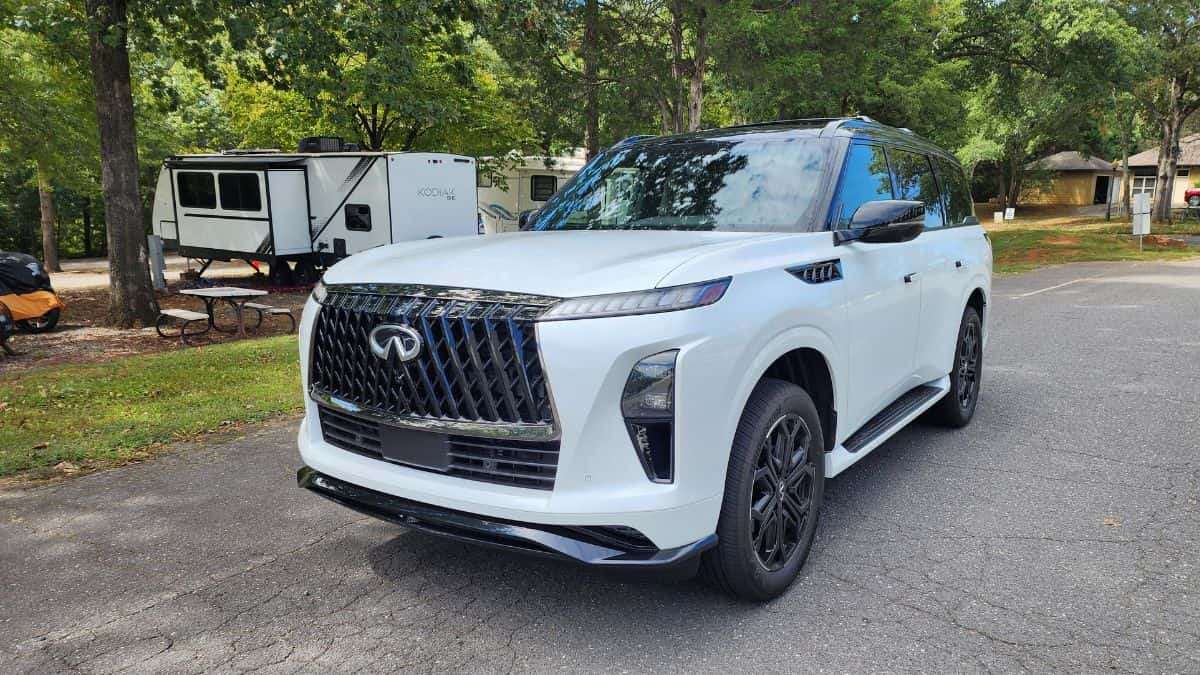
With the 2026 Infiniti QX80 Sport, that moment doesn’t last long. There’s a presence to it — a commanding silhouette in the driveway, dark accents that whisper “mature muscle,” and just enough menace in the grille that you think: maybe this is more than just a luxury cruiser. That’s how the tension sets in. And by day two of my seven-day drive, the question I kept asking myself was: Can a vehicle this large, with this much weight, still surprise you with poise and refinement?
In short: yes. The 2026 QX80 Sport is one of the rare full-size SUVs that balances gravitas and finesse — not perfectly, but in ways that are meaningful. Over this review, I’ll walk you through what’s new, what’s familiar, and what parts of the package truly elevate the experience.
What’s New in the 2026 Infiniti QX80 Sport
Let’s address the elephant: the Sport trim is new for 2026. It replaces last year’s Sensory trim as Infiniti’s penultimate offering, sliding between Luxe and Autograph in the hierarchy. Critics have already flagged the Sport for doing much of its heavy lifting via styling and feature upgrades, not performance changes.
Inside and out, the Sport brings a darker, more aggressive aesthetic. The grille gets reworked: straighter, more angular vanes. The front bumper is restyled with a lower splitter. All the trim bits - mirror caps, roof rails, badges - go black or dark chrome. Unique 22-inch six-spoke wheels (painted black) help complete the mood.
Infiniti also applies more standard luxuries: the 24-speaker Klipsch audio system, massaging seats up front, 64-color ambient lighting, and a frameless rearview mirror that doubles as a digital screen.
What’s not new is the engine and transmission - that remains the 3.5-liter twin-turbo V6 making 450 hp and 516 lb-ft, mated to a 9-speed automatic. In fact, the Sport is only offered with all-wheel drive, unlike lower trims where rear-drive might still be available.
So yes, “Sport” is more about attitude and content than track tweaks. (That caveat resonates in more than one public review.
From my week behind the wheel, I’ll show where those visual and comfort upgrades matter — and where I still wished for more mechanical differentiation.
Exterior Design of The 2026 QX80 Dark Grace, Muscular Restraint
Walking around the QX80 Sport, there’s a quiet confidence to its lines. Infiniti’s “Artistry in Motion” influence from the 2025 redesign carries over: flush door handles, a near-flat hood plane, sharp creases, and a blocky silhouette that recalls classic luxury SUVs.
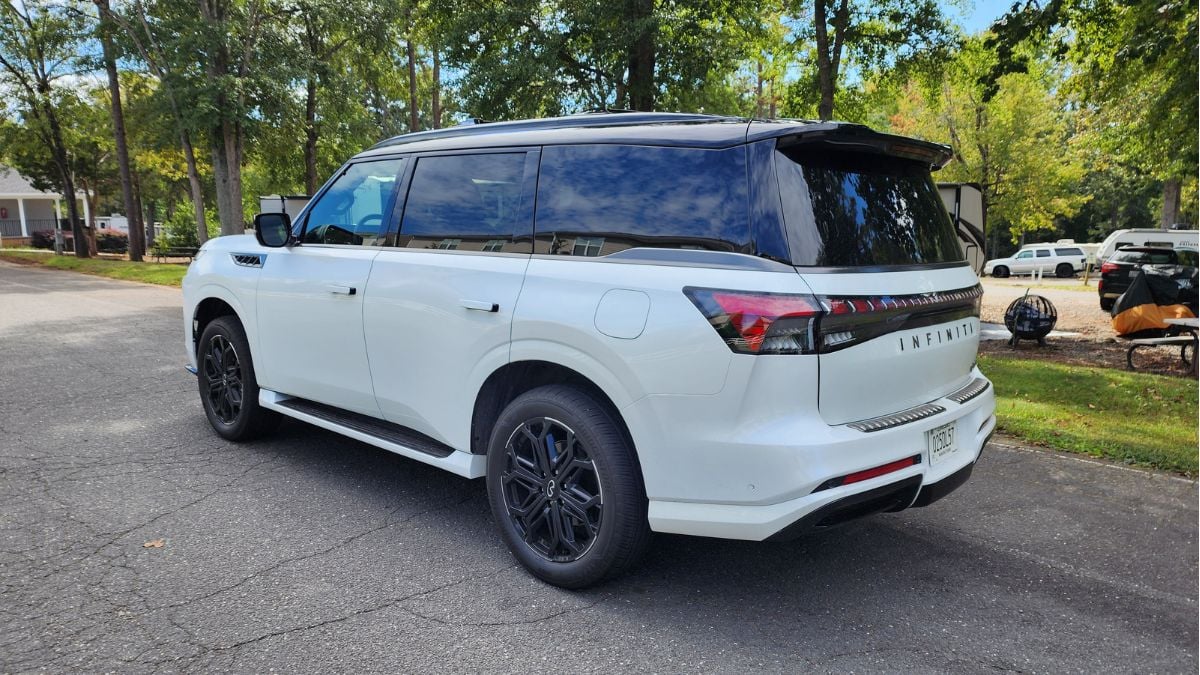
But the Sport trim adds personality. The blacked-out roof (when paired with contrasting body colors), darkened badges, and menacing grille soften what could’ve been overly formal into something more contemporary and muscular. The 22-inch wheels look aggressive without overreaching. The lower front splitter is subtle, just enough to hint at performance without turning the SUV into a fashion statement.
From certain angles, I caught myself thinking - this isn’t showy for show’s sake. The dark trim absorbs glare, the proportions remain elegant rather than exaggerated, and the overall presence conveys intent. In evening light, reflections off the open-pore wood inside peek through tinted windows - it all adds up to a layered aesthetic.
In tight urban parking, the sight lines and relatively modest overhangs help, but you always carry that awareness: this is a big vehicle. Still, the exterior is more than just imposing - it’s inviting in a reserved, premium way.
Interior Is Where Luxury and Ambiance Matter
Step inside, and the first thing you notice is how calm it is. The doors close solidly, and the cabin seems to whisper rather than shout. Car and Driver has already called the new QX80 “undeniably premium,” citing its “quiet, feature-rich” experience. That held true in my test week.
In the Sport trim, Infiniti leans into mood. The black and Dusk Blue leather choices — accented by diamond-pattern perforations — feel modern yet timeless. Dark chrome trim and open-pore wood add texture and depth. The ambient lighting (64 choices) gives you a canvas to paint the mood.
Material quality is consistently high. Surfaces where your hands touch (center console, armrests, door pulls) are either padded or softly wrapped. Controls have reassuring weight. The dashboard layout, with its elegant symmetry, feels intentional.
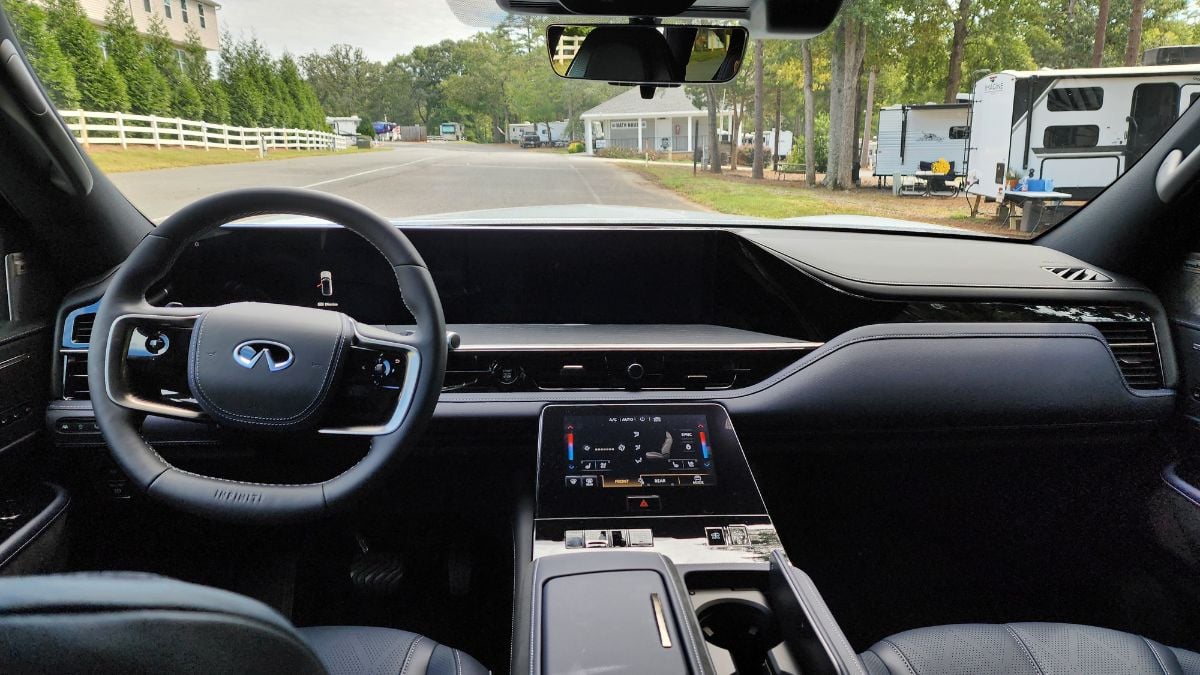
Infotainment screens are well laid out (more on that soon), and the transition between hard surfaces and soft ones is handled cleanly. My only nitpick: some gloss-black plastic zones collect fingerprints. But that’s a minor complaint in what’s otherwise a refined cockpit.
In short: the Sport interior doesn’t just polish what was already good - it accentuates it with drama, materials, and detail.
Infotainment and Tech Are Smart, Responsive and Well Thought Out
The twin 14.3-inch displays (One for the driver, one as infotainment) are now somewhat standard for the QX80. Infiniti calls them “Monolith” displays, and they’re sharp, responsive, and richly detailed.
Beneath that, a 9-inch haptic touchscreen handles climate, seat settings, and secondary controls. That layout keeps the main screen cleaner and safer to use while driving.
I tested the Invisible Hood View and Front Wide View camera modes — these are clever features that map what’s just ahead or beneath your grill to the display. In tight driveways or steep driveways, that view makes all the difference.
ProPILOT Assist 2.1 (Infiniti’s semi-autonomous suite) is standard on Sport. In highway mode, it maintained speed, lane centering, and even executed lane changes when I signaled. It’s helpful, though I still kept my eyes glued to the road (as you must).
Audio is a standout. The 24-speaker Klipsch system in Sport delivers crisp highs, deep lows, and decent staging. Turning it up on winding back roads, I felt it held together well without harshness.
What’s interesting: I did a blind test with passengers between this system and another luxury SUV in the same week — in my car, voices, strings, and dynamics had more nuance. That’s hard to fake.
Connectivity is robust: Google built-in, Wi-Fi hotspot, wireless charging, multiple USB-C ports, and a three-year InTouch premium subscription (per Infiniti’s site).
The system did not lag or stutter even when switching maps, media, and climate commands quickly — a pleasant surprise in an era when big touchscreens often hiccup.
Second-Row Seats: Comfort for Adults
If you’re buying this for family, the second row is critical. Throughout the week, I had colleagues in the back seats doing real-world tasks: video calls, reading, even a nap. They generally came out impressed.
Legroom is ample. Even with a tall driver up front (6’2”), my legs were comfortable behind mine. The floor hump is present (you can’t escape physics), but it’s lower than in many rivals, making the middle seat viable for shorter trips.
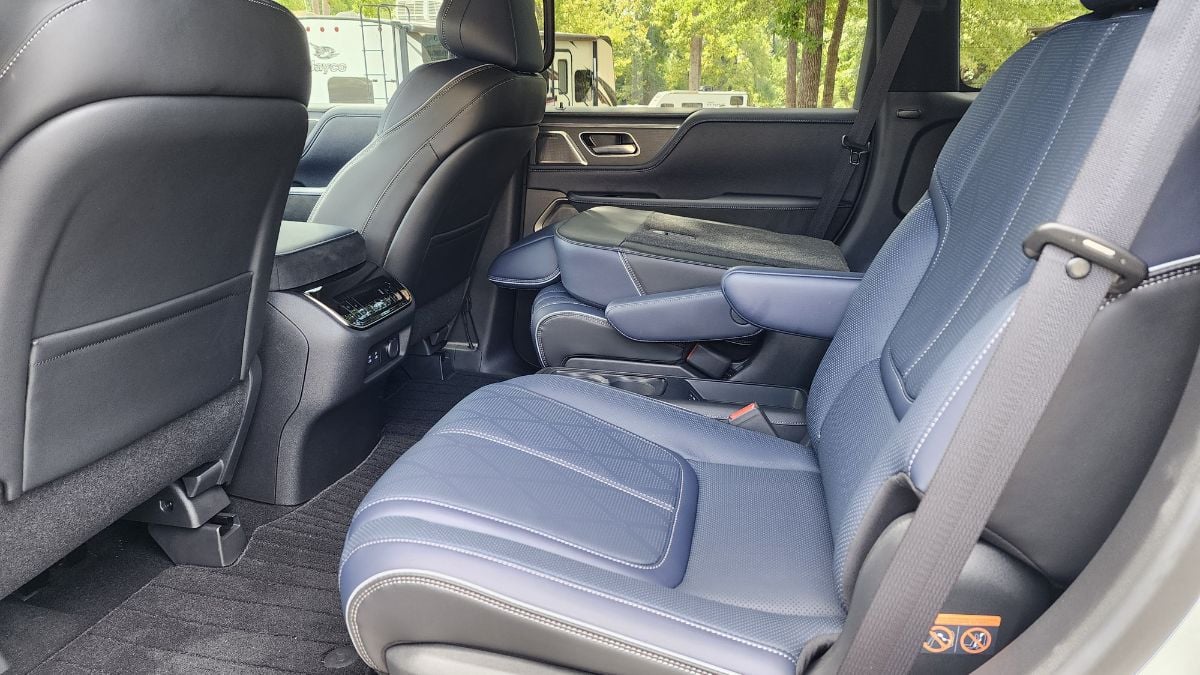
The second-row seats themselves are supportive without being stiff. In Sport trim, you get enhanced bolstering and ventilation. On a hot afternoon I tested the ventilated backs, and they held up well — not overwhelmed, even when sunlight worked against them.
One delightful surprise: the climate and seat controls in the rear are quick and intuitive. The ambient lighting and rear USBs (multiple) make it a modern experience, not an afterthought.
The roofline slopes gently, so headroom is good unless you’re very tall. My 6’3” friend did brush his hair once — but only marginally. Bottom line: the second row feels like a first-class zone in many family-sized luxury SUVs.
Third-Row Seats & Cargo — Usability Over Glamour
Third-row living in full-size SUVs is always a compromise, and so it is here. But the QX80 does better than many.
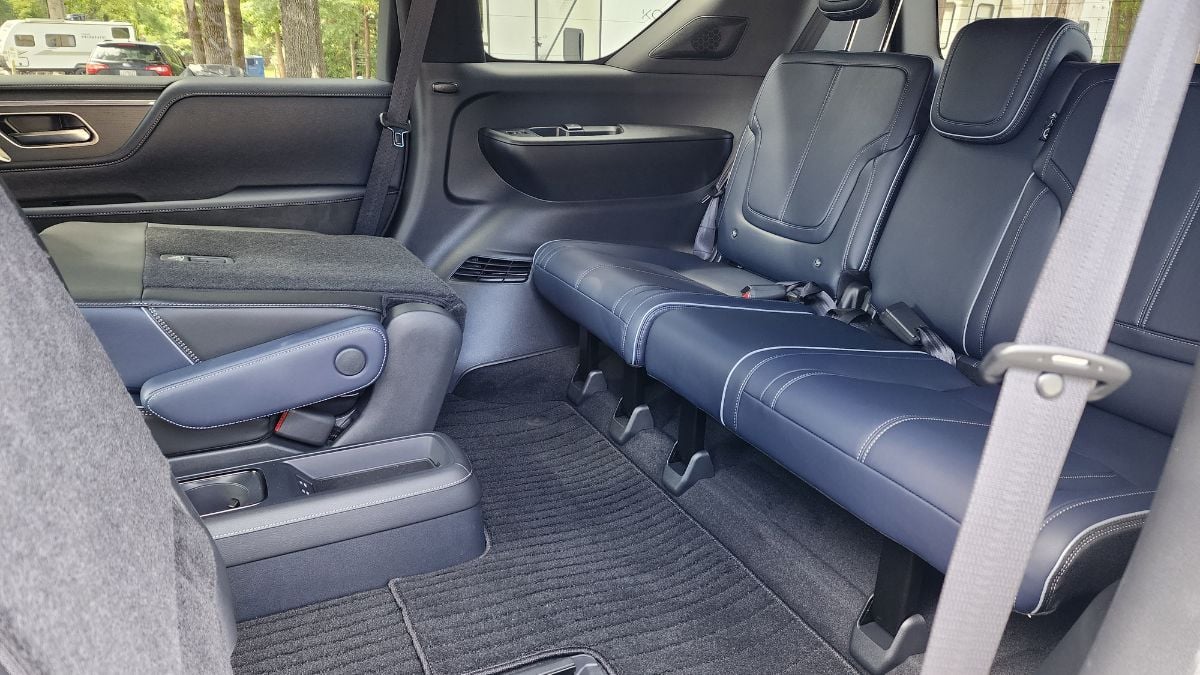
Entry is easier than average — the second-row seats slide and fold with decent clearance. Once inside, headroom is modest but usable for shorter adults or taller kids. Legroom is tight unless the second row is pushed forward, of course. In one drive day, I left an adult in the back for an hour; he emerged with achy knees but no strong regrets (especially for a bit of fun).
Across my week, I periodically loaded up gear — luggage, sports equipment, occasional boxes. Behind the third row, the QX80 offers roughly 22 cubic feet of cargo space (as per prior published specs). Behind row two, closer to 59 cubic feet. With both rows folded, you cross the 100-cubic-foot threshold.
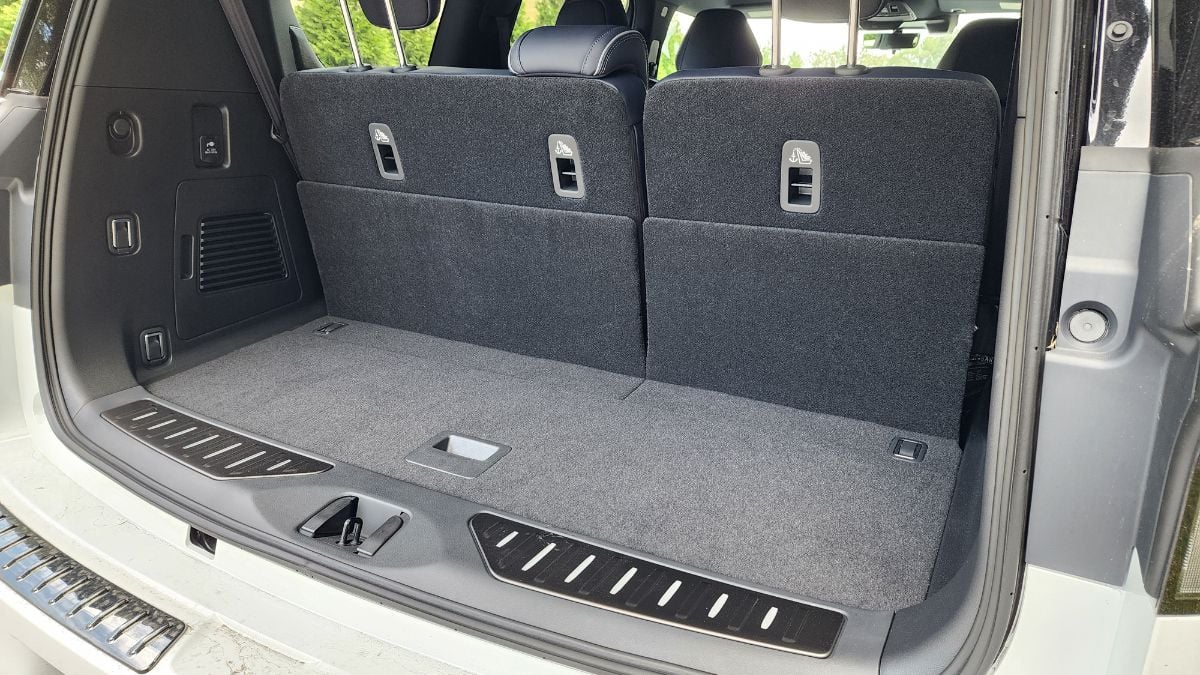
Power liftgate is smooth. The lowered stance (for ease of loading) is nice — but be gentle with heavy items; you’ll still need to manage elbow room for load clearance. Long objects (like skis or lumber) will need row three folded and perhaps some diagonal tilts.
It’s not the ultimate hauler in this class (some rivals extend cargo depth further), but as a working luxury SUV, it’s highly practical. I did fine with large suitcases, camp gear, and photography packs in a single trip.
Engine & Transmission of The 2026 Infiniti QX80: Familiar Heart, Confident Pulse
Under the hood is the turbocharged 3.5 L twin-turbo V6 putting out 450 hp and 516 lb-ft. That’s the same path Infiniti laid for 2025, replacing the older V8 lineup.
One thing I appreciated: that’s not just a spec, is that the torque comes on early and flat. In real-world merging, passing, and highway on-ramp tests, the QX80 Sport felt strong, confident, and never strained (even when fully loaded with passengers and gear).
The 9-speed automatic holds its own. Shift logic is smart; it downshifts cleanly. In Sport mode, gear shifts are more assertive; Economy mode is smoother and less eager. There were rare instances (say, steep uphill + trailer) where I wished for a bit more swing in the ratios — but those were mild complaints.
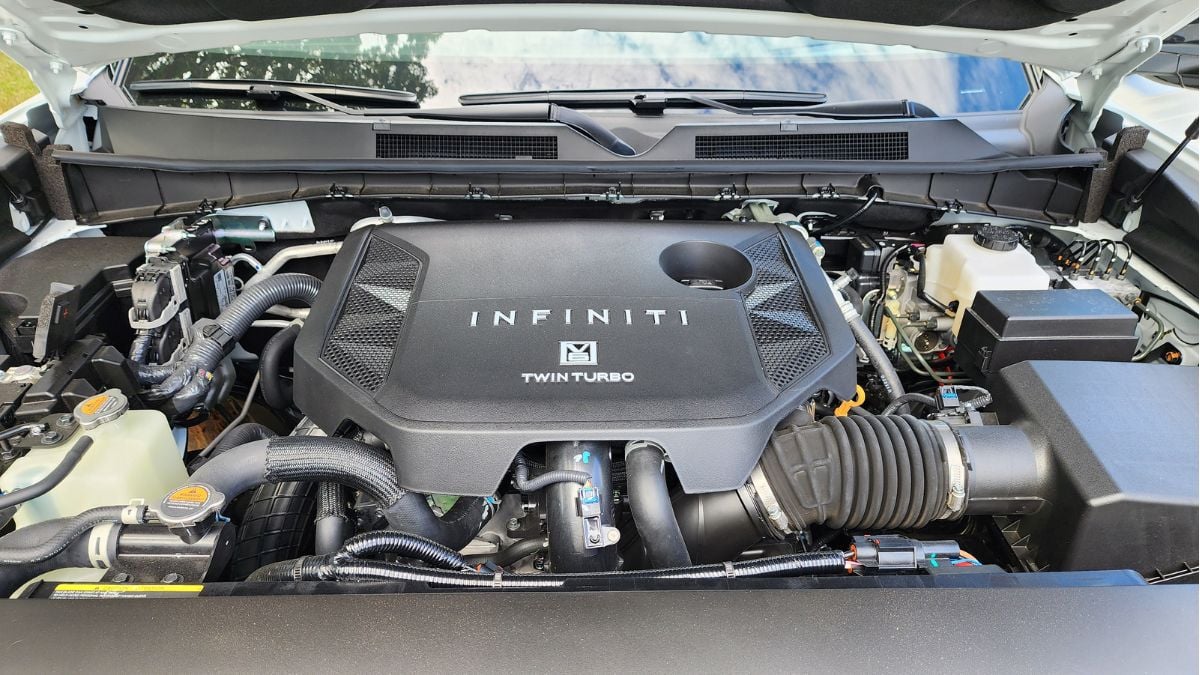
I tested throttle tip-in sensitivity, transient responses, and mid-range passing (60–80 mph). All were strong. There is some turbo spool behavior (around 1,800–2,500 rpm) — a slight pull before full torque — but it’s well managed, and the shift mapping helps hide the transition.
One question I asked myself: if Infiniti made a “Sport+” or track-tuned version someday, how far could they push this package? (After all, the brand has hinted at a “Track” identity in future models.)
Driving and Handling: Big Car, Composed Character
This is where the tension I mentioned at the start persists: can a full-size, heavy, three-row SUV remain composed under real driving?
Yes - more often than not.
The QX80 Sport leans toward the soft side, but Infiniti tuned suspension (including available electronic air suspension and damping) to isolate bumps and manage body motion well. On broken pavement, it floats rather than jerks. On highway expansion joints, it transitions gracefully. MotorTrend describes the ride/handling balance as “great, with the suspension more on the compliant side.”
On more spirited roads, you feel mass. Roll, pitch, and inertia don't disappear - yet the steering is predictably weighted and communicative. You can press, but you won’t surprise yourself. In quiet moments, I found the chassis surprisingly willing to correct itself in mid-corner if you eased off - a subtle, graceful capability.
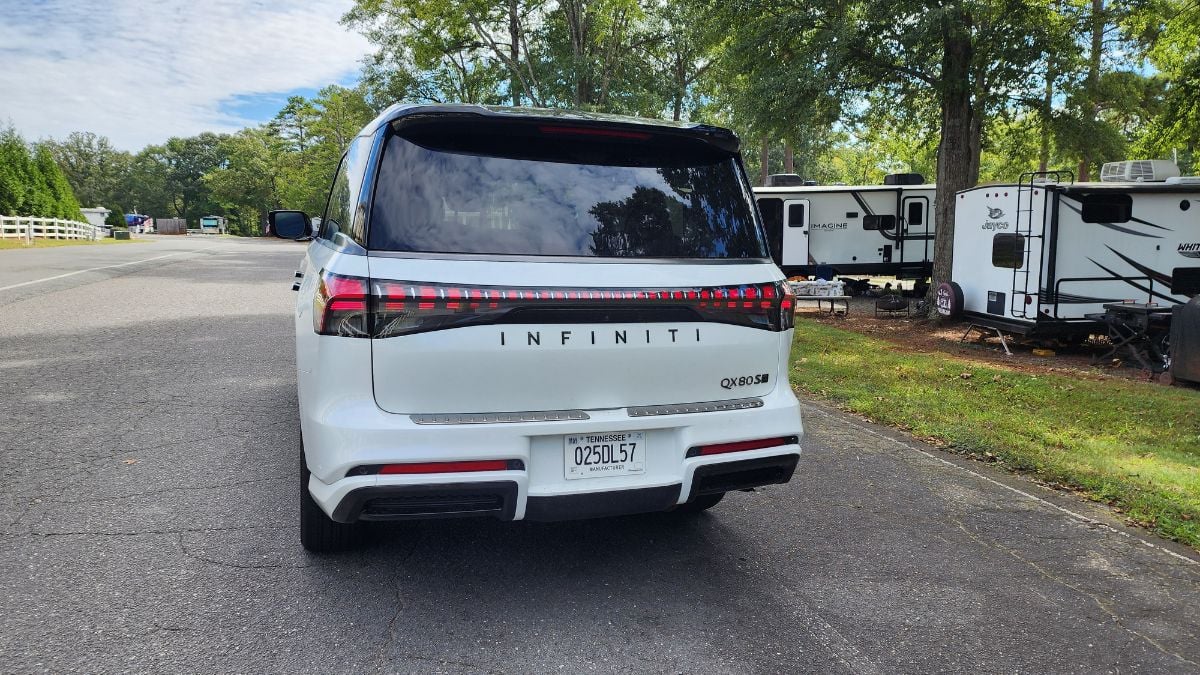
Brake performance was solid through my week. Pedal feel remained consistent even under repeated deceleration from highway speeds. On panic stops (simulated), the QX80 never felt unstable - again, not perfect, but confident.
Another observation: because you drive this car knowing its heft, you compensate instinctively. The suspension allows enough forgiveness that you don’t punish it for real-world driving errors. In urban transitions (ramps, lane merges), I felt fewer unsettled moments than many full-size alternatives.
If pushed (something I did on a section of rolling twisty road), the chassis will protest — but it doesn’t scream for mercy. That gives you room to explore its limits slowly.
Maintenance, Warranty & Cost of Ownership
One thing that often lurks in the back of a buyer’s mind is: how much will this beast cost me over time? On paper, Infiniti offers a 4-year / 60,000-mile basic warranty on new vehicles. INFINITI+2greenwichinfiniti.com+2 Many owners also benefit from complimentary scheduled maintenance (for a limited initial period) offered by Infiniti, easing the burden in early years. Car and Driver Still, given the QX80’s size, features, and complex systems (air suspension, cameras, advanced electronics), maintenance and repair costs will tend to exceed smaller or simpler vehicles.
Looking deeper, data suggests that over a 10-year span, an Infiniti QX80 can accumulate around $12,500 in maintenance and repair costs, per CarEdge’s estimates. On a per-year basis, RepairPal reports an average annual maintenance expense of ~$718 (though that figure depends heavily on region, usage, and how diligent the owner is with preventive care). In practice, that means factoring in tire replacement (22-inch), brake wear, suspension components, leaks, and the normal wear of high-end electronic and comfort systems. In a way, this reminds me of the theme discussed in Infiniti finally getting back to “Track” brand performance SUVs - the more features and tech you layer on, the more there is to maintain.
When I ran through my week of use, I mentally cataloged the systems I’d want to monitor: the air suspension compressors, the camera suites (Invisible Hood View, front wide view), adaptive damping links, luxury seat motors, etc. None failed in test, but they’re handing the future owner potential liabilities. For someone evaluating whether to spend on the Sport trim or climb upward, considering long-term reliability and service cost is just as critical as horsepower or ride quality.
Resale Value, Depreciation & Long-Term Appeal
Another “behind the scenes” angle that savvy buyers care about: how will this QX80 Sport hold its value in 5–10 years? Full-size luxury SUVs, especially those with radical styling or new tech, often see steep early depreciation. But Infiniti has some advantages: strong brand perception, solid reliability in the Infiniti/Nissan ecosystem, and a “fresh” redesign. The QX80’s switch from V8 to twin-turbo V6 in its redesign was bold (as covered in “2025 Infiniti QX80 gets sports-car power – is it enough?”) which may help or hurt in the long run depending on market sentiment. That article highlights the risks in mechanical change.
Because Sport is new in 2026, there’s no resale track record yet. But if early adopters maintain their vehicles well, the dark trim plus premium features could age more gracefully than base versions. The fact that the Sport trim adds unique visual and content upgrades (without mechanical changes) might help preserve its “special” status in used markets. In segment rivals (Escalade, Navigator, GLS, LX), trims that retain “headline features” often command better retention. Many readers will ask: will I lose too much by buying a Sport instead of Autograph or a fully tricked-out flagship? In thinking about that, revisit the 2025 Infiniti QX80 Autograph pushing boundaries - spending more now might pay off later, or conversely, you might overpay for perks you won’t use.
In my week of driving, I found myself imagining the car five years down the road: will the blue leather fad age well? Will all the cameras get calibration issues? Will buyers still appreciate the dark roof and trim? These mental stress-tests are part of what I do when I evaluate any high-end vehicle. My gut says the QX80 Sport has enough aesthetic restraint and mechanical consistency to fare better than many flashy trims over time, but buyers should always include a “used-market buffer” in their total cost projection.
Off-Road Capability & All-Weather Handling
We talked a lot about on-road behavior. But buyers often wonder: can this giant luxury SUV handle ice, snow, gravel, or trails? The 2026 QX80 Sport comes standard with all-wheel drive (unlike base trims that may allow rear-wheel drive), which gives a baseline for traction. Because Sport shares the same chassis and electronics as other QX80 variants, it retains the 4WD system’s modes (Snow, Tow, etc.), which help manage torque split, grip, and stability. In slippery conditions during my drive week, the AWD system felt confident — in light snow or rain, the SUV rarely lost composure, and ramping down torque was smooth.
That said, I didn’t take the Sport deep into serious off-road trails — that’s not its core mission. It’s not body-on-frame truck-rugged like a full-on expedition SUV. The clearance is generous for daily use, but on very rugged terrain, suspension travel and underbody protection may be limiting. For buyers expecting mountain roads, forest tracks, or serious off-grid adventures, this vehicle provides capability bordering on luxury-crossover crossovers, not hardcore expedition gear.
For anyone eyeing off-road ability, consider the hints at Infiniti’s performance ambitions as discussed in those Nissan/Infiniti models we should pick in 2025. If Infiniti leans harder into a “Track / Off-Road” identity, future versions might increase ground clearance, add richer chassis tuning, and maybe introduce a Sport+ or off-road package on the QX platform. For now, though, the 2026 QX80 Sport balances on-road luxury with credible all-weather competence, but can’t rival a dedicated off-road rig.
Summing Up & Questions for You
After seven days in the 2026 Infiniti QX80 Sport, I emerged with a simple conclusion: this is a luxury SUV that does big size with delicacy and intention. Its compromises are what you expect (fuel economy, weight, third-row tightness), but in nearly every other dimension, Infiniti has calibrated strength, comfort, and presence in a balanced way.
The Sport trim doesn’t rewrite the performance script, but it rewrites the mood. The darker styling, enhanced cabin ambiance, premium audio, and tech uniqueness make it feel special even amid its siblings. Driving it doesn’t feel like driving “the big SUV”; more like commanding something refined, capable, and thoughtfully expressive.
Overall, the 2026 QX80 Sport punches above its weight.” It’s not perfect. But for buyers in this segment, it’s rare to find something this cohesive.
Now I want to turn it over to you - the reader, the commenter, the curious car-lover:
- In a segment crowded with Escalade, Navigator, GLS, and LX, would the 2026 QX80 Sport’s blend of styling and refinement be enough to sway you, or would you insist on more mechanical firepower or sport tuning?
- Knowing what you now know about its compromises (fuel economy, third-row tightness, weight dynamics), would the Sport trim be the one you choose, or would you opt to step up (or down) in the QX80 lineup?
Drop your thoughts below. Let’s debate which full-size SUVs earn their keep - and whether the QX80 Sport belongs in that “must consider” list.
Armen Hareyan is the founder and Editor-in-Chief of Torque News. He founded TorqueNews.com in 2010, which since then has been publishing expert news and analysis about the automotive industry. He can be reached at Torque News Twitter, Facebook, Linkedin, and Youtube. He has more than a decade of expertise in the automotive industry with a special interest in Tesla and electric vehicles.
Images by Armen Hareyan.
Set Torque News as Preferred Source on Google
Follow us today...