
Allegedly brought on by pressure from the fossil fuel industry, the end of the $7,500 federal EV tax credit know as the “New Clean Vehicle Credit” has caused a lot of discussion in the EV community about which states have the most EVs per capita and what, if any, state EV incentives are still available. A recent r/electricvehicles subreddit post captures the topic where Sea_Amphibian5684 posted:
“I live in Arizona (Phoenix metro) and there are EV’s absolutely everywhere. I also travel frequently to Oregon and California and see the same thing.
So it’s totally wild to me that when I talk to, or travel to, other parts of the country where there aren’t many EVs, and I tell people that I own one, they spit out Facebook nonsense that they’re going to blow up and they’ll never get rid of their gas car.”
TowElectric responded with:
“I think California is tops for EV ownership. Second tier are places like Colorado and Washington State and Massachusetts.”
nam_416 added:
“What it costs per year to have your vehicle registered in the state plays a role. Some states jacked up the annual registration for EV fees compared to ICE, because EVs don't pay the gas tax.”
State Incentives
We decided to look into the numbers to see how the states rank in EV ownership and what incentives are offered by states now that the federal EV tax credit is gone. All is not doom and gloom. To start, many states still offer incentives. Here’s an example of four of the best.
Colorado offers the Vehicle Exchange Colorado program for up to $9,000 (new EV or PHEV)
towards an eligible new EV or plug-in hybrid when replacing an older vehicle, with updated amounts effective November 3, 2025.
Maine offers the Efficiency Maine EV incentive for up to $7,500 for qualified low-income buyers purchasing a battery electric vehicle, typically paired with an off-peak charging requirement for this specific program.
Connecticut offers the CHEAPR Rebate+ for up to $5,000 for income-qualified participants, for a used battery electric vehicle.
Vermont offers Replace Your Ride for up to $5,000 for income-qualified individuals who retire an older vehicle and replace it with an eligible new or pre-owned EV (or qualifying plug-in hybrid).
You can find information about EV incentives available in all 50 state by going to the U.S. Department of Energy’s Alternative Fuels Data Center website.
How the States Rank in EV Ownership per Capita and Why
Electric vehicle adoption in the United States varies far more by state than many people expect. Progress is shaped locally by policy choices, infrastructure investment, population patterns, and economic conditions. Some regions are moving quickly, while others remain early in the transition, which makes it useful to step back and compare where gaps exist.
Several recent analyses pull together data from federal agencies, state transportation departments, and industry research to paint a clearer picture of these differences. Looking at registrations, sales share, and charging access helps explain why adoption feels natural in some states and difficult in others.
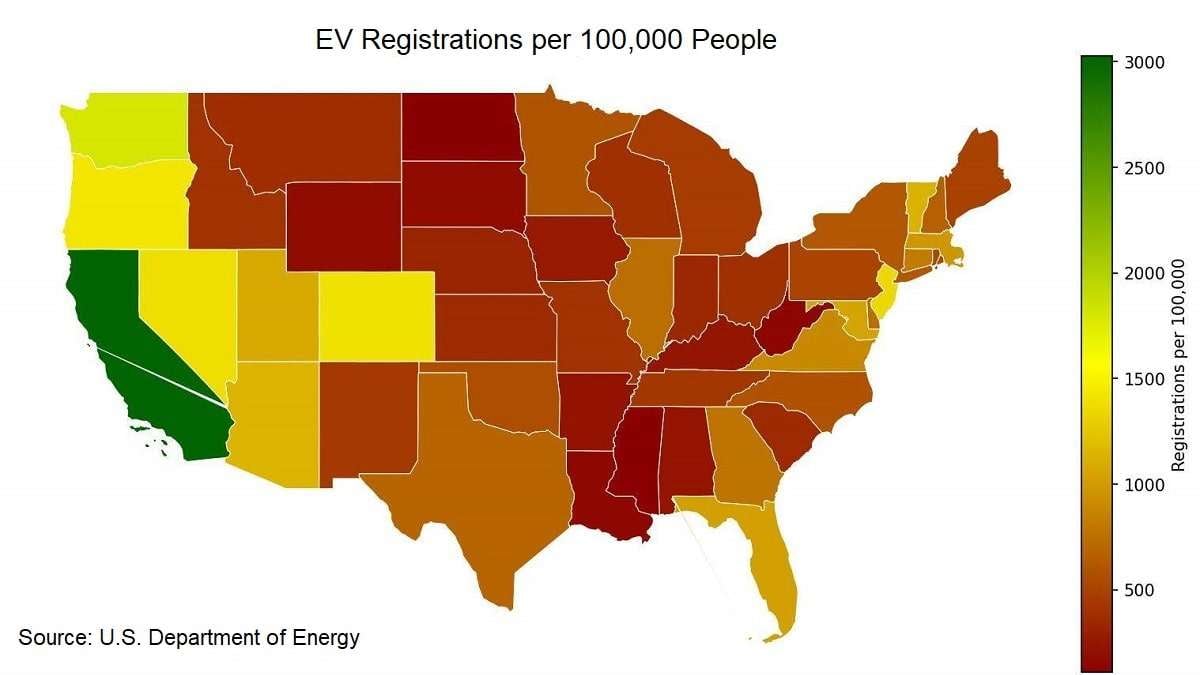
A small group of states stands out as clear leaders. West Coast and Northeastern states consistently show higher electric vehicle shares in both new sales and vehicles already on the road. Even so, the most advanced state still has electric vehicles making up well under ten percent of total vehicles in use, which highlights how early the market still is and how far we have to go.
California sits at the top in both scale and penetration. The state combines strict emissions authority, long running incentives, dense cities, and extensive charging buildout. These factors have helped push electric vehicles into everyday use at a level no other state has matched.
Washington state follows closely behind in total numbers and ranks near the top by share of vehicles. Policy alignment, early adoption of zero emission mandates, and strong public charging support have reinforced steady growth. Vermont stands out for registrations per capita rather than raw volume, showing how smaller states can still lead when adoption becomes culturally normalized.
Other states continue to struggle for a mix of practical reasons. Mississippi sits at the bottom of the rankings with very low electric vehicle presence and limited charging coverage. Low adoption reinforces weak infrastructure investment, creating a cycle that is hard to break.
Geography and demographics also matter. States like North Dakota and Wyoming face sparse populations and long distances between towns, which makes charging networks expensive to build and maintain. Arkansas has more residents but remains largely rural, where long travel distances and limited charging makes purchasing an EV a more difficult decision.
Policy and infrastructure remain the strongest levers for change. States with mandates, incentives, and aggressive charger deployment consistently outperform those without them. California’s charging network now rivals and even exceeds traditional fueling access, while lower ranked states often lag far behind in public investment.
Charging availability plays a major role in buyer confidence. States with many vehicles competing for a small number of public chargers risk congestion and wait times. High ratios of vehicles to chargers discourage adoption, even in places where interest exists.
Affordability adds another layer of complexity. Electric vehicles still carry slightly higher average price tag than many gas-powered counterparts. In states with lower incomes or less diversified economies, this cost barrier slows adoption regardless of environmental interest.
Federal programs and falling technology costs will influence the next phase of growth. Continued funding for charging networks and lower battery costs could help level the playing field. Reliable power supply and smart charging will also become more important as electric fleets expand.
Bottom Line
Electric vehicle adoption in the United States is uneven, but the reasons are visible and solvable. States that combine supportive policy, infrastructure spending, and economic accessibility move ahead faster. Closing the gap will require coordinated effort so cleaner transportation becomes practical everywhere, not just in a few leading regions.
What Do You Think?
Which state on the map surprised you the most, either for being higher or lower than you expected?
Do you think EV adoption in your state is being held back more by cost, charging access, or state policy?
Chris Johnston is the author of SAE’s comprehensive book on electric vehicles, "The Arrival of The Electric Car." His coverage on Torque News focuses on electric vehicles. Chris has decades of product management experience in telematics, mobile computing, and wireless communications. Chris has a B.S. in electrical engineering from Purdue University and an MBA. He lives in Seattle. When not working, Chris enjoys restoring classic wooden boats, open water swimming, cycling and flying (as a private pilot). You can connect with Chris on LinkedIn and follow his work on X at ChrisJohnstonEV.
Photo credit: Provided by author
Set Torque News as Preferred Source on Google
Follow us today...