

Modern cars are designed to survive rainstorms, car washes, and the occasional spilled coffee, but they are far less forgiving when confronted with industrial-strength chemistry.
A recent post in the Polestar subreddit illustrates that reality in stark, unsettling detail. What began as a routine trip to a garden center ended with a Polestar 4 declared effectively totaled, a six-figure problem measured not in speed or range, but in corrosion.
The chain of events is painfully mundane. The owner transported several products home, including five liters of 18 percent “strong white vinegar,” far more concentrated than the household variety most people associate with cleaning. The container, later described as defectively manufactured, leaked in the trunk. By the time the owner discovered the spill at home, the liquid had already worked its way beneath the trunk floor. In a modern EV, that is not empty space. It is the structure, wiring, control modules, and pathways that lead forward into the cabin.
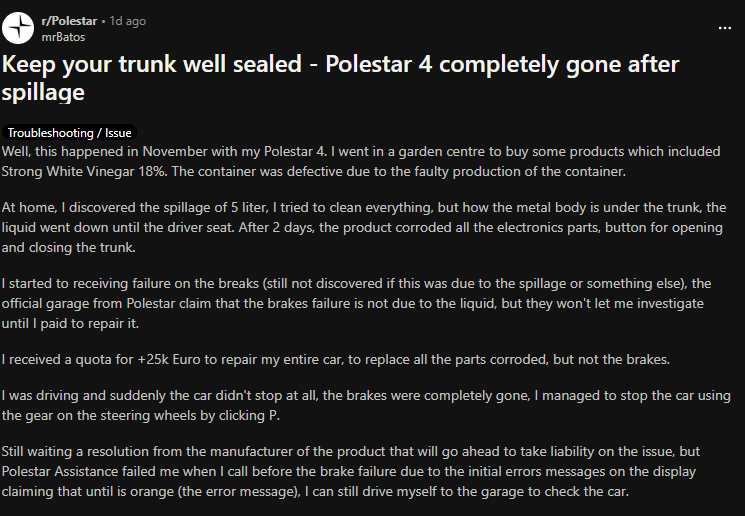
“Well, this happened in November with my Polestar 4. I went to a garden centre to buy some products, which included Strong White Vinegar 18%. The container was defective due to the faulty production of the container.
At home, I discovered the spillage of 5 liters. I tried to clean everything, but since the metal body is under the trunk, the liquid went down to the driver's seat. After 2 days, the product corroded all the electronic parts, including the button for opening and closing the trunk.
I started to receive failure on the brakes (still not discovered if this was due to the spillage or something else), the official garage from Polestar claims that the brake failure is not due to the liquid, but they won't let me investigate until I pay to repair it.
I received a quota of $29,168 to repair my entire car, to replace all the parts corroded, but not the brakes.
Advertising
I was driving, and suddenly the car didn't stop at all, the brakes were completely gone, I managed to stop the car using the gear on the steering wheel by clicking P.
Still waiting for a resolution from the manufacturer of the product that will go ahead to take liability on the issue, but Polestar Assistance failed me when I called before the brake failure due to the initial error messages on the display claiming that until it turns orange (the error message), I can still drive myself to the garage to check the car.”
Despite immediate cleaning efforts, the damage continued invisibly. Over the next two days, the acidic liquid corroded electronics tied to the trunk and spread forward toward the driver’s area. Fault messages began appearing, including brake-related warnings. The owner contacted Polestar Assistance but was told that as long as the alerts remained orange, the car could still be driven to the dealer. That guidance would later loom uncomfortably large.
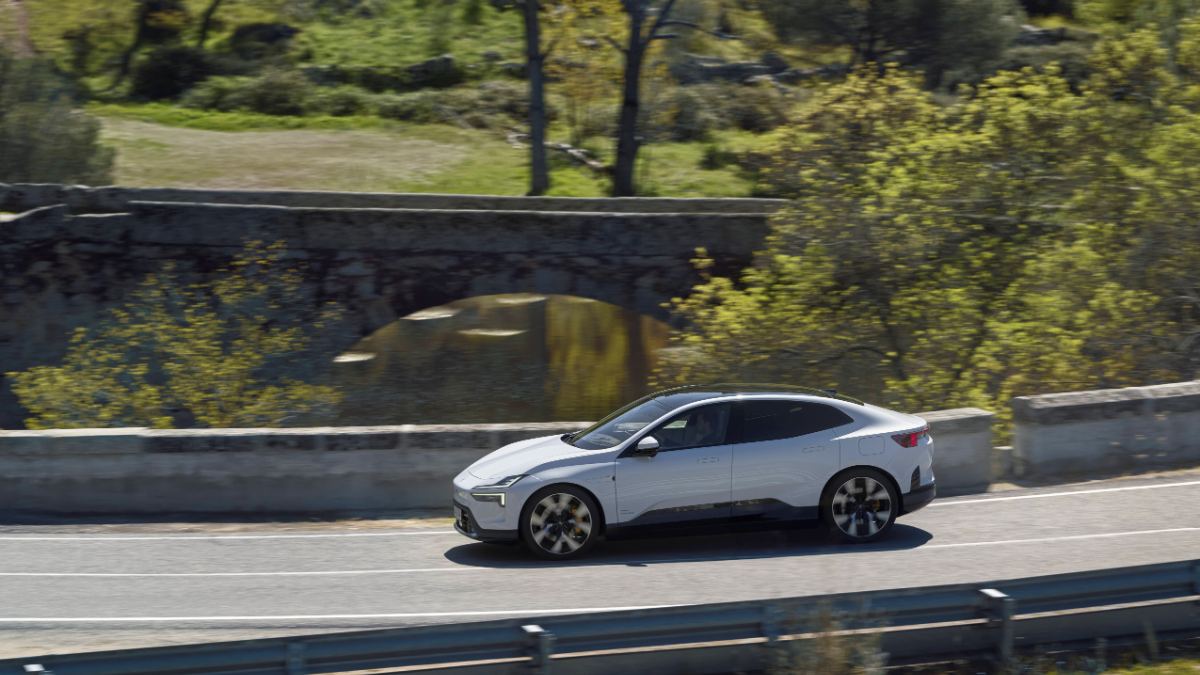
Polestar 4: Electric SUV & Electric Mirrors
- The Polestar 4 is an electric SUV with a coupe-like shape, designed to sit between a sedan and a traditional SUV.
- It does not have a rear window; instead using a rear-facing camera and an interior display for visibility.
- The interior focuses on minimalism, with a clean layout and digital controls replacing many traditional switches.
- The Polestar 4 is positioned as a premium electric vehicle, emphasizing design and technology over off-road capability.
The situation escalated from expensive to terrifying when the brakes failed completely while driving. With no stopping power available, the owner managed to bring the car to a halt by selecting Park via the steering wheel controls at a traffic light. It was a last-resort maneuver, executed under pressure, and it likely prevented serious injury or worse. Other commenters later pointed out how critical that detail was, noting that many drivers are unaware that engaging Park in emergencies can force a rapid stop.
At the dealership, the news was grim. Polestar’s official garage quoted more than $29,168 to replace corroded components throughout the vehicle, excluding the brake system. The brakes, the dealer claimed, were not related to the liquid damage, even though the failures followed the spill and subsequent electronic issues. Worse, the owner was told that further investigation would not proceed until repairs were authorized and paid for, effectively freezing the situation.
Community responses quickly converged on a hard truth. Vinegar at 18 percent concentration is not a benign household fluid. It is aggressively corrosive, capable of attacking metals, wiring insulation, connectors, and circuit boards with ease. Several commenters stressed that this was no ordinary spill, and that once such a liquid enters the hidden cavities of a vehicle, especially an EV packed with low-mounted electronics, the outcome is rarely localized or cheap.
Practical advice followed. Multiple users urged the owner to involve their insurance company immediately, allowing the insurer to cover repairs and pursue recovery from the product manufacturer separately. That approach removes the burden from the vehicle owner and acknowledges that this is less an automotive defect than a catastrophic contamination event. Others shared personal rules for transporting messy or dangerous cargo, emphasizing secondary containment such as sealed boxes or coolers, even for food, let alone corrosive chemicals.
There is also an uncomfortable systems-level lesson here. EVs rely on extensive wiring and electronics routed through the floor and body for efficiency and packaging. That makes them exceptionally vulnerable to fluid intrusion from above. Once contamination reaches those layers, the damage is not always immediately visible, but it can be progressive, unpredictable, and severe. The idea that a spill in the trunk could eventually compromise braking is not intuitive, but it is no longer implausible.
This story is less about Polestar as a brand and more about the collision between modern vehicle design and unexpected real-world use. A luxury EV can be rendered undrivable not by a crash or a failed battery, but by a leaking container of acid-strength vinegar. It is a sobering reminder that the weakest link is often not the technology itself, but the assumptions we carry about what a car can safely endure.
For other owners, the takeaway is simple and unglamorous. Be cautious about what you transport. Contain anything that can leak. And if warning messages appear after a chemical spill, do not drive on assurances alone. As this case shows, by the time the damage announces itself clearly, it may already be far beyond repair.
Image Sources: Polestar Media Center
Noah Washington is an automotive journalist based in Atlanta, Georgia. He enjoys covering the latest news in the automotive industry and conducting reviews on the latest cars. He has been in the automotive industry since 15 years old and has been featured in prominent automotive news sites. You can reach him on X and LinkedIn for tips and to follow his automotive coverage.
Set Torque News as Preferred Source on Google
Follow us today...







Comments
This recap sounds like a …
Permalink
This recap sounds like a ‘bumpy ride’ for the remarkable complexities that can start with only a leaky container of vinegar! 😱
Yet even as what could be an affected electrical circuit issue due perhaps to a liquid invasion beyond a mfg or system defect, the customer-support aspect of this sounds discouraging.
We’d like to be able to trust that “base brakes” will be the default mode for safety in most designs.
Yet if you expressed ‘any’ concern to a vehicle manufacture about possible “brake failure,” it seems worthy of support being more than any delay to ‘wait’ for both parties to determine who’s liable for the actual repair.
Good to know you’re in a more informed driver/owner than most consumers. Yet best of safety and a good resolution on this “curve ball” with an otherwise cool vehicle!