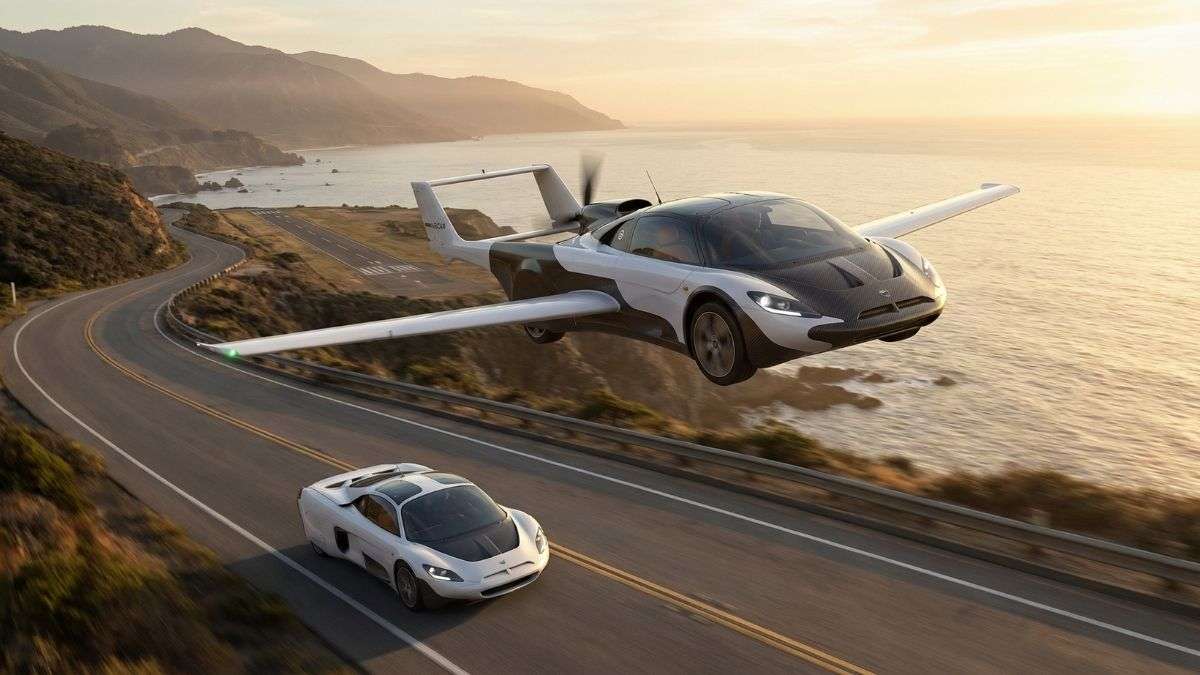

For nearly a century, the "flying car" has been the ultimate unfulfilled promise of the future: a Jetsons-esque dangling carrot that always seemed to be exactly ten years away. We have seen concepts, we have seen CGI renders, and we have seen clunky prototypes that looked more like Cessnas with clipped wings than anything you’d park in a garage. But the wait is officially over.
Slovakian innovator Klein Vision has just unveiled the production prototype of its "AirCar," a dual-mode vehicle that genuinely bridges the gap between the highway and the runway. With sales slated to begin in early 2026, we are no longer talking about a concept; we are talking about a product. With a price tag estimated between $500,000 and $1 million, it is certainly a toy for the 1%, but it represents a technological leap that could redefine personal mobility.
The AirCar is not an eVTOL (electric vertical takeoff and landing) drone; it is a gas-powered, road-legal sports car that transforms into a fixed-wing aircraft in under three minutes. It is loud, it is fast, and for the first time in history, it looks like a commercially viable product.

The Machine: What $1 Million Buys You
The AirCar is a marvel of transformer engineering. Unlike many of its competitors, which often look like helicopters with wheels or planes with folding wings that still span 10 feet, the AirCar looks remarkably like a hypercar when in "Road Mode." Its tail retracts, and its wings fold seamlessly into the fuselage, allowing it to fit into a standard parking space.
Under the hood—or rather, the fuselage—sits a BMW-sourced 1.6L engine in the prototype models, though the production version is expected to feature a significantly more powerful adept aviation engine, likely pushing 300 horsepower. This isn't an electric dream; it's a combustion-engine reality, necessary to achieve the range and power-to-weight ratio required for genuine cross-country travel.
The specs are impressive. In the air, the AirCar cruises at speeds of roughly 170-190 mph (approx 300 km/h) with a range of over 600 miles (1,000 km). On the ground, it’s capable of highway speeds, topping out around 100+ mph. The transition is automated: you push a button, and in roughly two minutes and 15 seconds, the rear spoiler extends to become a tail, the wings lift up and out, and the car becomes a plane.
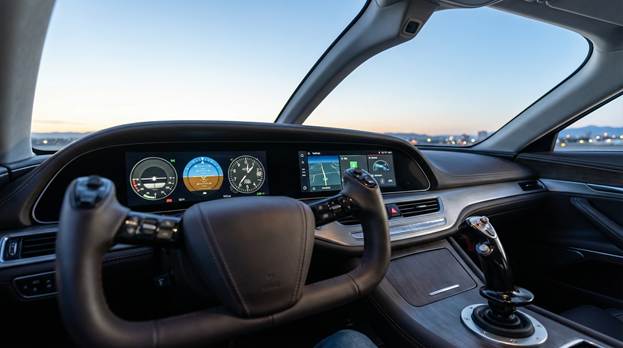
The driver (or pilot) sits in a futuristic, glass-enclosed cockpit that feels more like a luxury sports coupe than a spartan Cessna. However, make no mistake: to operate this machine to its full potential, you will need both a driver's license and a pilot's license.
Klein Vision’s History: Engineering Pedigree and Strategic Backing
To understand why this car is succeeding where others failed, you have to look at the man behind it. Professor Stefan Klein is not a tech billionaire with a whim; he is a designer and engineer with a pedigree that includes stints at Audi, BMW, and Volkswagen. He spent 20 years working on flying car concepts, including the AeroMobil, before breaking away to found Klein Vision with co-founder Anton Zajac.
The company’s trajectory has been defined by a methodical, engineering-first approach. They didn't start with marketing; they started with aerodynamics. The "AirCar" is actually the result of five generations of prototypes.
Critically, the question of "do they have enough money?" was largely answered in early 2024. In a strategic move that raised eyebrows in the West, Klein Vision sold a geographically limited license to Hebei Jianxin Flying Car Technology in China. While the exact sum was undisclosed, this deal provided the capital injection necessary to move from prototype to production.
China is aggressively pursuing low-altitude economy leadership, and Hebei Jianxin’s backing means Klein Vision has access to high-tech manufacturing capabilities that a small Slovakian startup could never afford on its own. Do they have enough backing to be successful? With Chinese manufacturing might behind the technology and a finished, certified prototype, the answer appears to be a resounding yes.
The Competition: A Crowded Sky
The AirCar is not entering a vacuum. The "flying car" market is suddenly crowded, but the AirCar occupies a unique "Goldilocks" zone in terms of capabilities and price.
- Pal-V Liberty: The Dutch-made Pal-V is a gyroplane (a helicopter-car hybrid). While it is road-legal and currently on the market, it is complex to fly, requires a manual transformation that takes much longer than the AirCar, and has a top-heavy aesthetic that doesn't appeal to the sports car enthusiast. It costs roughly $600,000.
- Samson Switchblade: The American Switchblade is a three-wheeled "motorcycle" class vehicle that flies. It is faster than the AirCar (claiming 200 mph in the air) and significantly cheaper (starting around $170,000), but it is sold primarily as a kit aircraft, meaning the owner has to build 51% of it to satisfy FAA regulations. The AirCar is a fully finished production vehicle.
- Alef Model A: The Alef is the current media darling because it is an eVTOL that looks like a mesh sedan. It takes off vertically, which is a huge advantage over the AirCar’s need for a runway. However, its range is limited (110 miles flying), and its road speed is capped at 25 mph (it's legally a "Low Speed Vehicle"). The AirCar is a true cross-country tourer; the Alef is an urban hopper.
The AirCar wins on the "Grand Tourer" metric. It is the only vehicle that offers a normal car driving experience combined with the range and speed of a legitimate light aircraft.
The Velocity of Development: Why Now?
If you look at the history of flying cars, it is a graveyard of broken dreams. The Curtiss Autoplane (1917), the ConvairModel 118 (1947), and the infamous Moller Skycar (which spent decades in development and millions of dollars without ever really flying) all failed.
So why has the last five years seen more progress than the previous eighty?
The answer lies in the convergence of three technologies: composite materials, advanced avionics, and compact propulsion.
In the past, to make a car strong enough to survive a crash, it had to be heavy (steel). To make a plane fly, it had to be light (aluminum). These two goals were mutually exclusive. Today, carbon fiber composites allow the AirCar to be rigid enough for the road but light enough for the sky.
Furthermore, computer-aided design (CAD) allows engineers like Stefan Klein to simulate the complex aerodynamics of a shape-shifting vehicle before building a single part. The speed of development we are seeing—from concept in 2017 to certification in 2022 to sales in 2026—is a testament to modern digital engineering.
Market Success: Will It Actually Sell?
The skeptical take is that the flying car is a solution in search of a problem. If you are rich enough to buy a $1 million AirCar, you are rich enough to buy a nice Porsche and a nice Cessna, or just charter a helicopter.
However, this misses the point of the "dual-mode" appeal. The friction of private aviation is high: you drive to the airport, park your car, walk to the hangar, pre-flight the plane, fly, land, park the plane, and then... call an Uber?
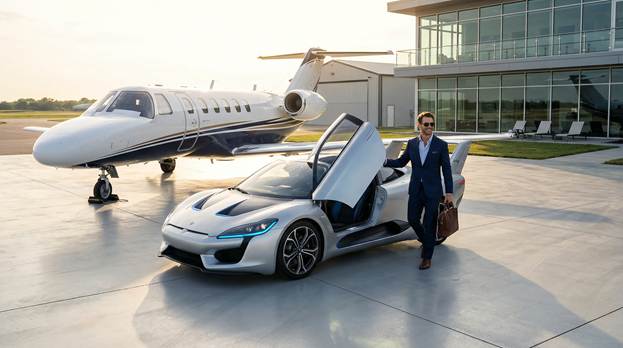
The AirCar solves the "last mile" problem of aviation. You drive from your garage to the runway, fly to your destination city, land, retract the wings, and drive to your meeting. There is no hangar transfer, no rental car, no waiting.
For this reason, the likelihood of market success is higher for the AirCar than for the eVTOL air taxis currently hyping the market. The AirCar fits into existing infrastructure. It uses existing gas stations. It uses existing runways. It doesn't require a new grid of electric chargers or new air traffic control laws for vertical city flight. It works today.
Regulatory Approval: Who Gets It First?
Klein Vision has already achieved a massive milestone: The AirCar was issued a Certificate of Airworthiness by the Slovak Transport Authority in January 2022, following 70 hours of rigorous flight testing compatible with European Aviation Safety Agency (EASA) standards.
This makes Slovakia the first country to officially "approve" the car. However, the broader market lies in the EU and China.
With the Hebei Jianxin deal, China is the most likely candidate for the first widespread adoption. China is rapidly deregulating its low-altitude airspace (below 3,000 meters) to encourage the "low-altitude economy." While the FAA in the United States is cautious and slow—currently struggling to define rules for eVTOLs—China is moving with state-sponsored speed.
Expect to see the AirCar flying in Bratislava and Beijing long before it is approved for flight in Boston.
The Target Buyer: The Pilot-Driver
Who is this for? The AirCar appeals to a very specific, but very passionate, demographic: the wealthy pilot-enthusiast.
There are over 600,000 active pilots in the U.S. alone. Many of them own small businesses and travel regionally. The AirCar is the ultimate tax-write-off business tool for the entrepreneur who needs to visit three factories in three different states in one day.
It also appeals to the "Supercar Collector" who is bored with Ferraris. A Ferrari can’t fly. The AirCar offers exclusivity that no Bugatti can match.
Wrapping Up
The Klein Vision AirCar is a triumph of persistence. It proves that the flying car doesn't have to be a vertical-takeoff drone or a sci-fi fantasy; it can be a brilliant piece of mechanical engineering that simply works. While the $1 million price tag keeps it out of reach for most of us, the fact that it exists—and is going on sale in 2026—changes the conversation. We aren't asking "if" anymore. We are asking "how much?" and "where do I sign?" The future has finally landed, and it has retractable wings.
Disclosure: Images rendered by Artlist.io
Rob Enderle is a technology analyst at Torque News who covers automotive technology and battery developments. You can learn more about Rob on Wikipedia and follow his articles on Forbes, X, and LinkedIn.
Set Torque News as Preferred Source on Google
Follow us today...