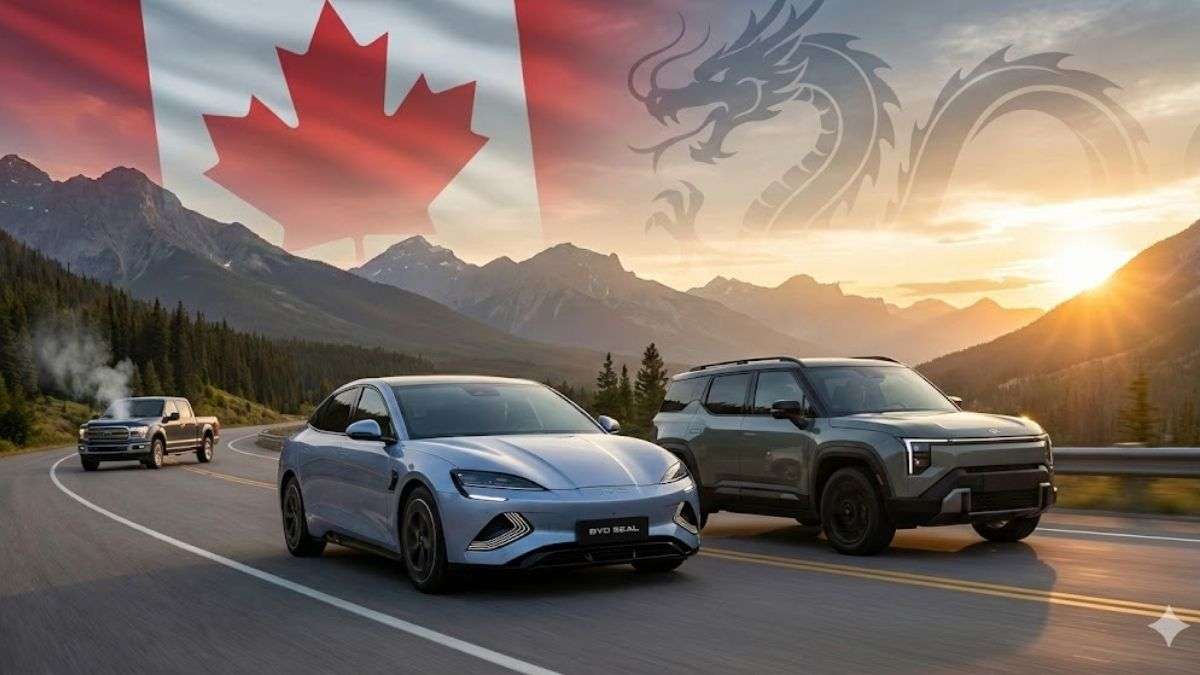

While the global automotive stage is usually dominated by flashy tech reveals, the real shockwave of 2026 didn’t come from a convention floor. It came from a high-stakes diplomatic corridor in Beijing. In a move that has sent shockwaves through the North American auto industry, Canadian Prime Minister Mark Carney and Chinese President Xi Jinping finalized a landmark trade agreement on January 16, 2026, effectively dismantling the 100% "surtax" barrier on Chinese electric vehicles (EVs).
By slashing tariffs to a mere 6.1% for an initial quota of 49,000 vehicles, Canada has officially broken ranks with the United States. This isn't just a policy tweak; it is a fundamental realignment of the North American automotive landscape. For the "Big Three" in Detroit and the burgeoning EV startups across the U.S. border, the message is clear: the safety net is gone, and the dragon has entered the garage.

The Canola Connection: Why Canada Cut the Cord with Washington
To understand why Ottawa would risk the ire of the White House, one must look at the kitchen table and the farm fields. For over a year, Canadian producers have been hammered by Chinese retaliatory duties on canola, which had ballooned to a staggering 84%. The new deal slashes those canola tariffs back to 15%, unlocking nearly $3 billion in export orders.
However, the motivations run deeper than agricultural relief. Under the Carney administration, Canada is actively pursuing a "diversification" strategy, viewing Washington—particularly under the current U.S. administration—as an increasingly unreliable and "unpredictable" partner. With U.S. trade policy characterized by sudden tariffs and threats to dismantle the USMCA, Canada is looking East to secure its economic future. By inviting Chinese EV makers like BYD and NIO into the market, Canada is gambling that it can trade a sliver of its domestic auto market for long-term Chinese investment in local manufacturing plants and battery supply chains.
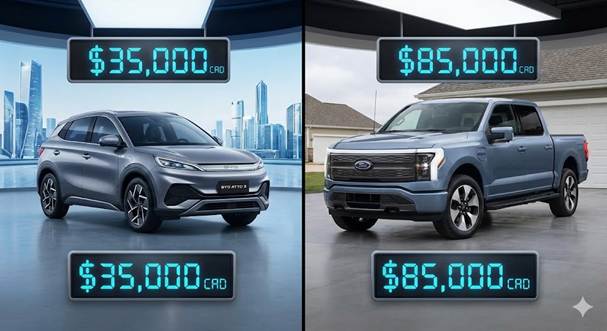
The Price Gap: China’s $35,000 Secret Weapon
The most immediate impact of this tariff reduction will be felt in the wallet of the Canadian consumer. For the past two years, Canadian EV adoption has stalled, with the country suffering the ignoble distinction of being one of the only major economies to see declining EV sales in 2025. The culprit? A lack of affordable options.
While American manufacturers have focused on high-margin electric trucks and luxury SUVs that often clear the $80,000 CAD mark, Chinese manufacturers have mastered the "value segment." Under the new agreement, Ottawa expects that within five years, more than 50% of the imported Chinese EVs will be priced under $35,000.
This is a price point that U.S. makers simply cannot currently match. China’s advantage isn't just cheap labor; it is a twenty-year head start in vertical integration. From controlling lithium mines to the world-dominant LFP (Lithium Iron Phosphate) battery technology produced by CATL and BYD, China can build a high-quality, 400km-range car for roughly 30% less than its Western counterparts. By reducing the tariff to 6.1%, Canada has effectively allowed these "budget" EVs to compete on a level playing field with domestic and U.S.-made cars for the first time.
Collateral Damage: The Impact on U.S. and Global Competitors
For the United States, this is a nightmare scenario. The integrated North American auto supply chain was built on the assumption of a unified trade front. Now, a "backdoor" has been opened. US-made EVs, which still rely on more expensive Nickel-Manganese-Cobalt (NMC) batteries and face higher production costs, will find it nearly impossible to compete with a $32,000 BYD Seagull or Atto 3 sitting on a lot in Toronto or Vancouver.
The impact isn't limited to the U.S. South Korean and Japanese automakers, who have also been slow to bring sub-$40k EVs to the Canadian market, will find their market share eroded. We are likely to see a "race to the bottom" in pricing, which, while great for the consumer and Canada’s climate goals, could lead to significant factory idling in Ontario and Michigan if those plants aren't quickly retooled for the affordable segment.
Furthermore, there is the risk of "policy fragmentation." If a car is built in Ontario using Chinese components or joint-venture technology, will it still be eligible for U.S. tax credits under the "Clean Vehicle" provisions of the Inflation Reduction Act? The legal and logistical headaches for OEMs operating on both sides of the border are about to become catastrophic.
Will the 6.1% Rate Go Viral?
One of the most pressing questions in the industry today is whether this "Canadian Model" will spread. The European Union has already implemented a tiered tariff system that is far more flexible than the U.S. "sledgehammer" approach. If Canada successfully attracts Chinese assembly plants—a key goal of the Carney-Xi deal—it creates a blueprint for middle-power nations to leverage Chinese tech while maintaining their own manufacturing base.
However, don't expect the U.S. to follow suit. Washington views Chinese EVs as a national security threat and a tool for "data harvesting." While Canada sees an affordable car, the U.S. sees a "computer on wheels" controlled by a foreign adversary. This fundamental disagreement ensures that the 49th parallel will soon become a stark divide in the global automotive trade.
Forecast: When Does China Take the Crown?
How long until Chinese EVs dominate the Great White North? The current quota of 49,000 vehicles represents roughly 3% of the Canadian market. It’s a modest start—a "controlled entry" designed to avoid a total collapse of the domestic sector. But the ceiling is set to rise to 70,000 within five years.
The real "dominance" won't come from imports, but from the joint ventures Carney is banking on. If BYD or Geely breaks ground on a plant in Ontario by 2028, we could see Chinese-designed, Canadian-built vehicles making up 20% to 25% of the market by 2032.
For U.S. car makers, the long-term prognosis is grim unless they can perform a radical pivot. If Detroit continues to ignore the "affordable EV" segment, they risk becoming a niche luxury player in Canada, while China captures the mass-market volume. The era of the "unbeatable" American auto hegemony in Canada ended the moment that 6.1% figure was inked in Beijing.

Wrapping Up
Canada’s decision to slash Chinese EV tariffs to 6.1% is a calculated gamble that prioritizes consumer affordability and agricultural exports over a unified trade front with the United States. While the initial 49,000-vehicle quota acts as a "speed bump," the long-term intent is clear: to integrate Chinese technology into the Canadian supply chain. For the U.S. auto industry, this represents a major breach in their northern defensive wall. Unless American OEMs can find a way to compete with the $35,000 price point, the Canadian car market of the 2030s will likely be defined not by the roar of a V8 from Detroit, but by the silent, cost-efficient hum of a motor from Shenzhen.
Would you like me to analyze the specific Chinese EV models most likely to hit Canadian dealerships first under this new quota?
Disclosure: Images rendered by Artlist.io and Nano Banana Pro.
Rob Enderle is a technology analyst at Torque News who covers automotive technology and battery developments. You can learn more about Rob on Wikipedia and follow his articles on Forbes, X, and LinkedIn.
Set Torque News as Preferred Source on Google
Follow us today...