
The automotive world is currently witnessing a phenomenon we haven't seen since the early days of the smartphone: a rapid, almost violent, technology-driven price correction. If you have been sitting on the sidelines of the electric vehicle (EV) revolution waiting for "the right time" to jump in, look no further. The floodgates have opened.
This year, a massive wave of off-lease EVs is hitting the secondary market, creating a "perfect storm" for buyers. Experts from Cox Automotive and Recurrent Auto have tracked a surge in inventory as the heavily subsidized leases of 2023 reach their 36-month conclusion. For the savvy consumer, this isn't just a market shift; it's a clearance sale on the future of transportation.
The Half-Price Hero: My $45,000 Steal
To understand the scale of the bargain, you only have to look at my own recent experience. I recently picked up a high-performance EV that was just two years old with barely 20,000 miles on the odometer. When new, the sticker price on this machine was well north of $100,000. I walked away with it for less than half of that.
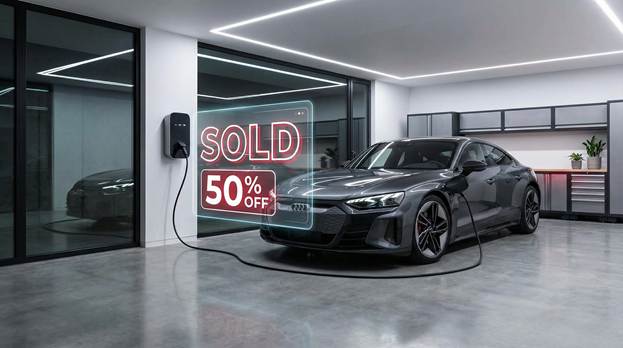
The car still smelled new. It still had the balance of the factory bumper-to-bumper warranty and nearly six years left on the battery warranty. This is the new reality of the EV market. Because the first-generation early adopters paid the "innovation tax," the rest of us can now enjoy the spoils. When you can buy a 2023 or 2024 model with cutting-edge tech for the price of a mid-range gas-powered Honda, the "math" of car buying changes forever.
What the Used Wave Means for the New Market
This influx of high-quality used stock is doing something fascinating—and terrifying for manufacturers—to the new EV market. When a three-year-old Tesla Model 3 or Ford Mustang Mach-E is available for $25,000, it makes a new $45,000 base model look like a poor financial decision.
As a result, we are seeing "negative equity" from leases forcing OEMs (Original Equipment Manufacturers) to rethink their pricing. To compete with their own used cars, manufacturers are being forced to slash MSRPs or offer eye-watering incentives on new models. This creates a feedback loop: lower new prices drive used prices even lower, cementing 2026 as the year the "mass market" EV finally arrived—it just happens to be a used one.
The "Safe Choice" Paradox
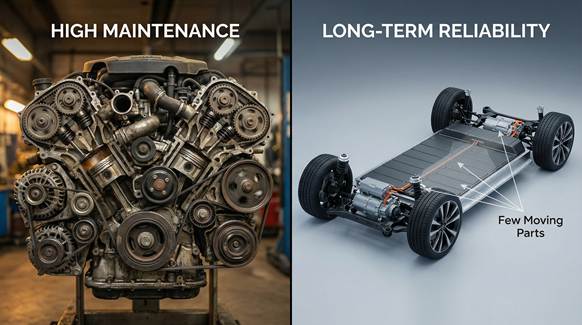
Many buyers are still terrified of used EV batteries, but the data tells a different story. In fact, buying a used EV is often safer than buying a used internal combustion engine (ICE) car.
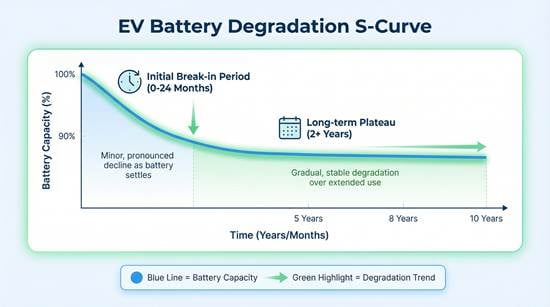
Most mechanical or software "infant mortality" issues in EVs—the bugs that haunt early production runs—tend to manifest within the first 10,000 miles. By the time an EV hits the used lot with 25,000 miles, it has been "vetted" by the previous owner. Furthermore, federal law in the U.S. mandates that EV batteries be warrantied for 8 years or 100,000 miles, and real-world studies from Geotab show that modern packs are losing only about 1.5% to 1.8% of their capacity per year. At that rate, the car's chassis will likely rust away before the battery becomes unusable.
The Best Used EVs to Buy Right Now
If you are ready to pull the trigger, some models represent significantly better value and long-term reliability than others. Here are my top picks for the 2026 used market:
- Chevrolet Bolt EV/EUV: The ultimate "bang for buck." You can often find these for under $15,000. They are incredibly serviceable, and most have already had their batteries replaced under recall, effectively giving you a "zero-mile" heart in a used body.
- Hyundai Ioniq 5 / Kia EV6: These models sit on a 800V architecture, meaning they charge faster than almost anything else on the road. They are built like tanks and are now hitting the $28,000–$32,000 range.
- Tesla Model 3 (2021+): Look for models with the Heat Pump and the LFP battery (Standard Range). They are incredibly reliable, have the best charging infrastructure, and parts are plentiful.
- Ford Mustang Mach-E: A great choice for those who want a "real car" feel. Serviceability is high because Ford dealers are everywhere, and the rapid depreciation has made the Extended Range models a steal.
When Will the Bleeding Stop?
You might be wondering if you should wait even longer for prices to drop further. My advice? Don't. We are approaching the "depreciation floor."
The rapid price drops we’ve seen over the last 24 months were driven by three things: a price war started by Tesla, a sudden oversupply of leases, and a lack of consumer confidence. By late 2026, the supply of off-lease vehicles will begin to stabilize. More importantly, as the public realizes that these batteries are lasting 200,000+ miles, the "fear discount" will evaporate. Once the used market matches the utility of the new market, prices will peg themselves to the cost of a comparable gas vehicle, and the era of the 50% discount will vanish.
Wrapping Up
The "massive wave" of used EVs isn't a sign of a failing technology; it’s a sign of a maturing market. For the first time, high-performance, long-range electric mobility is available at prices that undercut traditional economy cars. With battery longevity proven by data and warranties that protect you well into the next decade, the risk of "going electric" has never been lower. If you’ve ever wanted to drive a car that feels like a spaceship without the astronomical price tag, your window is officially open.
Disclosure: Images rendered by Artlist.io
Rob Enderle is a technology analyst at Torque News who covers automotive technology and battery developments. You can learn more about Rob on Wikipedia and follow his articles on TechNewsWord, TGDaily, and TechSpective.
Set Torque News as Preferred Source on Google
Follow us today...