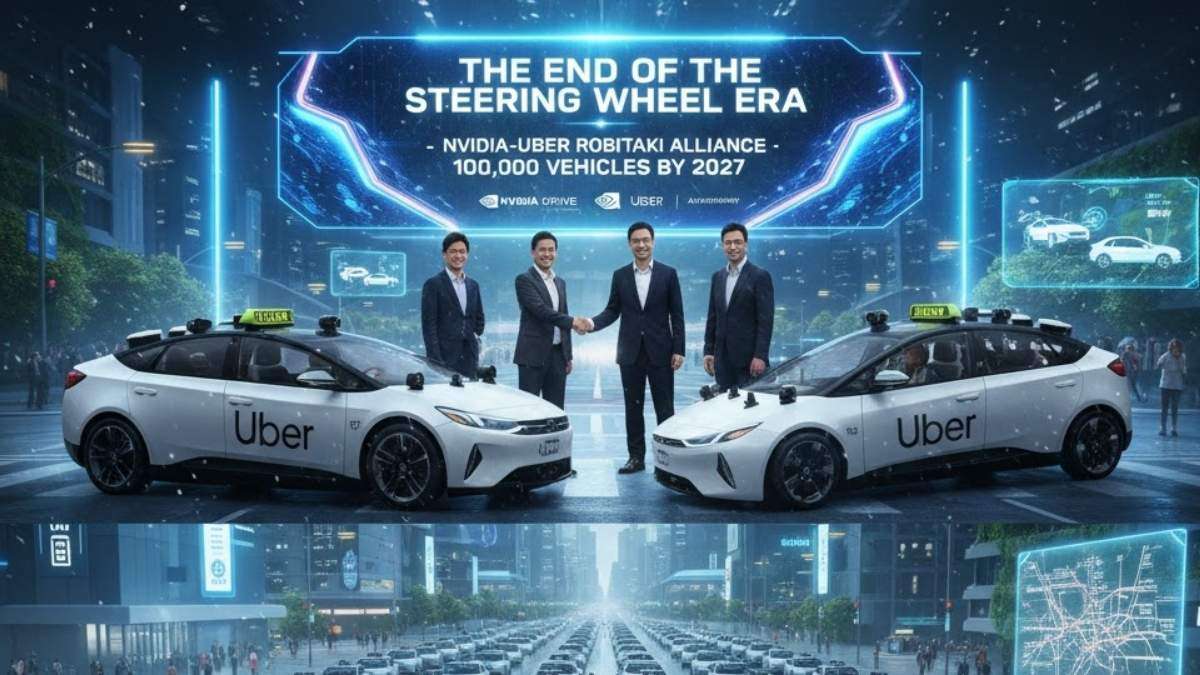

The neon lights of the Las Vegas Strip have always been a backdrop for the future, but at CES 2026, the future didn't just show up—it parked itself center stage. The bombshell announcement of the Nvidia Robotaxi Alliance—a strategic triumvirate between AI titan Nvidia, ride-hailing king Uber, and luxury EV maker Lucid Motors—has sent shockwaves through the automotive world.
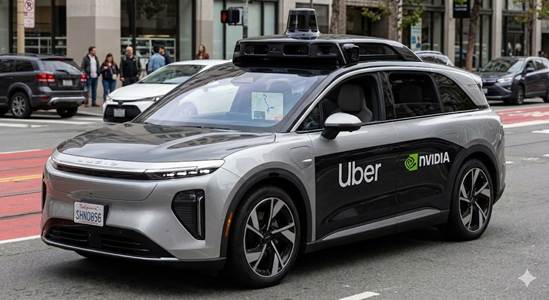
For years, the promise of a driverless society felt like a moving target, always "five years away." However, with the unveiling of the production-intent Lucid Gravity robotaxi, powered by Nvidia’s DRIVE AGX Thor and the new Alpamayo reasoning AI, the industry has finally hit its "ChatGPT moment" for physical movement.
The Alliance That Rewrote the Playbook
The Nvidia Robotaxi Alliance isn't just another pilot program; it is an industrial-scale offensive. By combining Nvidia’s massive compute power with Uber’s 150 million monthly active users and Lucid’s premium vehicle architecture, the group has solved the "scale" problem that has plagued solo efforts for a decade.
The centerpiece of this alliance is the Nvidia Alpamayo model. Unlike previous iterations of self-driving software that relied on rigid, hand-coded rules, Alpamayo uses vision-language-action (VLA) models to "reason" through traffic. If a ball rolls into the street, the AI doesn't just see an obstacle; it understands that a child is likely to follow. This human-like intuition is what Nvidia CEO Jensen Huang claims will reduce the "disengagement rate" to near zero, making the technology safe enough for mass public trust.
The Impact on the Autonomous Landscape
This alliance fundamentally changes the competitive landscape by moving away from proprietary "walled gardens." While companies like Tesla have historically kept their Full Self-Driving (FSD) stack locked within their own hardware, the Nvidia-led approach is more akin to the "Android of Autonomy."
By offering a certified, high-performance platform that multiple manufacturers can plug into, Nvidia is creating a standardized ecosystem. This puts immense pressure on other autonomous taxi efforts, such as Waymo and Zoox, to either lower their costs or expand their partnerships. We are seeing a shift from "who has the best sensor" to "who has the largest network." Uber’s decision to act as the "unified operating network"—integrating vehicles from Lucid, Stellantis, and even BYD—positions it as the gatekeeper of the robotaxi era.
The Uber Business Model: From "Gig" to "Grid"
For Uber, the transition to a fully autonomous fleet is an existential necessity. Currently, roughly 75% of a rider’s fare goes toward compensating the human driver. By removing the driver, Uber can theoretically slash prices by 50% or more while simultaneously increasing its own profit margins.
However, this transition is a double-edged sword for their business model:
- Asset-Light vs. Fleet-Heavy: Uber is attempting to remain "asset-light" by partnering with companies like Lucid and Nuro rather than owning the cars. The goal is for third-party fleet owners to manage the maintenance, cleaning, and charging, while Uber takes a platform fee.
- The Price War: With no driver costs, ride-sharing could become cheaper than owning a personal car. This would expand Uber’s total addressable market from "people who need a ride" to "everyone who needs to move."
The "Big Societal Question" for Drivers
The elephant in the room remains the millions of independent contractors who currently drive for Uber and Lyft. Uber CEO Dara Khosrowshahi has admitted that robotaxis could displace drivers in the next 10 to 15 years.
While the short-term future involves a "hybrid network" where humans handle difficult routes and weather conditions, the long-term outlook is clear. Uber is already pivoting its "earner base" toward other roles, such as helping AI companies label data or maintaining the very robotaxis that replaced them. But for the average gig worker, the "flexibility" of the gig economy is rapidly approaching a hard expiration date.
Who Can Stand Against the Nvidia Alliance?
Despite the Nvidia-Uber-Lucid juggernaut, the race is far from over. Several key players have the capital and the data to compete:
Company
Competitive Advantage
The Challenge
Waymo (Alphabet)
100+ million miles driven; highest safety record in the industry.
Scaling manufacturing; currently depends on custom-built fleets.
Tesla
Billion-mile data advantage from consumer cars; massive manufacturing scale.
Vertical integration makes it difficult for them to "partner" with others.
Lyft & Mobileye
Asset-light strategy using Holon Urban Shuttles.
Currently trailing Uber/Waymo in total city deployments.
Baidu (Apollo Go)
Dominance in the Chinese market; already operating millions of driverless rides.
Geopolitical tensions and data-sharing regulations in Western markets.
Waymo remains the "gold standard" for safety, but Tesla’s sheer volume of real-world data remains a formidable threat. If Elon Musk can truly crack "Unsupervised FSD" by the end of 2026 as promised, the battle will become one of Nvidia’s "Reasoning AI" vs. Tesla’s "End-to-End Neural Nets."
The Timeline: When Do the Drivers Go Home?
Estimating the complete elimination of human drivers requires looking past the technology and toward regulation and infrastructure.
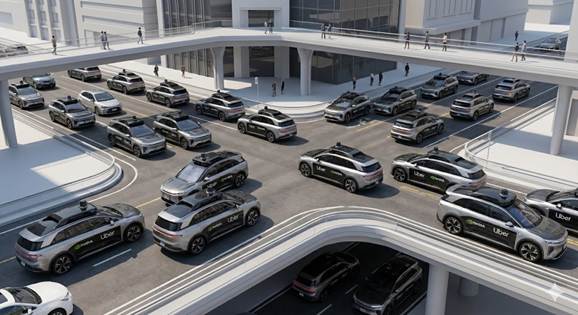
- 2026–2030 (The Hybrid Era): Expect to see robotaxis in every major "tier-1" city (SF, LA, Phoenix, Austin, London). Humans will still be required for rural areas, extreme weather, and complex "edge cases."
- 2030–2035 (The Mass Adoption): As the cost of a robotaxi ride drops below $0.50 per mile, the economic incentive for human drivers will vanish.
- 2040 (The Complete Transition): Most experts, including Uber’s CEO, predict human drivers will be largely eliminated from ride-sharing by 2040.
What Will Cause the Final Elimination?
The "complete" elimination of humans won't be caused by a single software update, but by insurance and legislation. Once data proves that autonomous vehicles are 10x safer than humans (a milestone Waymo is already approaching), the insurance premiums for human-driven commercial vehicles will become prohibitively expensive. Eventually, cities may even ban human drivers from "high-density zones" to eliminate traffic congestion caused by human error and slow reaction times.
Wrapping Up
The Nvidia Robotaxi Alliance unveiled at CES 2026 is the clearest sign yet that the "science fiction" of autonomous mobility has transitioned into "industrial reality." By uniting the world’s most powerful AI chips with the world’s largest ride-sharing network, the alliance has created a blueprint for a post-driver world. While competitors like Waymo and Tesla offer formidable alternatives, the scale of the 100,000-vehicle commitment starting in 2027 sets a new pace for the entire industry. For the millions of people who currently make a living behind the wheel, the message from Las Vegas is clear: the steering wheel is becoming an optional accessory.
Disclosure: Images rendered by Artlist.io
Rob Enderle is a technology analyst at Torque News who covers automotive technology and battery developments. You can learn more about Rob on Wikipedia and follow his articles on Forbes, X, and LinkedIn.
Set Torque News as Preferred Source on Google
Follow us today...