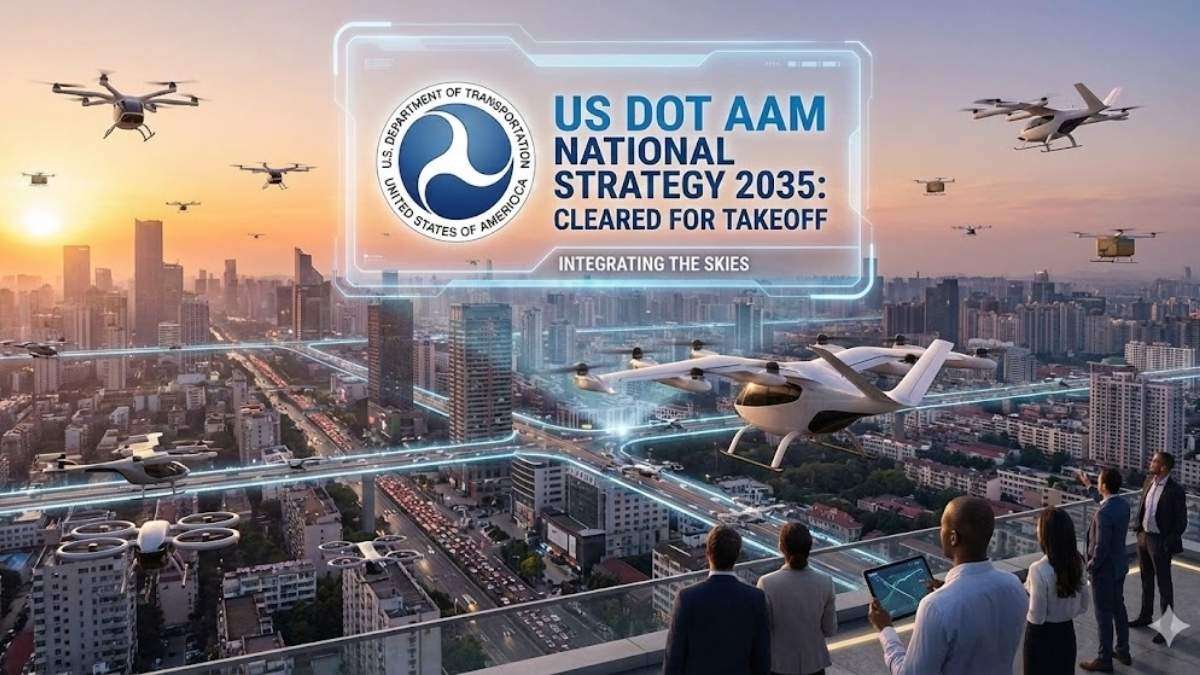

The dream of the "flying car"—or more accurately, Electric Vertical Takeoff and Landing (eVTOL) aircraft—has long been a staple of science fiction. Over the last decade, however, billions of dollars in investment have moved that dream from fiction to friction-filled reality. Companies like Joby Aviation and Archer Aviation are currently flight testing real hardware. But the biggest hurdle hasn’t just been gravity and battery density; it’s been regulatory uncertainty.
Last week, that uncertainty significantly diminished. The US Department of Transportation (DOT) officially released its comprehensive Advanced Air Mobility National Strategy: A Bold Policy Vision for 2026–2036, charting a course for the integration of air taxis and advanced drones into the national airspace through 2035. This isn't just paperwork; it is a major policy win that signals the U.S. government is finally ready to move from observing the sector to actively facilitating it.
Here is why this strategy is pivotal and what it means for the future of personal transportation.
Why This Strategy is a Critical Policy Win
For years, the AAM industry has been operating in a "wild west" environment, developing technology faster than regulators could define the rules. Investors are wary of ambiguity. By releasing this interagency strategy, the DOT has provided the one thing capital markets crave most: certainty.
This document goes beyond the Federal Aviation Administration (FAA). It coordinates efforts across the Department of Homeland Security, the Department of Energy, and NASA. It acknowledges that AAM isn't just about certifying a plane; it's about cybersecurity, energy grid demands, and national security. This whole-of-government approach validates the sector as a national priority, ensuring the U.S. doesn't fall behind in the next great leap in transportation technology.
Impact on the Air Taxi Timeline
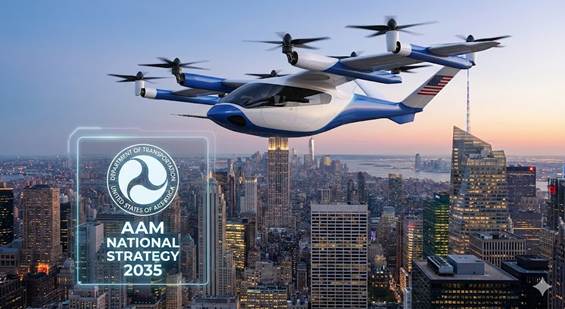
Will this strategy mean you’ll be flying to work next year? No. Leading players like Joby Aviation are already deep into the FAA type certification process, aiming for limited commercial launch around 2025-2026. In fact, Joby just announced that the new strategy aligns perfectly with their commercial launch plans, calling it a "pivotal step."
However, the strategy drastically affects the scaling timeline. Certification allows the first plane to fly; the National Strategy allows the thousandth plane to fly efficiently. By addressing airspace integration and automation goals now, the DOT is trying to prevent a future bottleneck where we have certified aircraft but nowhere to fly them because the air traffic control system can't handle the volume. The strategy explicitly targets "Initial Operations" by 2027 and full integration of autonomous systems by 2035.
What Else Needs to Happen?
The aircraft are merely the visible tip of a massive infrastructure iceberg. For flying cars to become common, several other things must happen simultaneously with aircraft development.
The Vertiport Puzzle: We need physical locations for takeoff, landing, and passenger processing. These "vertiports" need to be integrated into existing city landscapes—on top of parking garages, near transit hubs, or retrofitted onto existing heliports.
The Energy Grid: Charging a fleet of eVTOLs requires immense power. A recent NREL study indicated that a busy vertiport could have power demands comparable to a small town. Utilities need to upgrade grid capacity at these locations to handle rapid, high-voltage charging sessions without causing local brownouts.
Public Acceptance: This is perhaps the hardest hurdle. Communities need to be convinced that these vehicles are safe and, crucially, quiet. While eVTOLs are significantly quieter than helicopters, having hundreds buzzing overhead is a new environmental factor that requires community engagement, a point heavily emphasized in the DOT strategy document.

The Global Race for the Skies
The U.S. is not operating in a vacuum. The European Union Aviation Safety Agency (EASA) has been aggressive in establishing its own regulatory framework for eVTOLs, often moving faster than the FAA on specific certification standards. Meanwhile, China has adopted a pragmatic approach, allowing companies like EHang to conduct extensive real-world operational tests. In fact, EHang received a production certificate from the CAAC earlier this year, putting them technically ahead in terms of regulatory approval for mass production.
The DOT’s strategy is a necessary response to this global competition. It is an acknowledgment that if the U.S. wants to set the global standards for AAM technology and safety, it needs a unified national front rather than a piecemeal regulatory approach.
When Will We Reach "Critical Mass"?
We need to define "critical mass." If it means seeing an air taxi occasionally, that will happen between 2026 and 2028 in select early-adopter cities like New York or Los Angeles, likely on premium routes (e.g., airport to downtown).
However, critical mass—where taking an air taxi is as normal as taking an Uber Black—requires two things: scale and automation. The initial flights will be piloted, which keeps costs high. The DOT strategy looks toward 2035 for significant integration of autonomous systems.
Realistically, we will likely see a scaled network where prices become accessible to the upper middle class around 2030-2032. True democratization, driven by pilot-less flight, is likely a post-2035 reality, contingent on the successful rollout of the automation outlined in the new strategy.
A Vision of the Future
When personal flying vehicles become common, the very architecture of our cities will shift. The focus will move upward. Rooftops, currently utilized for HVAC units, will become prime real estate for transit hubs.
Regional connectivity will explode. A 100-mile trip that currently takes two and a half hours in traffic will become a predictable 40-minute hop. This could redefine suburbia, allowing people to live further from city centers while maintaining reasonable commute times. The low-frequency hum of electric rotors will replace the harsh chop of helicopters, creating a new, busier, but hopefully sustainable soundscape over our heads.
Wrapping Up
The DOT’s National Strategy for AAM is not a magic wand that solves all engineering challenges overnight. It is, however, the essential foundation upon which a new industry can be built. By providing regulatory clarity and interagency support through 2035, the U.S. government has signaled that the era of personal flying vehicles is no longer a question of "if," but a highly structured plan of "when." The hardware is almost ready; now the paperwork is catching up.
Set Torque News as Preferred Source on Google
Follow us today...