
As the automotive world descends upon Las Vegas for CES 2025, the narrative shift is undeniable. The most crucial battleground in the industry is no longer just about battery range or 0-60 times; it is about the digital soul of the machine. The "software-defined vehicle" is here, and leading into this year's show, one clear victor is emerging in the fight for the premium dashboard: Qualcomm.
While many competitors will make noise at CES, industry analysis suggests that Qualcomm’s Snapdragon Cockpit Elite platform has effectively become the default choice for next-generation premium electric vehicles. With a staggering design-win pipeline and a technology stack that addresses the specific needs of modern automakers, Qualcomm is expected to announce further major partnerships at the show, cementing its dominance.
Here is a look at how the mobile chip giant conquered the automotive dashboard and why its latest platform is leaving competitors behind.
The Quiet Conqueror: Qualcomm’s Automotive Ascent
Qualcomm’s success in automotive wasn't an overnight phenomenon; it was a calculated strategic pivot born from its dominance in the smartphone sector. They recognized early that as cars became "computers on wheels," the requirements for power efficiency, always-on connectivity, and integrated processing would mirror mobile devices, just on a massive scale.
By leveraging their expertise in ARM-based computing and 5G connectivity, Qualcomm created the "Snapdragon Digital Chassis." This approach allowed automakers to move away from fragmented, multi-supplier electronic control units (ECUs) toward centralized, powerful Systems-on-Chip (SoCs).
The results speak for themselves. Qualcomm currently boasts an automotive revenue pipeline exceeding $45 billion, with relationships across nearly every major global automaker, from GM and BMW to Hyundai and Ferrari. They didn't just enter the market; they redefined how OEMs handle in-vehicle infotainment (IVI).
The Snapdragon Cockpit Elite Advantage
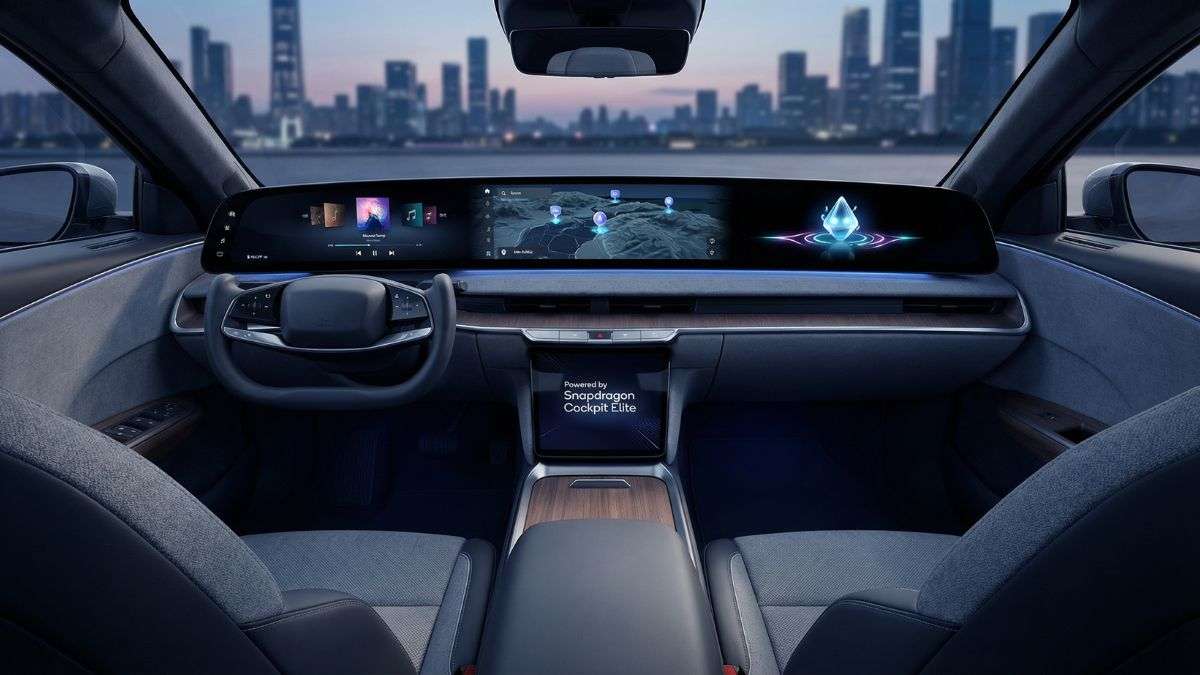
Heading into CES, the focus is on the Snapdragon Cockpit Elite. This isn't just another processor; it’s a platform debuting Qualcomm's custom Oryon CPU architecture in the automotive space, designed specifically for the intense demands of premium EVs.
But why are OEMs choosing this over rivals like Nvidia or Intel?
- Vs. Nvidia: Nvidia is a powerhouse in AI and graphics, and their Drive Thor platform is formidable. However, Nvidia’s heritage in high-end gaming GPUs often translates to higher power consumption and thermal output—significant challenges in an EV where every watt counts toward range. Qualcomm, with its mobile DNA, excels in performance-per-watt efficiency. Furthermore, the Snapdragon Cockpit Elite offers unrivaled integration of connectivity (5G, Wi-Fi 7) directly onto the SoC, something Nvidia often requires separate modules for.
- Vs. Intel and Others: While Intel has a strong foothold in ADAS through Mobileye (discussed below), their cockpit presence has struggled against ARM-based architecture. The Snapdragon Cockpit Elite’s ability to handle multiple high-resolution screens, complex 3D graphics, and—crucially—on-device generative AI for voice assistants without needing the cloud gives it a distinct edge over x86 alternatives in a modern vehicle environment.
The Cockpit Elite is winning because it is the most balanced, integrated solution for a premium "digital cockpit" experience that demands both high performance and energy efficiency.
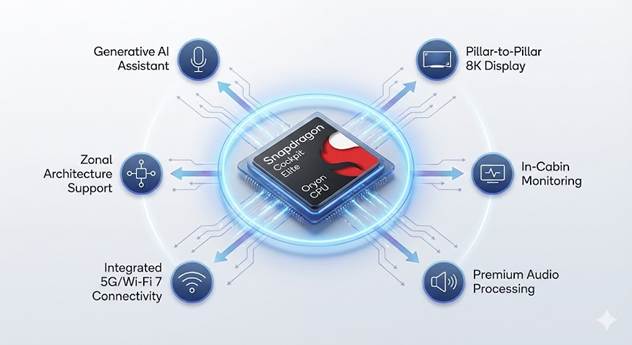
[IMAGE SUGGESTION: A graphical representation of a System-on-Chip (SoC). The center chip is labeled "Snapdragon Cockpit Elite / Oryon CPU." Arrows point outwards to various car functions: "Generative AI Assistant," "Pillar-to-Pillar 8K Display," "In-Cabin Monitoring," "Premium Audio," and "Integrated 5G/Wi-Fi 7."]
Beyond the Dash: Outperforming in ADAS
While the cockpit is the visible battleground, Qualcomm is also making significant strides in Advanced Driver Assistance Systems (ADAS) with its Snapdragon Ride platform.
For years, Mobileye (an Intel company) was the undisputed king of ADAS, providing "black box" vision solutions that worked well but offered automakers little flexibility. Nvidia countered with massive, open compute power for autonomous driving development.
Qualcomm carved a lucrative middle path. Snapdragon Ride offers scalable, open solutions. It allows automakers to scale from basic Level 2+ safety features up to premium Level 3 automated driving using the same architectural family. This flexibility, combined with their ability to integrate ADAS and Cockpit functions onto fewer chips, appeals immensely to automakers trying to simplify complex vehicle architectures and reduce costs.
The "Intel Inside" Moment for Cars
We are rapidly approaching a tipping point where the average consumer will start caring about who makes their car's brain. For decades, car buyers cared about horsepower, leather quality, and sound systems. Today, the frustration of a laggy touchscreen, a slow voice assistant, or obsolete maps is a primary pain point.
Premium EV buyers are beginning to understand that the longevity and quality of their vehicle depend on the computing hardware. A car powered by a Snapdragon Cockpit Elite platform ensures headroom for years of Over-the-Air (OTA) updates, enabling new features and maintaining resale value.
Just as PC buyers learned to look for the "Intel Inside" sticker in the 90s to ensure quality, car buyers in the late 2020s will likely seek out vehicles powered by established tech giants. Knowing your $80,000 EV has a Qualcomm processor rather than generic, underpowered silicon will become a critical purchasing factor.

Wrapping Up
CES 2025 will undoubtedly feature flashy prototypes and wild concepts. But the real story will be found in the press releases confirming production partnerships. Qualcomm has effectively utilized its mobile heritage to build an automotive juggernaut that balances power, efficiency, and connectivity better than its rivals. As the Snapdragon Cockpit Elite becomes the standard-bearer for premium EV experiences, Qualcomm isn't just participating in the software-defined vehicle revolution—they are supplying the ammunition.
Disclosure: Images rendered by Artlist.io
Rob Enderle is a technology analyst at Torque News who covers automotive technology and battery developments. You can learn more about Rob on Wikipedia and follow his articles on Forbes, X, and LinkedIn.
Set Torque News as Preferred Source on Google
Follow us today...