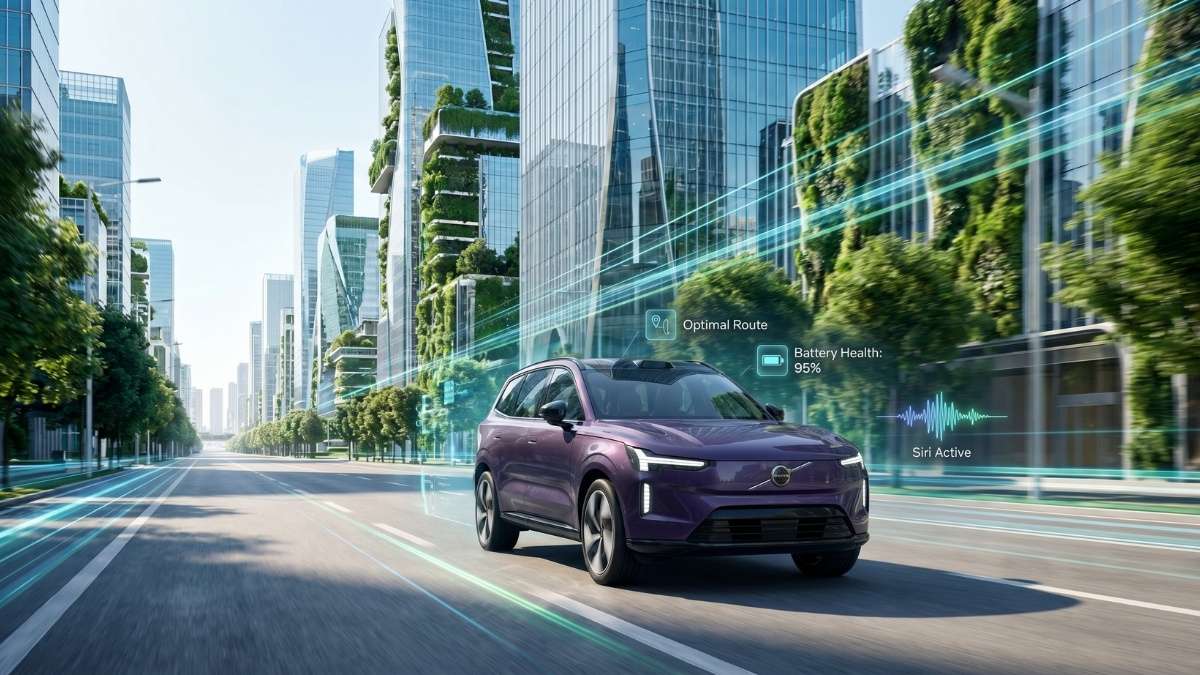

If you have followed my columns over the years, you know I have a complicated relationship with the "smart" tech in our cars. For a long time, "smart" was marketing-speak for "a menu system designed by someone who clearly hates you." But we’ve hit a massive inflection point. Apple’s latest move to deeply integrate advanced AI into CarPlay is not just another software update; it’s a fundamental shift in the relationship between man and machine. I want to call out a similar column on Android Auto by John Goreham.
According to the latest reports on iOS 26.4 CarPlay support, Apple is moving past simple screen mirroring and into the realm of total vehicle integration. We aren't just talking about a better way to skip a song on Spotify anymore. We are talking about a car that knows you’re cranky because you skipped breakfast and adjusts the cabin temperature and GPS route accordingly.
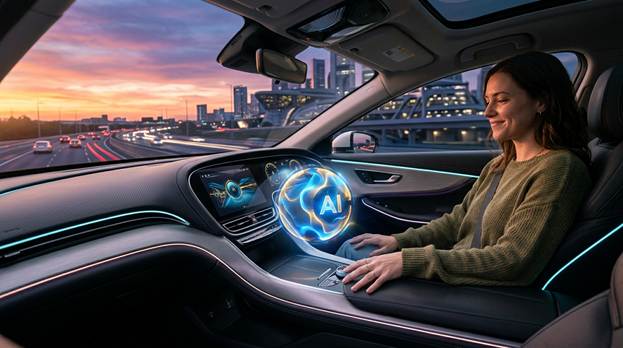
The Digital Butler in the Dashboard
The new Apple CarPlay is hosting a suite of AI models—not just a revamped Siri, but hooks into ChatGPT and Apple’s own proprietary "Apple Intelligence" local models. The advantage here is "Contextual Awareness." In the past, if you told your car you were hungry, it might give you a list of every McDonald's within fifty miles. Today’s AI understands that you’re on a diet, you’re in a hurry, and you’re driving a car that’s currently low on windshield wiper fluid.
By hosting these diverse AIs, Apple allows the car to act as a filter. ChatGPT handles the complex, conversational queries ("Tell my kids a story about a dragon who loves electric cars"), while Apple’s local AI handles the privacy-sensitive data like your calendar and home security status. This improves the car ownership experience by turning the vehicle into a proactive assistant rather than a reactive tool.
Ending Road Rage with Emotional Intelligence
We’ve all been there. Someone cuts you off on the I-405, and suddenly your blood pressure is high enough to power a small village. This is where Apple’s AI shines. By monitoring cabin cameras and voice tonality, the AI can detect rising frustration levels.
Imagine a scenario: You yell a choice word at a delivery van. Instead of the car remaining silent, the AI - let's call it "Calm Siri" - immediately lowers the volume of your heavy metal playlist, dims the ambient lighting to a soothing blue, and asks, "It looks like you're stressed, Rob. Should I find a route with less traffic or perhaps play that Jazz album you like?" It’s hard to maintain a level five rage when your car is essentially offering you a digital valium.
This impacts traffic significantly. High-stress drivers make poor decisions. By smoothing out the emotional spikes of thousands of commuters, AI can actually reduce the "accordion effect" in traffic jams caused by aggressive braking and lane-weaving.
The Death of Range Anxiety and the EV Revolution
The biggest hurdle for EV adoption remains range anxiety. People are terrified of being stranded in a cornfield with 1% battery. Apple’s new integration solves this by talking directly to the car’s battery management system.
Take the upcoming Volvo EX-60, which is set to feature built-in Google Gemini. While some might see Apple and Google as rivals, the future is "Co-opetition." Apple CarPlay will likely bridge the gap, allowing your iPhone to communicate with the Volvo’s Gemini-powered systems.
Here’s a story: I’m driving a Volvo EX-60 from San Jose to Lake Tahoe. The AI knows the elevation gain is going to eat my battery. It doesn't just show me chargers; it coordinates with the charging stations to reserve a spot based on my real-time ETA. If the wind picks up (increasing drag), the AI recalculates and suggests I drop my speed by 5 mph to ensure I arrive with 10% remaining. It turns a high stress "will I make it?" gamble into a choreographed, stress-free dance.
Taming the Backseat Monsters: Long Trips with Kids
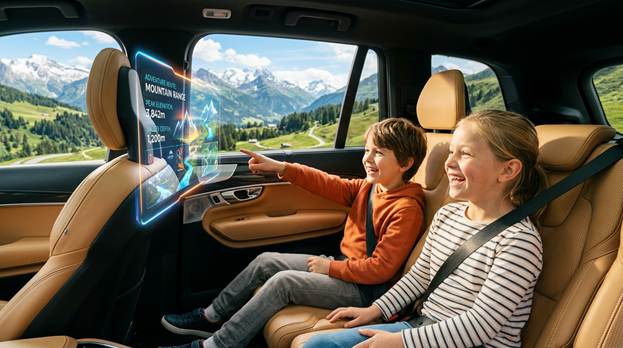
If you have children, you know that "Are we there yet?" is the verbal equivalent of a waterboarding session. Apple’s AI-hosted CarPlay turns the car into a mobile learning center and entertainment hub.
Because the AI has access to the external cameras, it can engage the kids with "Interactive Sightseeing." The AI can narrate the history of the landmarks you’re passing or start a game of "I Spy" using the car’s object recognition sensors. "I spy a red truck in the right lane—can you find it?" This isn't just a distraction; it's an immersive experience that prevents the "digital isolation" of everyone just staring at their own separate iPads.
Law Enforcement and the Rules of the Road
This is where things get a bit "Minority Report." With AI deeply embedded in the driving experience, your relationship with law enforcement will change. Apple’s AI can act as a "Compliance Coach."
Instead of getting a ticket for doing 45 in a 35 zone you didn't realize changed, the AI can gently vibrate the steering wheel and say, "The limit just dropped, slowing you down to keep your record clean." It’s much cheaper to have an AI nudge you than to pay a fine and watch your insurance premiums skyrocket. For manufacturers, this data—kept private through Apple’s encryption—can prove the safety of their vehicles, leading to lower fleet insurance costs.
The Volvo EX-60 and the Gemini Factor
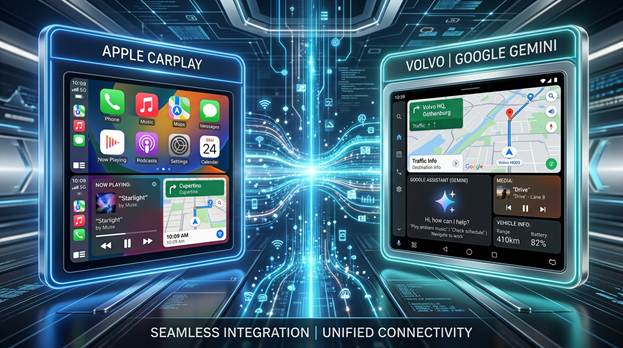
The Volvo EX-60 is a fascinating example of the "Dual-Brain" car. With Google’s Gemini built into the hardware and Apple CarPlay running on top, we are seeing a platform war move into the driveway. However, for the user, this is a win.
The built-in Gemini handles the "Vehicle Operations" - the deep-level diagnostics, the regenerative braking maps, and the HVAC. Apple CarPlay handles the "Personal Life" - your messages, your curated playlists, and your smart home. This synergy means the car is no longer a "dumb" vessel for your phone; it is a collaborative partner. If Gemini notices a tire is low, CarPlay can automatically find a shop near your next calendar appointment and ask if you want to book a service.
The Commute as a Productivity Powerhouse
For the daily commuter, this AI integration turns "dead time" into "lead time." We’ve had voice-to-text for years, but it was clunky. New AI can summarize twenty unread emails and ask, "Your boss is asking about the quarterly report; should I draft a reply saying you'll have it by 2 PM based on your current progress?"
It moves the needle from "distracted driving" to "assisted productivity." Because the AI is smart enough to know when traffic is heavy, it will refuse to read you a complex email when you need to focus on a merge, waiting instead for a straight stretch of highway. This is the kind of safety-first thinking that regulators love.
Wrapping Up
Apple’s move to bring high-level AI into the car via CarPlay is the most significant automotive advancement since the introduction of the seatbelt. By hosting sophisticated AI models, Apple isn't just making cars "smarter"—it's making them more human.
We are looking at a future where:
- Road Rage is mitigated by emotional AI.
- Range Anxiety is eliminated through predictive logistics.
- Commuting becomes a period of high-level personal assistance.
- Manufacturers like Volvo benefit from a more engaged, satisfied customer base.
The car is finally becoming what it was always meant to be: an extension of our homes and offices, rather than just a way to get between them. As these systems roll out in iOS 26.4 and beyond, the "driving experience" will shift from the mechanics of the road to the quality of the journey. And honestly? I can’t wait to let my car handle the stress while I handle the music.
Disclosure: Images rendered by Artlist.io
Rob Enderle is a technology analyst at Torque News who covers automotive technology and battery developments. You can learn more about Rob on Wikipedia and follow his articles on TechNewsWord, TGDaily, and TechSpective
Set Torque News as Preferred Source on Google
Follow us today...