
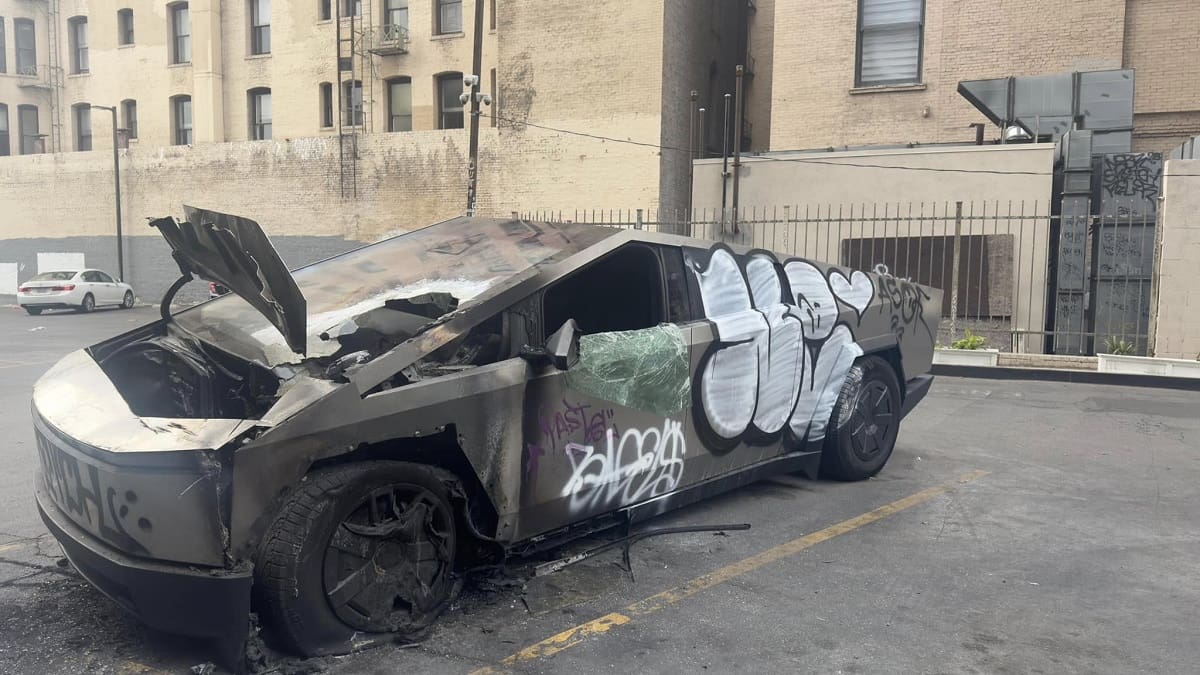

The future looked really bright for the Tesla Cybertruck back in early 2021 when it had over a million reservations, and Elon Musk estimated that Tesla could sell about a half-million trucks annually. Things continued to look good after its first year of production, as Tesla managed to ship about 46,000 units. This wasn’t a bad production ramp for the first year of a new vehicle with a production line capacity of 125,000 units per year. However, between then and now, the situation has become dire.
Social media is adding to the Cybertruck’s gloomy outlook. Let’s start with a long thread on Reddit about used Cybertruck prices:
zman0900 made the original post:
“According to an estimate obtained in Tesla’s app by an owner, a $100,000 AWD Foundation Series with about 6,200 miles on the odometer is now worth $65,400.”
On another Reddit thread, a Model 3 owner posted his impressions of the Cybertruck:
“I had a Cybertruck as a loaner while my model 3 was in service. I’d describe it as a vehicle that wasn’t meant to be driven.
The variable ratio steering, gear noise, yoke, buttons for signals are all either bad choices or bad design.
The worst thing of all is the flat-ish windshield and the multi-tone glare shield causing continuous glare right in your eye line.”
Finally, this comment captures the mood of another long Reddit thread about Cybertruck being a bust posted by InfamousBird3886:
“It’s enormous, impractical, breakable, hideous, and extremely unsafe. There’s basically no use case. If the reliant robin didn’t exist, I might argue that it’s the worst vehicle ever made.”
The Decline Is Accelerating
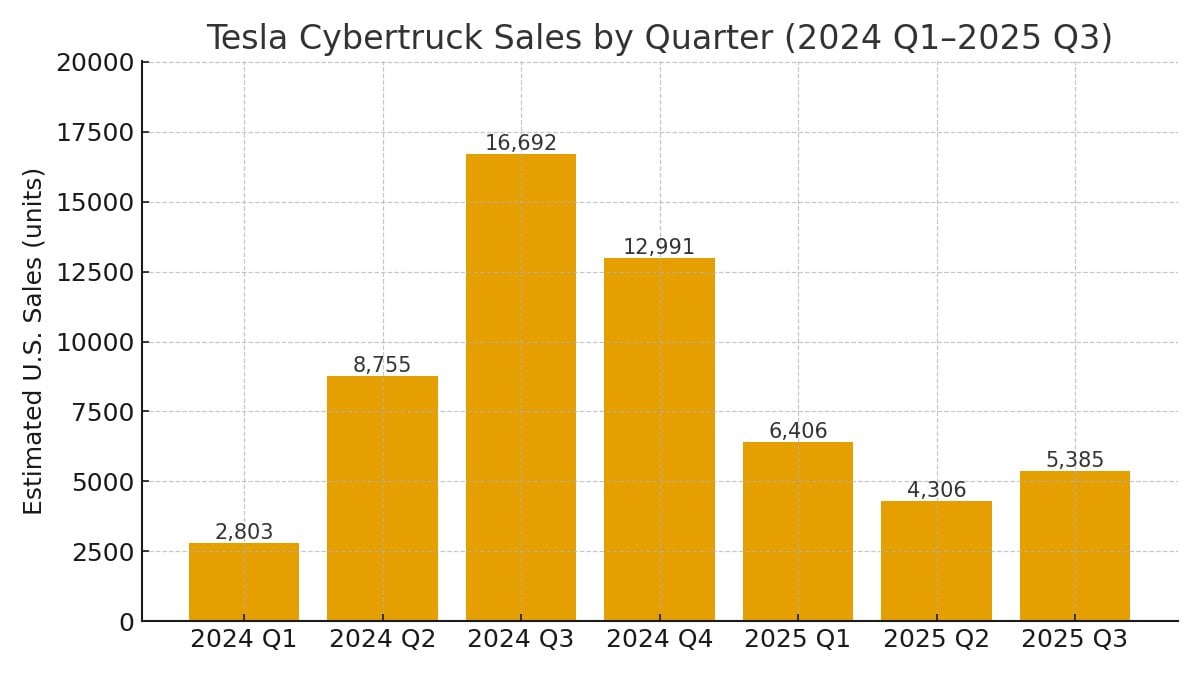
In the first half of 2025, Tesla has only managed to ship about 16,800 Cybertrucks. What’s worse is that the decline in sales seems to be accelerating. According an estimate by Cox Automotive, Tesla could only sell 5,385 Cybertrucks in the third quarter of 2025. This is down 63% from the previous year. It is absolutely terrible performance considering the fact that overall EV sales in the U.S. increased by over 40% in the third quarter. The third quarter performance was bolstered by the fact that it was the last quarter in which the federal EV tax credit was active. Even with the rush to buy EVs before the federal tax credit expired, Cybertruck sales dipped.
Industry experts put the cost of the Cybertruck production line in Austin, TX at around $1.1 billion. The Cybertruck has an estimated gross margin of about $16,000 which means that Tesla will need to sell about 68,750 Cybertrucks just to recoup the cost of the production line. As of mid-2025, approximately 46,000 to 50,000 Cybertrucks have been sold in total, though exact figures can vary by estimate. This means that Tesla will struggle to recoup its initial investment, let alone drive a profit from the Cybertruck.
How long can a company sit on almost a billion dollars of unsold inventory? Multiple outlets have reported that Tesla reached an inventory of over 10,000 Cybertruck units in early May 2025. With an average sales price of about $78,000, Tesla could be sitting on almost $800 million in Cybertruck inventory. At this level of inventory, the company will almost certainly need to curtail or stop production.
Before we get into the inside baseball below, Tesla has already started cancellations which could be indications about the Cybertruck’s future. Tesla recently canceled the least expensive rear-wheel-drive (RWD) model due to low demand and high price. This version was removed from the online configurator in September 2025. The remaining models available are the dual-motor all-wheel drive and the Cyberbeast. Also, the company has discontinued components like the range extender.
Europe Says No to Cybertruck
Europe is a big market for Tesla, but the Cybertruck won’t be sold there. In 2024, Europe made up approximately 18% of Tesla's unit sales.
It appears that the Tesla Cybertruck is not being allowed in Europe due to safety and design regulations, specifically its sharp-edged, stainless-steel body, which violates EU rules for protecting pedestrians, cyclists, and motorcyclists. The vehicle's weight also exceeds the 3.5-ton threshold for certain vehicle categories and would require speed limiters not included on the current model. As a result, the Cybertruck lacks the required EU type-approval and cannot be registered for public roads.
Another indication that the Cybertruck has European problems is the U.S. Army. The U.S. Army has confirmed that its personnel cannot import the truck into Europe due to non-compliance issues. The Tesla Cybertruck has not been officially banned in Europe, but it is effectively prohibited from being sold or registered because it does not meet EU safety regulations.
While it may be possible to get a single vehicle approved through a more rigorous, low-volume process, the general mass-market "type approval" required for sale is not possible in its current form.
A Possible Short-Term Fix
It looks like Tesla has started to sell stranded Cybertruck inventory to other companies controlled by Elon Musk. There are reports that SpaceX and xAI are purchasing hundreds and possibly thousands of Cybertrucks to absorb supply and support quarterly sales results. This further fuels the perception that they Cybertruck is a commercial flop while leaving open questions about true retail demand and long-term viability.
What The Cybertruck Will Leave Behind
Although it doesn’t look long for this earth, the Tesla Cybertruck is a revolutionary vehicle by many standards. From its 48-volt electrical architecture to the use of giga castings, much of what was perfected in the Cybertruck will no doubt find its way into future vehicles.
Stainless steel body panels take a huge step towards eliminating planned obsolescence by resisting the corrosion that once pushed drivers into new cars every four or so years. Cybertruck panels do not need paint and they do not rust, which supports the concept of a “million-mile chassis.” Skipping paint also trims cost and environmental impact. Paint shops demand giant buildings, tight climate control, extensive robotics, and advanced filtration, which adds up to hundreds of millions of dollars. They also use large amounts of energy and water while emitting VOCs, hazardous waste, and greenhouse gasses from ovens and solvents.
Moving from 12 volts to 48 volts required an engineering investment and supplier support, since most auto parts are standardized on 12 volts. Tesla had to solve safety concerns, electrical noise, and sourcing gaps to make the switch work. The reason is simple physics. Power lost as heat is equated as I (current) squared R (resistance), so raising voltage lowers current and cuts waste. Most important, the 48-volt architecture enables the use of thinner wire, which means heavy eight-gauge copper can give way to lighter eighteen-gauge strands. The result is lower cost, less heat, lower weight, and steadier power for steer by wire, brake by wire, and autonomy sensors.
Large high pressure aluminum die castings, called “giga castings,” form the front and rear of the structure in single shots. This approach replaces more than 170 stamped and welded pieces with two integrated sections. The change removes many welds, fasteners, and lengthy quality checks while shrinking the robot count on the line. Labor and tooling can be reduced by meaningful margins, with estimates near 40% for those areas. The structure becomes more rigid, crash performance improves, and production scales with cleaner, simpler steps.
The Cybertruck is the first production truck with steer by wire. Steer by wire removes the mechanical link between the yoke and the wheels, using sensors and actuators to translate driver inputs in real time. The ratio tightens for easy parking and relaxes at highway speeds, while rear wheel steering gives a large truck the agility of a smaller vehicle. The design reduces parts and unlocks features for off road control and future autonomy. With steer by wire, tradeoffs remain since software faults and power loss must be covered by robust backups, and some drivers still prefer traditional road feel.
What Do You Think?
Should Tesla pause, pivot, or push harder on Cybertruck marketing as volumes fall?
If Cybertruck went away tomorrow, what lessons should the industry keep from this experiment?
Chris Johnston is the author of SAE’s comprehensive book on electric vehicles, "The Arrival of The Electric Car." His coverage on Torque News focuses on electric vehicles. Chris has decades of product management experience in telematics, mobile computing, and wireless communications. Chris has a B.S. in electrical engineering from Purdue University and an MBA. He lives in Seattle. When not working, Chris enjoys restoring classic wooden boats, open water swimming, cycling and flying (as a private pilot). You can connect with Chris on LinkedIn and follow his work on X at ChrisJohnstonEV.
Photo credit: Heera Kapoor (with permission)
Set Torque News as Preferred Source on Google
Follow us today...


Comments
Lesson for the industry: don…
Permalink
Lesson for the industry: don't do Nazi salutes and/or endorse white supremacy. It's objectively bad for business.
"Large high pressure…
Permalink
"Large high pressure aluminum die castings, called “giga castings,” form the front and rear of the structure in single shots. This approach replaces more than 170 stamped and welded pieces with two integrated sections. The change removes many welds, fasteners, and lengthy quality checks while shrinking the robot count on the line."
Also results in higher repair costs and easier damage. It's no wonder people have broken their CTs by towing heavy loads.
"Moving from 12 volts to 48 volts required an engineering investment and supplier support, since most auto parts are standardized on 12 volts... which means heavy eight-gauge copper can give way to lighter eighteen-gauge strands. The result is lower cost, less heat, lower weight, and steadier power for steer by wire, brake by wire, and autonomy sensors."
When was the last time you were inside a car's electrical system? A majority of the wiring is 18 AWG or smaller. This was done solely to save money and create a propriety vehicle system that could only be $erviced by Tesla...
"The Cybertruck is the first production truck with steer by wire. Steer by wire removes the mechanical link between the yoke and the wheels, using sensors and actuators to translate driver inputs in real time."
Considering the number of deaths by Tesla's "self-driving" mode, I would rather not trust an important function like steering to Tesla's software.
None of the above mentioned "features" revolutionize the auto industry in any way. They are just gimmicks to sell a bad car.
I was one of the early…
Permalink
I was one of the early reservation holders for the $49K AWD Cybertruck. When the production version came out 63% higher in price, I decided not to buy it. The reason there were so many preorders in the first place was simple—it was a great value. That value disappeared when they added things most of us didn’t ask for, like rear-wheel steering, and dropped the true exoskeleton design that was originally promised. It’s really just stainless body panels over a frame now.
All that being said, I’ve had the 48-hour test drive, and I can honestly say it’s not even close to any other truck or car—it’s the best vehicle I’ve ever driven. The power, the steer-by-wire, the adjustable suspension, and the overall tech are second to none.
I still think if Tesla can bring the AWD version down to around $59K (without scaling it down like they did for the rear-wheel-drive model with cloth seats and stripped features), it would sell like crazy—just like it would have from the start.
I love the truck and truly hope they keep building it. The only real fear out there is a major price drop like the $20K hit the Model Y saw. Nobody wants to take that kind of loss. But if they can stabilize pricing and hit that $59K target, it’ll be the hit Tesla expected it to be.
Soon as I read clams that…
Permalink
Soon as I read clams that corrosion is a concern for a 4 yo car i knew the writer had NO CLUE of what they are talking about. Unless you live inside a salt mine, no modern car, ironically other than the Cybertruck, corrodes that quickly...none. This is coming from a mechanic in the US Northeast corridor. The cybertruck on the otherhand DOES rust which we have seen tons of complaints, and has all these special care procedures for this supposed tough exterior that a painted car doesn't. Seems like a fan boy that writes about cars because they've been privileged enough to test drive a bunch but doesn't actually know anything about the ins and outs outside of the manufacturers talking points. This article is a joke.