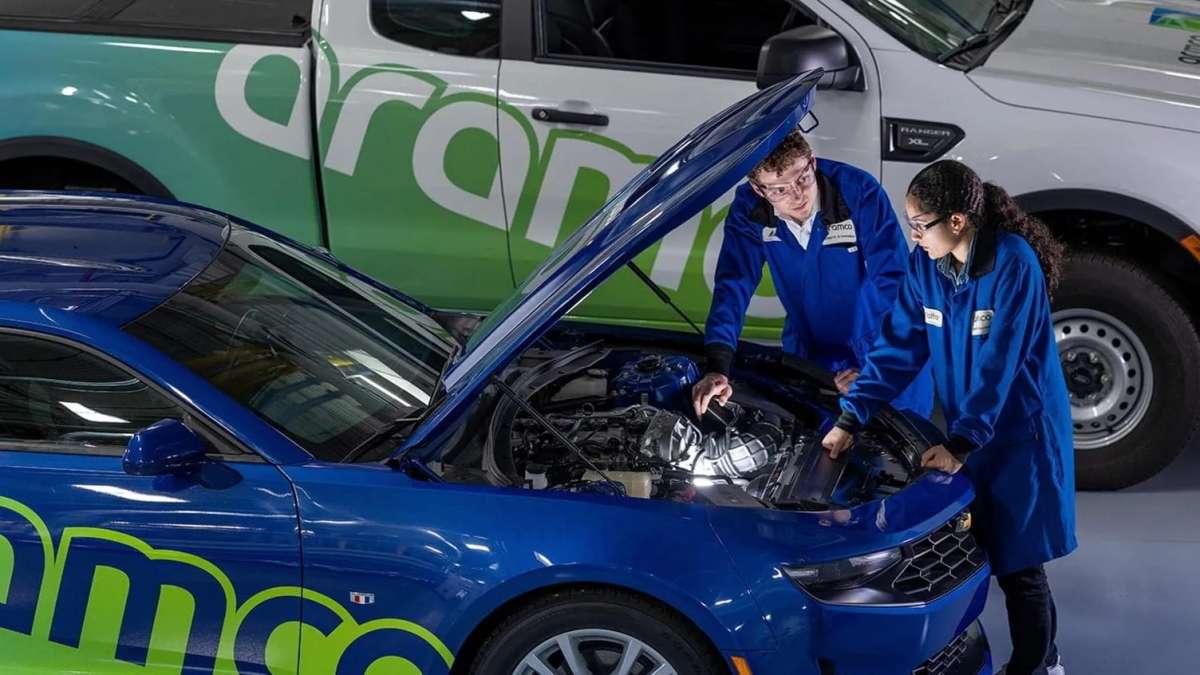

Every now and then, we get a practical example of how the internal-combustion engine can still evolve. There are many examples such as Mazda’s Skyactiv engines, Koenigsegg’s Freevalve technology, synthetic fuels, and more. The latest development comes from Saudi oil company, Aramco, and it puts a new meaning behind the term “electrified powertrains”.
Aramco calls it the “Dedicated Hybrid Engine” (DHE),
The new engine is 35 percent more efficient than a comparable engine. It also achieves an efficiency of 41-42 percent, which is almost double that of a conventional gasoline engine. The engine achieves this through a simple design and two electric motors, mounted on each end of the crankshaft.
The design is based around a 1.6-liter, OHV (pushrod), inline-three engine with two valves per cylinder (versus the usual four). It also uses a monoblock construction and a longer stroke, prioritizing low-end torque and more efficient thermal management.
The new system provides flexibility and scalability.
In its current state, the internal-combustion engine can serve purely as a power generator, working steadily, while the electric motors handle various loads. However, the DHE is also designed to be able to work in tandem with the electric motors and provide power to the wheels.
Having two electric motors on each end of the crankshaft translates to superior torque control. Some details, like the timing system, are omitted, but considering the simplified pushrod design, Aramco’s DHE will likely feature a timing chain or timing gears. With the two electric motors directly connected to the crankshaft, the timing components will need to be extra robust.

While the prototype engine features a 1.6-liter displacement, the simple construction allows for easy scalability. A 3.2-liter V-6 is possible, by joining two monoblocks. Early prototypes were tested on a midsize sedan, which prompted the development of a turbocharged variant, due to greater power demands in certain scenarios.
As the name suggests, Aramco’s Dedicated Hybrid Engine is developed for a series of hybrid applications from day one, rather than being adapted for that, post-production. This, alongside other aspects of the engine (mentioned above), reduces manufacturing costs by as much as 25 percent, compared to a conventional hybrid engine. Moreover, auxiliary systems like the water pump are electrically driven, instead of belt-driven, negating mechanical drag.
The oil giant is collaborating with a French engineer, Pipe Moters, who possesses extensive experience in motorsports. The engine was first unveiled at the SAE World Congress Experience in Detroit back in April 2026. Aramco is actively seeking production partners for its innovative engine. This is a big step in keeping the internal-combustion engine relevant, while serving as a bridge technology in regions with insufficient EV infrastructure.
Other advancements that work to prolong the ICE lifespan.
-
Synthetic fuels - Porsche currently has one active plant dedicated to producing eFuels. However, the Chile facility’s current production output of 130,000 liters (34,000 gallons) per annum is not sufficient. Toyota and Exxon Mobil have joined forces and already have a successful project with vehicles running on synthetic fuels. The only challenge remains scaled production and distribution.
-
Mazda Skyactiv - these engines have been around for a decade now, but the Japanese company is continuing to evolve the technology. In fact, the next-generation Mazda MX-5 Miata will get a larger, but more efficient Skyactiv-Z engine. These engines use high compression ratio and utilize a combination of both diesel and gasoline engine cycles.
-
Mazda Mobile Carbon-capture system - Last year, Mazda showcased the Vision-X coupe concept, which features an interesting piece of tech. The system works with crystalline zeolite substrate pellets that absorb C02 emissions, before they leave the exhaust. These pellets will be replaced at gas stations. The system is not a replacement for particulate filters, but rather an addition. Mazda is planning to test the feasibility in motorsports. The issue is that it further complicates the emissions-dedicated periphery of modern vehicles, while the exhausted pellets require gathering and recycling.
Aramco’s Dedicated Hybrid Engine sounds like the perfect middle ground between having an internal-combustion engine and reducing the carbon footprint of cars. Would you like to see a version of this engine enter production? Share your thoughts in the comments below.
About the author
Dimitar Angelov has been an automotive journalist since 2014. His passion for cars and motorcycles led him to take up classic car restoration at the Classic Car Museum in Malta. While living there, he also graduated with a Master's in Media and Communications. Aside from Torquenews, his work can also be seen on Topspeed.com, HotCars.com, Motorheads.com, Jalopnik.com, and his own website, Ridereverie.com, where he also includes motorcycle content.
Image source: Aramco
Set Torque News as Preferred Source on Google
Follow us today...