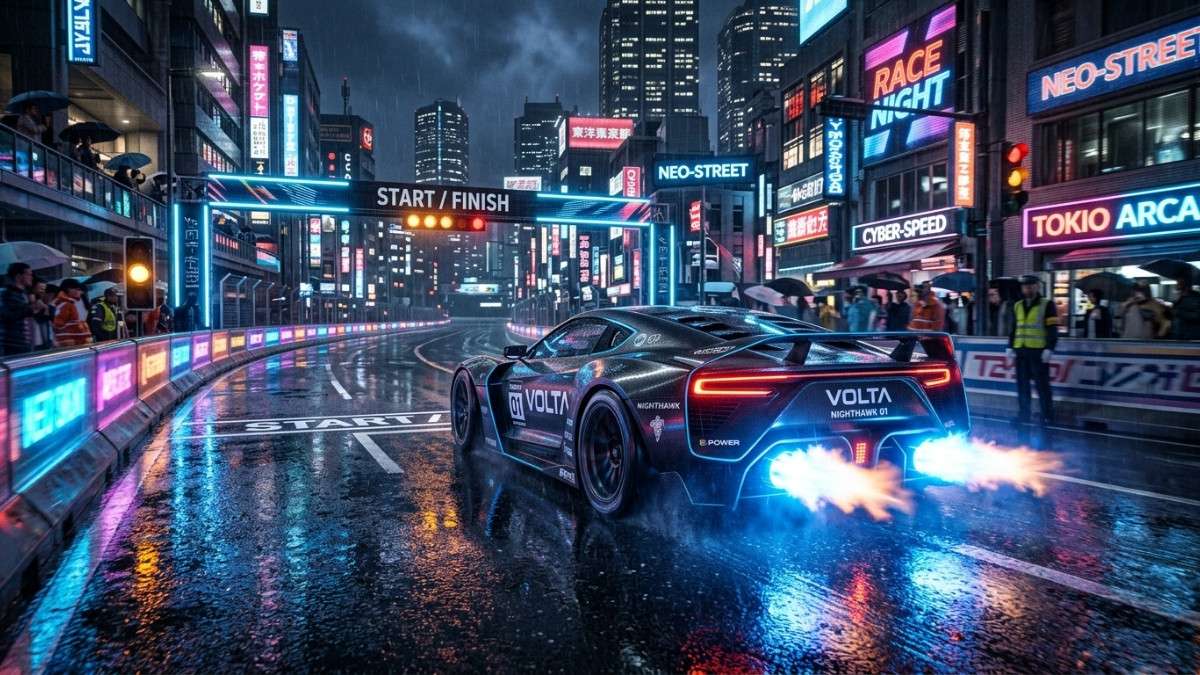

The automotive industry has consistently operated on a razor-thin edge between profound technological advancement and reckless absurdity. For decades, manufacturers have chased the elusive goal of ultimate performance, pushing the boundaries of combustion, aerodynamics, and, more recently, electric battery architecture. However, we are now entering a deeply concerning era where the fundamental definition of a street-legal automobile is being blurred with that of a low-altitude missile. The catalyst for this latest arms race isn't a legacy automaker from Stuttgart or Detroit, but rather a Chinese electronics firm best known for manufacturing high-end cordless vacuum cleaners.
Recently, Dreame unveiled its highly anticipated Nebula Next 01 Jet EV Concept, a vehicle that essentially straps aerospace-grade rocket propulsion units to an electric sports car chassis. Unveiled during their tech conference in San Francisco, the Jet Edition is claimed to feature a dual solid-fuel rocket booster system generating a peak thrust of 100 kN. The result is an almost incomprehensible zero-to-sixty sprint of 0.9 seconds.
This concept serves as a direct, aggressive challenge to Elon Musk’s long-standing promise of a SpaceX-package Tesla Roadster, which aims to utilize cold-gas thrusters to achieve similarly staggering acceleration. As a strategic technology analyst, I spend a significant amount of time evaluating the integration of autonomous systems, 800V architectures, and advanced safety sensors in modern EVs. I'm currently planning to purchase a Volvo EX60, a vehicle that epitomizes pragmatic safety and intelligent design. In stark contrast, the emergence of rocket-assisted hypercars represents a terrifying pivot. We must ask ourselves: are these companies solving a legitimate performance bottleneck, or are they recklessly creating an unmanageable public safety nightmare?

The Complex Mechanics of Integrated Thrust
To understand why rocket boosters are suddenly appearing on electric vehicle blueprints, we have to look at the fundamental physics of tires and asphalt. Modern electric motors are incredibly efficient at delivering instant, massive torque to the wheels. However, the limiting factor in any car's acceleration is the friction coefficient between the rubber tire and the road surface—often referred to in engineering circles as the tire's "mu."
Once an electric motor delivers enough power to overcome that mechanical grip, adding more horsepower is a futile exercise; it merely results in spinning tires and burnt rubber. High-performance electric vehicles have essentially maxed out the physical limitations of street-legal tire compounds.
Rocket or jet propulsion completely bypasses this mechanical limitation. Because thrust acts independently of the friction between the tire and the road, it provides a brute-force push that effectively ignores the pavement. Whether it's the solid-state rocket technology proposed by Dreame or the compressed air systems championed by Tesla, the integration of independent thrust allows a chassis to accelerate at rates previously confined to Top Fuel dragsters and fighter jets. But thrust doesn't just push a car forward; it can be vectored to push a car downward, creating artificial aerodynamic grip without the drag penalties associated with massive rear wings. While the engineering is fascinating, applying it to a consumer product borders on madness.
Comparing Tesla and Dreame: Compressed Air Versus Solid Fuel
The approaches taken by Tesla and Dreame highlight the differing philosophies in this bizarre new micro-segment. Tesla’s proposed "SpaceX Package" relies on cold-gas thrusters. This system essentially uses the car's battery to power a hyper-efficient pump, compressing ambient air into massive, ultra-high-pressure composite over-wrapped pressure vessels (COPVs) located where the rear seats would normally be. When released, the compressed air provides a sudden, violent burst of thrust. It is theoretically safer from a thermal perspective, as it does not involve combustion, but it requires lugging around heavy, highly pressurized tanks.
Dreame, leveraging its background in developing incredibly fast, compact digital motors for vacuums, has taken a decidedly different route. The Nebula Next 01 Jet Edition claims to use a solid-fuel rocket booster system. This suggests a chemical reaction, which inherently introduces immense heat, volatility, and exhaust challenges.
There is a monumental difference between engineering a digital motor to suck dust out of a carpet and engineering a solid-fuel rocket to propel a two-ton vehicle safely down a highway. Both systems face a severe energy density bottleneck. Sustaining thrust requires either massive amounts of compressed air or highly volatile propellants, neither of which are practical for a vehicle intended for anything beyond a single, quarter-mile demonstration. The reality is that these systems are incredibly complex, heavy, and offer zero practical utility for a daily driver.
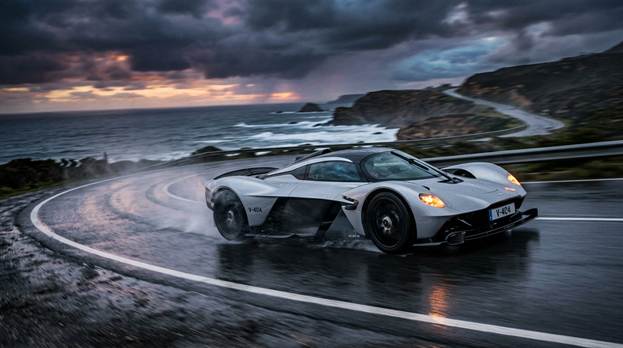
The Terrifying Reality of Sub-Two-Second Acceleration
When we discuss a vehicle accelerating from zero to sixty miles per hour in 1.8 seconds—or the 0.9 seconds claimed by Dreame - we are no longer talking about a driving experience; we are talking about a physiological event. Such acceleration exerts longitudinal forces well in excess of 1.5 Gs.
For a highly trained professional driver strapped into a multi-point harness with a HANS device, these forces are manageable. For an average consumer, sudden and unexpected exposure to this level of G-force can lead to momentary disorientation, target fixation, and even a mild "grey-out" where blood drains from the head, resulting in a temporary loss of situational awareness.
The most profound danger, however, does not lie in a straight line; it lies in the corners. If a driver uses a rocket thruster to achieve 60 mph in a fraction of a typical braking zone, they will enter corners carrying an insurmountable amount of kinetic energy. Standard carbon-ceramic brakes and DOT-approved tires cannot dissipate that energy quickly enough to prevent a catastrophic crash. Furthermore, if vectoring thrusters are used to dynamically increase downforce during a high-speed turn, any software glitch or mechanical failure in that system would result in an immediate and violent loss of traction. When I drive around Bend, Oregon during the winter, relying on my home's Yarbo robot to clear the driveway snow, I'm constantly reminded of how easily traction is lost in standard conditions. Introducing vectoring rocket thrust into unpredictable real-world environments is an engineering disaster waiting to happen.
The Demographic Dilemma: Age and Hypercars
We must also confront the socio-economic reality of the hypercar market. Vehicles equipped with aerospace propulsion systems will easily command price tags deep into the six-figure, or even seven-figure, range. The primary buyer demographic for these extreme machines consists of highly affluent individuals, typically in their late 50s, 60s, or 70s.
From a biological standpoint, this creates a terrifying mismatch between human capability and machine output. Research consistently shows that reaction times and visual processing speeds decline as we age. A driver in their 60s simply does not possess the central nervous system reflexes required to safely manage a vehicle that alters its physical trajectory in milliseconds.
We have already witnessed numerous incidents involving high-performance EVs where drivers, unaccustomed to instant electric torque, have mistakenly depressed the accelerator instead of the brake, launching their cars into storefronts or traffic. Imagine the scale and severity of such an accident when the misapplied pedal is directly linked to a 100 kN solid-fuel rocket booster. Putting this level of unadulterated, violent power into the hands of aging hobbyists is a recipe for catastrophic, high-visibility tragedies.
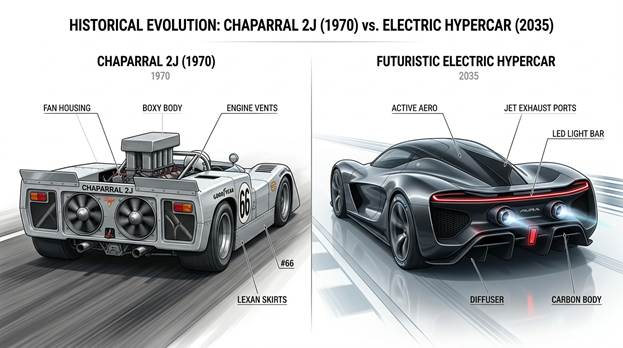
A Look Back: Fans, Rockets, and Track Bans
Attempting to cheat the physical limitations of mechanical grip using air and thrust is not a new concept in the automotive world; it simply has a long history of being banned or abandoned. In the world of motorsport, the most famous example is the Chaparral 2J from 1970. This radical race car used a secondary snowmobile engine to power two massive fans at the rear, sucking the car down onto the track. It generated immense downforce at any speed, but it was quickly banned because it was deemed too dangerous and kicked up massive amounts of debris into the faces of trailing drivers.
More recently, the McMurtry Spéirling resurrected this "downforce-on-demand" fan concept, famously shattering the outright hillclimb record at the Goodwood Festival of Speed. It proved that manipulating air is the ultimate performance hack, but the Spéirling is a dedicated track weapon, not a vehicle designed for a trip to the grocery store.
If we look at actual rockets, the 1928 Opel RAK.2 utilized 24 solid-fuel rockets to reach 238 km/h. It was a spectacular publicity stunt, but it ended there. The market, and sensible engineering, has historically rejected these systems for civilian use because they are deafeningly loud, incredibly dangerous, and entirely impractical.
Infrastructure and the Future of Rocket-Congested Streets
If these aerospace-inspired automotive technologies ever reach critical mass, our current civil infrastructure is entirely unprepared to handle them. Consider the reality of a busy suburban intersection where a driver decides to aggressively launch a rocket-boosted vehicle.
The immediate noise pollution would be deafening, violating local ordinances instantly. More concerning is the exhaust. Whether it is a super-heated chemical discharge from a solid-fuel rocket or a violently compressed air blast from a cold-gas thruster, the backdraft could easily strip the paint off the vehicle behind it, melt the asphalt, or cause severe injury to a pedestrian standing on the curb. My wife Mary and I manage a household with four dogs—Fable, Dolly, Adonis, and Winston—and two cats. The sheer auditory trauma of a rocket car launching down a residential street would be a neighborhood nightmare.
To mitigate these risks, regulatory bodies will be forced to intervene aggressively. We are already seeing the beginnings of this in places like South Australia, which recently implemented a mandatory U-class license training course specifically for drivers of ultra-high-powered vehicles. If rocket cars become a reality, we will undoubtedly see the creation of specialized licensing tiers, mandatory track-only restrictions for thruster deployment, and potentially crippling insurance premiums. We are steadily moving toward a dystopian future where "driving" a car is replaced by "navigating a ground-level projectile," and our legal and insurance frameworks are vastly ill-equipped to handle the liability.
Wrapping Up
The automotive industry's pursuit of zero-to-sixty times under one second, as demonstrated by the Dreame Nebula Next 01 Jet Edition and the Tesla Roadster SpaceX package, represents the ultimate triumph of "can" over "should." While the engineering capability to strap aerospace thrusters to electric sedans certainly exists, the biological limitations of the human body and the infrastructural constraints of our public roads dictate that this is a dangerous dead end.
We are manufacturing consumer machines that are fundamentally too fast for human reflexes, too powerful for public asphalt, and too hazardous for daily life. While I firmly believe that technological innovation is the lifeblood of the automotive industry, when that innovation involves unleashing solid-fuel rockets in suburban neighborhoods, we have crossed the line from progress into absurdity.
Disclosure: Images rendered by Artlist.io
Rob Enderle is a technology analyst at Torque News who covers automotive technology and battery developments. You can learn more about Rob on Wikipedia and follow his articles on TechNewsWord, TGDaily, and TechSpective.
Set Torque News as Preferred Source on Google
Follow us today...