
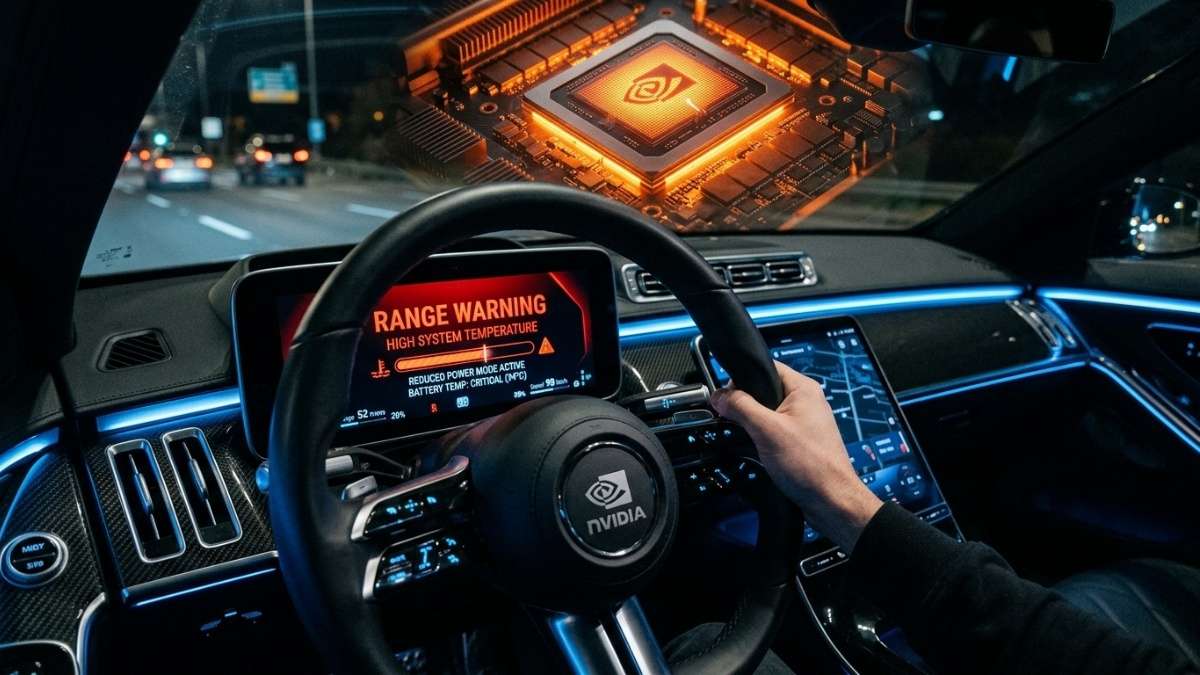

In the high-stakes race toward full vehicle autonomy, the industry has long been obsessed with TOPS (Tera Operations Per Second). The logic was simple: more compute equals safer driving. However, as the latest generation of high-performance AI silicon hits the pavement, a cooling reality check is setting in. We are witnessing a technical "tug-of-war" where the very brain required to navigate the car is cannibalizing the energy needed to move it.
At the center of this controversy is Nvidia. While the company dominates the AI data center and the nascent autonomous driving (AD) market, its latest automotive iterations are running so hot they are significantly reducing EV range during summer conditions. This thermal inefficiency isn't just a minor engineering hurdle; it is a fundamental design flaw that might force automakers to look toward more energy-conscious competitors like Qualcomm and AMD.
The State of the Drive: The Long Road to Level 4 and 5
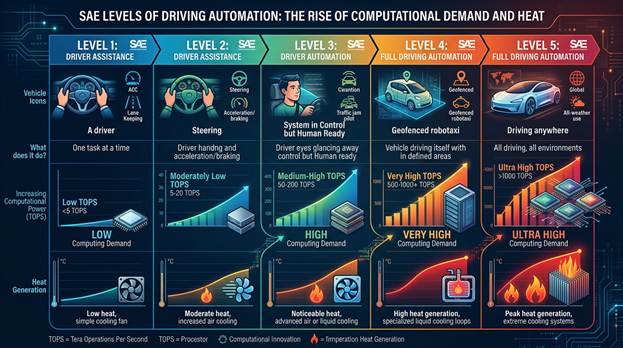
To understand why we are pushing silicon to its thermal limits, we must look at where we stand on the SAE levels of driving automation. Currently, the industry is firmly entrenched in Level 2+ and early Level 3. We have "hands-off" systems, but "eyes-off" remains a legal and technical rarity.
Level 4 autonomy - where the car can handle all driving tasks within a specific "geofence" -is likely viable for consumer vehicles by 2028-2030. However, the jump to Level 5 (true go-anywhere, any-condition autonomy) remains a decade or more away. The complexity of "edge cases" requires an exponential increase in processing power, which in turn demands sophisticated liquid cooling systems that drain the main traction battery.
According to recent industry reports, including OICA’s latest summary of global automotive trends, the path to Level 5 is being hampered by infrastructure readiness and the energy cost of the onboard "supercomputers" needed to process vision and LiDAR data in real-time.
Nvidia’s "Power-First" Blind Spot
Nvidia has built a trillion-dollar empire on the back of raw performance. From the GeForce gaming cards to the Blackwell data center architecture, their philosophy is "performance at any cost." But in the automotive world, "cost" is measured in miles of range.
In the PC market, Nvidia has faced criticism for designing GPUs so large they require massive aftermarket cases, leading to widely reported issues with 12VHPWR power connectors. In the data center, the Blackwell B200 architecture is pushing the limits of liquid cooling, requiring facilities to undergo massive, expensive retrofits just to keep the processors from thermal throttling.
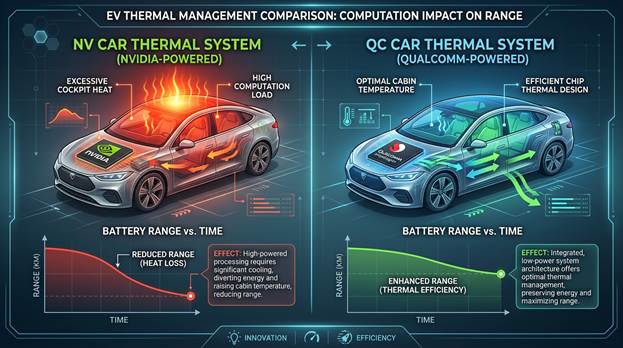
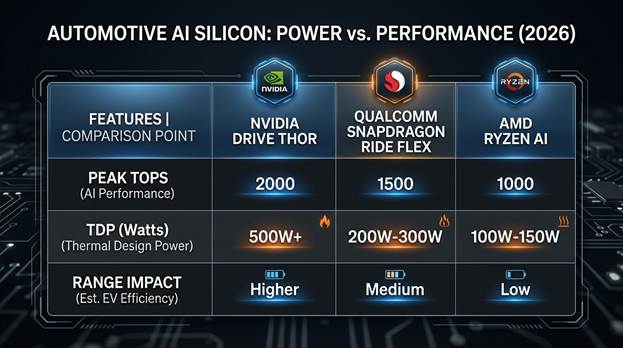
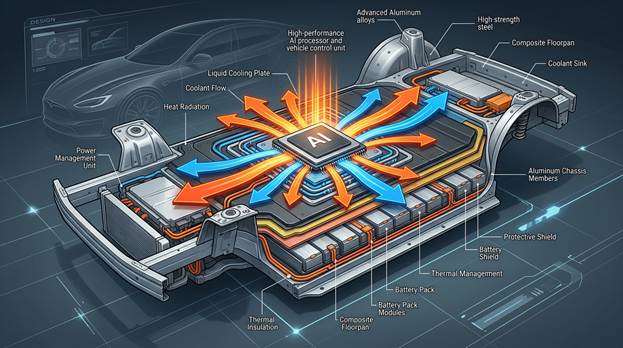
This "don’t listen, just build bigger" attitude has now migrated to the automotive sector. Nvidia’s latest DRIVE Thor platform is a marvel of AI throughput, delivering over 1,000 TOPS, but it is incredibly power-hungry. Reports indicate that Nvidia's high-performance modules can draw up to 130W per chip, leading to a massive thermal load. On a 95-degree summer day, when the battery already requires significant cooling, this parasitic load can reduce an EV’s range by 10% to 15%.
The Opportunity for Qualcomm and AMD
While Nvidia focuses on brute force, competitors are finding an opening by prioritizing "performance per watt."
- Qualcomm: The King of Efficiency
- AMD: The Adaptive Listener
Qualcomm spent decades perfecting the smartphone chip, where thermal throttling is the enemy. Their Snapdragon Ride Platform and the new Snapdragon Ride Flex SoC are built on this heritage. Qualcomm’s architecture is inherently more efficient at managing heterogeneous computing tasks without the massive thermal spikes seen in Nvidia’s monolithic designs.
AMD has a history of listening to customer pain points to gain market share. In the automotive space, their acquisition of Xilinx gave them a "secret weapon": FPGAs. These allow automakers to customize hardware logic for specific ADAS tasks, which is far more energy-efficient than running generic code on a high-wattage GPU.
The Software Hurdle: Why Nvidia Still Leads
If Qualcomm and AMD are more efficient, why hasn't everyone switched? The answer lies in the "Nvidia Moat." Nvidia doesn't just sell chips; they sell an entire development ecosystem. Their CUDA platform and DriveOS 7 suite are years ahead of the competition.
For AMD and Qualcomm to truly unseat the incumbent, they must:
- Standardize the Software Stack: Provide "turnkey" AI training tools that allow developers to port CUDA-based workloads to their platforms with zero friction.
- Prove Reliability: Nvidia has "automotive grade" tenure. Rivals must prove their silicon can survive 15 years of thermal cycling without performance degradation.
Wrapping Up
The "tug-of-war" between compute power and EV range is the next great frontier in automotive engineering. Nvidia’s current trajectory—characterized by immense power draw and massive thermal output—is creating a rift between their high-performance goals and the practical needs of EV owners. While Nvidia holds the software crown for now, the energy-efficient architectures of Qualcomm and the adaptive approach of AMD are becoming increasingly attractive to automakers who can no longer afford to sacrifice 50 miles of range for a faster processor. The winner of the autonomy race won't just be the smartest car on the road, but the one that manages its heat the best.
Disclosure: Images rendered by Artlist.io
Rob Enderle is a technology analyst at Torque News who covers automotive technology and battery developments. You can learn more about Rob on Wikipedia and follow his articles on TechNewsWord, TGDaily, and TechSpective.
Set Torque News as Preferred Source on Google
Follow us today...






