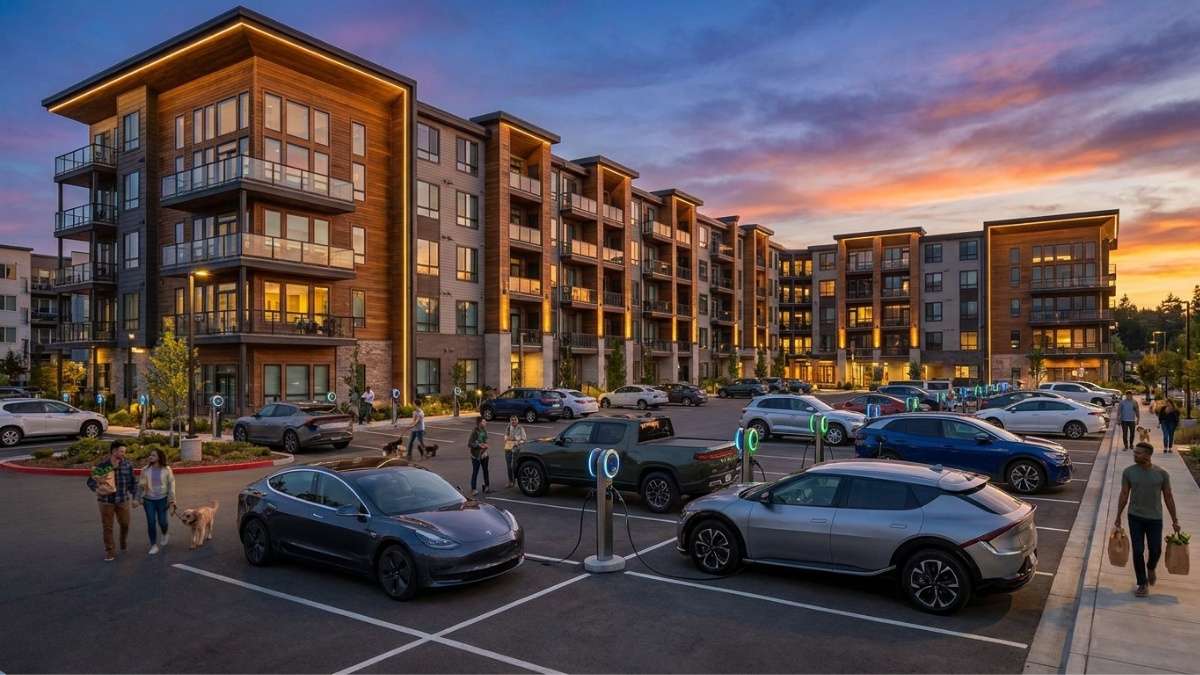

If you step back and look at the electric vehicle market today, the industry has achieved something remarkable: they have made EVs highly desirable. We have vehicles that are faster, quieter, and technologically superior to their internal combustion engine (ICE) counterparts. Yet, for all the rapid advancements in battery chemistry and autonomous driving, automakers are slamming headfirst into a massive, unyielding brick wall of their own making.
This wall isn’t range anxiety or raw vehicle cost—it is the catastrophic lack of charging infrastructure for people who do not own a single-family home.
We call it the multi-family housing "charging desert." If you live in an apartment, a condo, or a townhome with shared parking, owning an EV is less of a convenience and more of a logistical nightmare. And as we see market dynamics shift—evidenced by recent reports showing global EV demand rebounds in May 2026 as Europe and emerging markets offset China and US slowdown—it becomes painfully obvious that the next massive wave of EV adoption hinges not on the suburban homeowner, but on the urban and suburban renter.
Here is why this charging desert exists, how it is bottlenecking the industry, and the framework required to finally fix it.
The Gravity of the Multi-Family Charging Bottleneck
To understand the scope of this problem, we have to look at the demographics. According to data broadly tracked by the US Census Bureau, tens of millions of Americans live in multi-family housing units. This demographic represents a massive chunk of the car-buying public. Yet, the entire EV charging paradigm has been built around the "garage-owner" model. The assumption by early EV pioneers was that you drive home, plug your car into your dedicated 240-volt Level 2 charger, and wake up with a "full tank."
For apartment dwellers, that model is fundamentally broken.
Property managers and Homeowners Associations (HOAs) are notoriously hesitant to install EV chargers. They look at the upfront capital expenditure—which often requires trenching through concrete, upgrading electrical panels, and dealing with complex permitting - and balk. Furthermore, who pays for the electricity? How is it metered? What happens when a resident moves out?
Because these questions have historically been difficult to answer, the default response from property owners has been to do nothing. Consequently, apartment residents are forced to rely on public fast chargers. This negates one of the primary financial benefits of EV ownership- cheap residential electricity rates - and turns "refueling" into a weekly, hour-long chore rather than an invisible, overnight convenience. You simply cannot expect a mass-market consumer to adopt a new technology if it introduces significant new friction into their daily routine. Until this charging desert is irrigated, the EV market will artificially cap its own growth.

Evaluating Leading Solutions to the Urban Charging Dilemma
Fortunately, the tech industry and specialized infrastructure startups are recognizing this vacuum and engineering solutions. We are moving past the brute-force method of simply dropping an expensive commercial charger into a residential lot.
Automated Load Management (ALM): One of the most significant barriers to retrofitting apartments is the building's electrical capacity. Upgrading a main transformer is prohibitively expensive. Automated Load Management (ALM) software solves this by allowing multiple chargers to share a single circuit. If ten cars are plugged in, the system distributes the load intelligently based on which car needs the most charge and when it is scheduled to depart. Companies like ChargePoint and various smart-panel startups are leveraging ALM to bypass massive infrastructure upgrades.
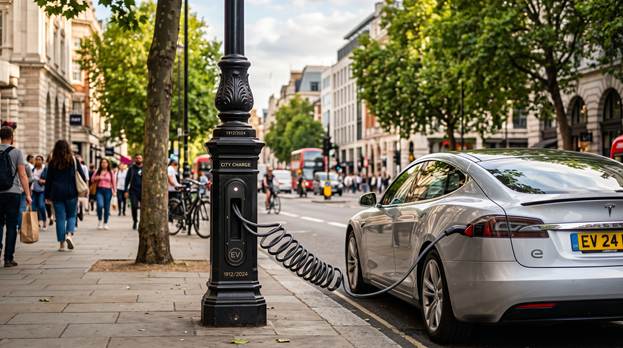
Pole-Mounted and Curbside Charging: For urban dwellers without dedicated parking lots, companies are utilizing existing infrastructure. European startups, and increasingly North American infrastructure projects funded by the Department of Energy, are retrofitting streetlamps with EV charging cables. Because the light pole already has a power supply, the cost of deployment is drastically reduced. It allows renters who utilize street parking to plug in overnight seamlessly.
Mobile Charging and Charging-as-a-Service: When fixed infrastructure is impossible, mobility steps in. Services like SparkCharge deliver modular, portable batteries directly to the EV owner’s location. Think of it as Uber Eats for electricity. While currently a premium stopgap, autonomous charging robots (essentially large battery packs on wheels) being developed by several OEMs could soon navigate apartment garages, charging vehicles while residents sleep, without requiring a single cable to be hardwired into the building.
What Automakers Must Do to Eradicate the Charging Desert
The biggest mistake automakers are making right now is assuming their job ends when the car rolls off the lot. Historically, Ford and GM didn't have to build gas stations; Exxon and Shell did that. But the EV transition is a paradigm shift, and automakers must become ecosystem providers, much like Apple became with the iPhone, iTunes, and the App Store.
To make multi-family charging ubiquitous, automakers must take aggressive, direct action.
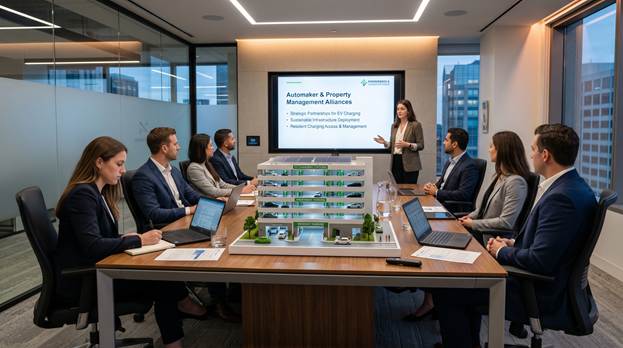
First, they need to subsidize the property manager. Automakers should be partnering with massive property management conglomerates - like Greystar or AvalonBay - to underwrite the cost of charger installations. By offering heavy discounts or financing on Level 2 chargers, OEMs can ensure their customers have a place to plug in.
Second, EV companies must bundle charging solutions into the vehicle lease. If an apartment dweller leases an EV, the automaker should provide a concierge service that handles the legal and logistical friction of getting a charger installed at their specific parking spot, or provide a heavily subsidized subscription to a mobile charging service.
Finally, OEMs need to standardize their hardware and software to interface perfectly with property management billing systems. A property manager should be able to view a dashboard that seamlessly tracks energy usage by tenant, billing it directly to the resident’s rent ledger. If automakers make the backend effortless for the landlords, the physical chargers will follow.
The Foundational Framework for Ubiquitous Access
Technology and corporate strategy alone will not bridge the gap; a robust regulatory and policy framework is absolutely vital. The market will naturally focus on high-margin, easy deployments unless policy forces a broader, more equitable rollout. The National Renewable Energy Laboratory (NREL) has repeatedly highlighted that equitable infrastructure is the lynchpin of total fleet electrification.
The cornerstone of this framework must be sweeping "Right to Charge" legislation. Currently active in only a handful of progressive states, these laws legally prevent HOAs and landlords from unreasonably denying a tenant’s request to install an EV charger at their own expense. This legislation needs to be adopted federally to remove the localized bureaucratic red tape that strangles adoption.
Next, we need updated building codes. Every new multi-family dwelling constructed today should be mandated as "EV Ready." This means the conduit and electrical panel capacity are installed during initial construction, when the cost is pennies on the dollar compared to retrofitting concrete later.
Furthermore, utilities must roll out aggressive Make-Ready programs. In these programs, the utility covers the entire cost of the infrastructure up to the parking space (the "make-ready" portion), leaving the property owner responsible only for the relatively cheap charging station hardware itself. By socializing the heavy infrastructure costs, we remove the primary objection of the landlord.
Forecasting the Resolution of the Charging Desert
When will this problem actually be solved? If we look at the current trajectory of battery technology, policy rollouts, and capital investment, we are looking at a messy middle period for the next five years. Property managers move slowly, and the electrical grid upgrades required are inherently localized and lethargic.
However, a convergence is coming. By 2032, several critical factors will align: battery densities will allow for 400+ mile standard ranges (meaning urban drivers will only need to charge once every week or two), Right-to-Charge laws will have reached critical mass in major metropolitan areas, and automated load management will be a standard feature in all commercial electrical panels.
I forecast that by the early 2030s, the "charging desert" will largely transition into a minor inconvenience before evaporating entirely by 2035. At that point, EV charging will be viewed by property managers much like high-speed Wi-Fi or air conditioning—not as a luxury, but as a mandatory baseline utility required to maintain occupancy rates.
Wrapping Up
The multi-family housing charging desert represents the most significant friction point in the global transition to electric mobility. While early EV adoption was successfully driven by homeowners with private garages, crossing the chasm to the mass market demands that the industry accommodate the millions of consumers who rent or live in dense urban environments.
By leveraging smart software like Automated Load Management, utilizing existing urban infrastructure, and deploying innovative mobile charging services, tech companies are proving the problem is solvable. However, automakers can no longer remain passive observers relying on third parties to build the gas stations of the future. OEMs must aggressively partner with property management conglomerates and subsidize installations. When paired with a strong legislative framework centered on "Right to Charge" laws and utility make-ready programs, this roadblock can be dismantled. We are looking at a horizon of 2032 before the desert truly greens, but the groundwork must be aggressively laid today if automakers wish to sustain their current momentum.
Disclosure: Images rendered by Artlist.io
Rob Enderle is a technology analyst at Torque News who covers automotive technology and battery developments. You can learn more about Rob on Wikipedia and follow his articles on TechNewsWord, TGDaily, and TechSpective.
Set Torque News as Preferred Source on Google
Follow us today...