
Follow us today...


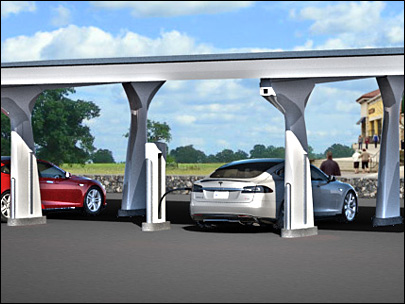
In signature fashion, Tesla Motors unveiled a huge, ambitious plan to build charging stations all over the country so that someone with a Model S could travel from one end of the country to the other without any road trip range anxiety whatsoever.
It was huge, it was grandiose, it was so.. Musk-ey.
Not that there's anything wrong with that. Musk is a huge figure, figuratively speaking, and has done some really awesome stuff that seems to have been pulled off purely by force of personality and determination. PayPal, the banking site that wasn't really a bank, Space X, the civilian space faring company that actually flies, and Tesla, the high-priced electric carmaker that somehow sells the cars it makes.. The guy is really good at pulling off the things other people laugh at.
Still, he's also a master of selling ideas. His presentation to the world to introduce the big, bold new charging station plans was big. Huge, even. It was star-studded, full of glam, and very entertaining. Yet it missed one very important point. One that most people who aren't electric vehicle geeks wouldn't have understood if it had been included, actually.
It's a little pesky thing called plug-in standards. You see, the world has pretty much chosen to use the SAE J1772 plug standard. At least, in regular, everyday, slow-to-charge cars they have. You cannot use the same plug that charges your Volt, Karma, or Leaf with a Tesla Roadster or Model S. They aren't the same and they use different connections. Tesla has a converter for use at public charging stations that allows their cars to work with a J1772 plug-in, but it only works at lower charge speeds and cars that use this plug as standard cannot use the new Tesla Charging Stations.
Funny thing is, Tesla isn't the only one using their own, proprietary standard. Another, competing fast-charging standard is CHAdeMO, for which there are already over 113 stations in the U.S. alone (1,200 more in Japan). Right now, there are actually more EVs on the road worldwide using the CHAdeMO standard than there are using the SAE J1772 standard, which has more than there are using the proprietary Tesla standard.
So what Musk forgot to mention during his grand gala presentation announcing the charging station network is that it will only work with Tesla-made vehicles. In other words, if you buy an electric car but it doesn't use Tesla's standard plug-in (patented, by the way), then you're S.O.L. using their network to drive freely across the nation. So if you can't afford a $60,000+ electric sedan..
To paraphrase the Soup Nazi.. NO CHARGE FOR YOU!
To compare this to what we're all used to, this would be like installing gas pumps that only allow a car with a filling port on the left side to use them. Worse, though, if the car's filling hole is not at least 2.87 inches wide, your spigot won't fit in it either.
On the other hand, this move by Tesla is much like how Apple took over the smart phone market. While Blackberry was the first readily-adopted smart phone, Apple came out with one that was prettier and had much better marketing. Even though it was expensive, could only be used with stuff they would sell you at a premium, and slower.. it had better salesmen and so it became the most prominent smart phone on the market while its competition slowly dies a cold death in Canada.
Except.. There's a huge difference between a $500 phone and a $60,000 car.
Oh, and another thing.. all that fast charging Elon was touting the other night? It plays hell with battery life expectancies. It's gonna suck when that expensive sedan becomes a brick a lot sooner than you'd expected..
Follow us today...


Comments
Right on Brotha
Permalink
Right on Brotha
Talking about killing the
Permalink
Talking about killing the electric car II, revenge, bloody style. I think Elon will prove you fully wrong Aaron. After all, you are not the first troll coming his way.
I'm always a troll when I
Permalink
In reply to Talking about killing the by Elp Tique (not verified)
I'm always a troll when I question the beauty and perfection that is (supposedly) electric vehicles. Sorry if reality is a little tough for you.
How do you like the
Permalink
In reply to I'm always a troll when I by Aaron Turpen
How do you like the $5/gallon? I guess life is really soft on you. Btw, 26K miles on EV/PV in 18 months. So tough... not having to give a weekly donation to Big Oil and his trolls.
Talking about beauty and perfection, it might have escaped your attention that electro magnetic power is the strongest force in the universe and plasma (eletrically charged ions) is the main matter of this wonderful universe. Something to add to your pondering on beauty and perfection.
No $5 a gallon here. Sorry
Permalink
In reply to How do you like the by Elp Tique (not verified)
No $5 a gallon here. Sorry to burst your bubble, but I live where gasoline is made, from ground to pump. We consistently have the lowest prices in the nation.
Next, it's not about the "force" of electricity and magnetics, Elp, it's STORAGE that's the problem. There's no plasma in EVs. It's inefficient electricity production piped through inefficient lines then stored in inefficient batteries. Most of that "beautiful perfection" is lost from the get-go.
Oops. EVs are nice for those few who can use them in their current iteration, but they aren't "all that."
Ohhhh, you mean the one that
Permalink
In reply to No $5 a gallon here. Sorry by Aaron Turpen
Ohhhh, you mean the one that makes that trip from the far distances of my roof all the way to the battery of LEAF? Yep, long trip that. It did not even have to come out of the ground, getting refined, spewing smoke of every kind to be made.
Just clean photons dancing with electrons, forming a current (fyi plasma), ionizing a metal (lithium, plasma again).
EVs can be nice for most people, as soon as the veil of lies is taken away from their eyes. I average 50 miles a day, not exactly a short range and the LEAF has driven every single one of them, power by the sun for every single one of them. It is that simple, like all truths.
Come live where I live and
Permalink
In reply to Ohhhh, you mean the one that by Elp Tique (not verified)
Come live where I live and see how long those panels and that battery pack lasts. Then we'll talk.
I live in rural america....
Permalink
In reply to Come live where I live and by Aaron Turpen
I live in rural america.... still the LEAF works for me. If you do live in Alaska with bears, sorry for you.
I live in Wyoming. To get
Permalink
In reply to I live in rural america.... by Elp Tique (not verified)
I live in Wyoming. To get into town is 45 miles where there are no charging stations. We have high winds during the winter, very cold temperatures, and rough roads (some of which aren't paved). The Leaf has no thermal management, which means in the winter it will lose a lot of its range unless kept in a heated garage (energy used). The Mini EV's issues with this problem testify to that fact.
The LEAF and other EVs are not for everyone. A few people can use them and the marketing and purchase demographics for them attests to who those people are. Many people are not in that market.
Definitely not a candidate
Permalink
In reply to I live in Wyoming. To get by Aaron Turpen
Definitely not a candidate for the LEAF. If you can afford it, the TESLA is a superior car and would take care of you for sure. The rest of us (90% of US residents) can use the LEAF for most day to day use.
Enjoy the beauty of Wyoming. Magnificent land.
PS: www . recargo.com has the map with all recharging stations. However, with the TESLA it almost does not matter. An 240 (drier type) outlet can take care of it.
$60,000 is about $15,000 more
Permalink
In reply to Definitely not a candidate by Elp Tique (not verified)
$60,000 is about $15,000 more than the average median income here.
Remarkably misleading article
Permalink
Remarkably misleading article from Torque News.
1) with any new technology, there is a proliferation of systems; eventually in a free market one system predominates. There are a number of flaws with the J1772 standard and the CHAdeMO standard. Third party reviews have placed Tesla's charge standard ahead of these others. Give it time.
2) The Model S is unlike any other EV (if you hadn't figured that out already). Other EVs are not capable of fast charge times. Furthermore, there are very few EVs on the road at present. There is no reason the fledgling Tesla Motors should feel compelled to support charging of other EVs. They are trying to sell _their_ product! Quit complaining. And as far as Roadsters, there are under 3 thousand in the WORLD. Not big numbers. Maybe the functionality to charge Roadsters and other EVs can be added on later but quit griping.
3) Tesla has designed their batteries to be charged unlimited number of times on the Superchargers, with no adverse effect to the battery life. The supercharger communicates with the battery management system and only fast-charges in the middle section of charging, when it is safe for the battery. This is documented on Teslamotors.com
SO quit spreading FUD.
Ooo Misleading because I
Permalink
In reply to Remarkably misleading article by Logical_Thinker (not verified)
Ooo Misleading because I didn't compare how good or not so good all of these disparate charging systems are despite that not being the focus of the article?
It doesn't matter which is better or not, "Logical_Thinker". What matters is that there are so many differences and thus, a huge charging network that only works with one type of electric car means everyone else cannot use it. Which means that electrics are.. less useful.
Actually, there are other EVs capable of fast charge times, though I haven't bothered comparing them to the Model S since it's not the point here.
Tesla has NOT made their batteries (sourced from Panasonic) to be fast-charged "an unlimited number of times." That's just garbage of the highest order. I call YOU out for spreading FUD.
Here's a reference re: no
Permalink
In reply to Ooo Misleading because I by Aaron Turpen
Here's a reference re: no limits on supercharge cycles
teslamotors.com/forum/forums/no-limits-supercharge-cycles
BTW, FUD means fear, uncertainty, and doubt... which is nothing of what I posted.
**IF** that statement in a
Permalink
In reply to Here's a reference re: no by Logical_Thinker (not verified)
**IF** that statement in a FORUM is correct, then Tesla needs to be marketing with it.
In the military, FUD means "Fed Up Device" - as in "device not working properly" or "information not to spec."
Of course, what I talk about in the article above doesn't sow "fear" only doubt about the magnificence of EVs in today's market. Which, of course EVangelists can't stand. Electrics have their place and have usefulness for SOME people, but they have big limits and issues that have to be addressed. Pretending they don't exist won't make them go away.
I haven't even gotten into how much electricity is actually required to move a car like the Model S or the Leaf compared to what's used in your home or how that's going to affect the national grid if these cars become prolific. Where I live, things would be fine, since we produce a net surplus of energy of all sorts, but for people in heavily populated areas like California, where most energy is imported, theyll be in a world of hurt that will make the Enron rolling blackouts look like candyland.
the whole point is the
Permalink
In reply to **IF** that statement in a by Aaron Turpen
the whole point is the engineers have calculated enough solar per supercharger station to create net extra electricity.
First, it's not true that EVs
Permalink
In reply to **IF** that statement in a by Aaron Turpen
First, it's not true that EVs guzzle electricity.
But furthermore, the whole point re: the Superchargers is that the Tesla engineers have calculated enough solar per supercharger station to create net EXTRA electricity back to the grid.
Are these charging stations
Permalink
In reply to First, it's not true that EVs by Logical_Thinker (not verified)
Are these charging stations going to be the only ones used to charge every electric car made? Nope. Most are grid-tied and dependent. Second, EVs on fast charge use HUGE amounts of power.
Using Tesla's numbers, the Tesla charger at 41 amps uses more than the power used by an entire rack of servers running for a full week. That's about equivalent to running your electric clothes dryer for the entire day, nonstop.
Going up to the numbers given for the new stations (which we can derive from the battery pack size and claimed charging times), we get a massive 90kWh charge (440V-DC at 100amps). Looking at that in comparison to my latest power bill, I can see that this is equivalent to more than a month's worth of power in my home. So to charge your Model S at a convenient fast-charge station, you're going to use the equivalent of a month's worth of household electricity so you can drive a couple of hundred miles (tops)?
You don't call that guzzling? And seriously, how much electricity can one of these small spaces with solar panels really be producing to "give back" to the grid? Assuming they aren't storing all of it to power up that car, since it's plainly obvious that the station won't be able to produce that uber-charge from solar alone - it will have to be stored over time instead. That storage means a loss as does the conversion of the power to the storage medium and its release to the car.
Look, "Logical", Musk's vision is fine and it's better than what we currently have, but it's not perfect nor is it realistic the way he's presented it. Nor will it do anyone a lot of good in the near future. Even out to 2020, it is very unlikely we're going to have a huge segment of the auto market be electrics and only a fragment of those will be battery electrics and only a fragment of those will be using the Tesla charging standard.
So as ambitious as the Tesla plan is, it's not really earth shattering or game changing and it's not going to significantly change the automotive market for a very long time, if at all. It will, however, garner a lot of PR for Tesla (the entire point, given the company's history) and probably sell more of their cars. Especially given the paltry number of options currently available in the luxury market that Tesla sells in.
It costs about $9 in
Permalink
In reply to Are these charging stations by Aaron Turpen
It costs about $9 in electricity to fully charge a 300 mile Tesla Model S. That's not a lot of cost.
$9 at a slow charge
Permalink
In reply to It costs about $9 in by Logical_Thinker (not verified)
$9 at a slow charge speed/rate. Raise that speed/rate and your costs will go up. Power delivery is measured by utilities in amps, not volts. Speed up the charge rate, you raise the amps to accomplish it. Even at your rate, though, $9 at 30 days is $270, which is actually a lot more than our monthly power bill (which runs about $60-85).
Just a gentle hint: suggest
Permalink
In reply to $9 at a slow charge by Aaron Turpen
Just a gentle hint: suggest googling the definition of voltage, current, power, and energy. Utilities sell energy. Speed of charging does not change the energy spent. You just move the same energy faster assuming no crazy extra loss from the method (assuming fast charging does not cook things)..
Here's an idea: call your
Permalink
In reply to Just a gentle hint: suggest by Anonymous (not verified)
Here's an idea: call your utility company and ask them whether your rates will raise if you start using high-amps on a regular basis, such as for your fast car charger at home. They'll tell you.. "YES" because it means they have to account for your sudden, huge draw on their system and so they'll likely re-classify you as a commercial user.
Tesla advises that Model S
Permalink
In reply to Here's an idea: call your by Aaron Turpen
Tesla advises that Model S owners top off their car daily: plug it in when you get home. So you are not talking about a once-weekly 85 kwh load, but rather an additional ~10 - 15 kwh load daily. As noted this will increase your power bill by about $40/month.
It's going to cost no more to charge than a Volt, in other words. And the average Volt owner is paying about that much per month (some more, some less) to drive.
Well, I personally don't
Permalink
In reply to $9 at a slow charge by Aaron Turpen
Well, I personally don't drive 300 miles every day. If you drive that much, that's nearly 80,000 miles annually. Consider this: the average driver puts about 12 to 15,000 miles annually on their cars. As has been well documented, somewhere around 70 or 80 percent of the US drives less than 40 miles daily. So for the majority of Americans, a $9 charge would last them 300 / 40 = about 7 days of driving. So $9/wk means about $36/month additional on their power bill (assuming they don't go TOU or install solar to offset the power use, etc)
I think the article did not
Permalink
I think the article did not mention a Key Fact. The Tesla Supercharge Stations are FREE.
I understand the non-standardization of the connectors quite well. But it is hard to argue with when the charging is free.
So some of the article's analogies like the following really are not fair:
"this would be like installing gas pumps that only allow a car with a filling port on the left side to use them."
Wow.. totally destroyed my
Permalink
In reply to I think the article did not by steve (not verified)
Wow.. totally destroyed my argument with your beautiful application of non-logic.
Do your reading ... yes its a
Permalink
Do your reading ... yes its a patented technology but Tesla does allow for other car manufacturers to use their technology. They are trying to encourage other auto makers to use it as well. Clearly your ignorance on the matter shows